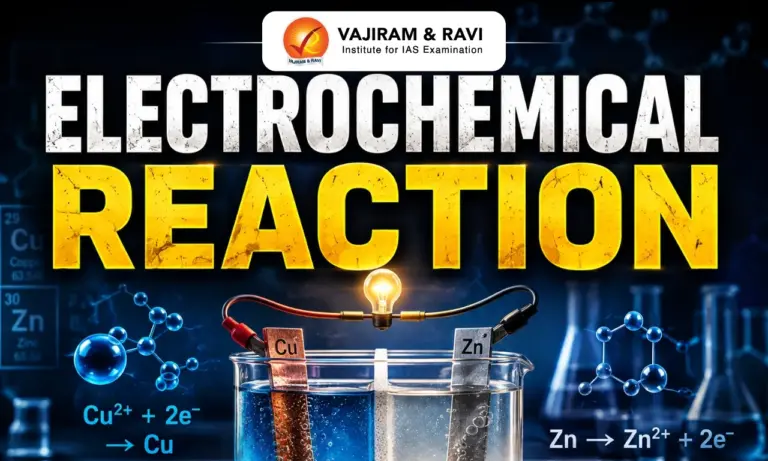
An Electrochemical Reaction is a chemical reaction that either produces electricity or uses electricity to cause a chemical change. It involves the movement of electrons between substances, usually a solid conductor and a liquid electrolyte. These reactions form the basis of batteries, fuel cells, electroplating, corrosion, electrolysis and many industrial processes. Electrochemistry has become increasingly important for clean energy technologies, electric vehicles and sustainable manufacturing.
What is Electrochemical Reaction?
An Electrochemical Reaction is a reaction in which chemical energy changes into electrical energy or electrical energy changes into chemical energy through electron transfer. The reaction takes place at the interface of an electrode and an electrolyte. Oxidation occurs at the anode, while reduction takes place at the cathode. The complete process requires a closed electrical circuit for continuous electron flow and ion movement between the electrodes.
Electrochemical Reaction Principle
Electrochemical Reactions work on the movement of electrons and ions between electrodes and electrolytes under suitable electrical conditions.
- Electron Transfer: Every Electrochemical Reaction is a redox reaction. Oxidation releases electrons at the anode, while reduction accepts electrons at the cathode. Both reactions occur simultaneously and maintain continuous electric current.
- Electrodes and Electrolyte: Electrodes are electronic conductors- Anode and Cathode, whereas electrolytes are ionic conductors such as acids, bases and salts in molten or dissolved form. The reaction occurs only where the electrode and electrolyte come into contact.
- Ion Movement: Positive ions move towards the cathode, while negative ions move towards the anode. Their movement carries electric current through the electrolyte and enables chemical transformation.
- Energy Conversion: A galvanic cell converts chemical energy into electrical energy through spontaneous reactions. Electrolysis converts electrical energy into chemical energy by driving non spontaneous chemical reactions.
- Faraday’s Law: Michael Faraday established that fixed quantities of electricity produce fixed amounts of chemical change. One gram equivalent of a substance reacts with 96,485 coulombs, known as one Faraday of electricity.


Electrochemical Reaction Mechanism
The electrochemical process explains how electrons and ions interact to produce electricity or bring about chemical changes.
- Electrodes are placed in an electrolyte: Two electrodes, called the anode and cathode, are immersed in an electrolyte containing free moving ions.
- A closed circuit is formed: The electrodes are connected through an external wire, allowing electrons to move between them.
- Oxidation occurs at the anode: The substance at the anode loses electrons. These electrons enter the external circuit.
- Electrons flow through the circuit: The released electrons travel from the anode to the cathode through the connecting wire, creating an electric current.
- Ions move inside the electrolyte: Positive ions move towards the cathode, while negative ions move towards the anode to maintain electrical balance.
- Reduction occurs at the cathode: The cathode accepts electrons, causing positive ions to gain electrons and form new substances.
- Chemical products are formed: Depending on the reaction, metals may be deposited, gases such as hydrogen or oxygen may be released, or new compounds may be produced.
- Energy conversion takes place: In a galvanic cell, chemical energy changes into electrical energy. In electrolysis, electrical energy is converted into chemical energy.
Electrochemical Reaction Types
Electrochemical Reactions occur in different forms depending on the substances involved and the nature of electron transfer.
- Simple Redox Reactions: These involve direct electron transfer between ions and electrodes without major structural changes. Ferric and ferrous ion reactions are common examples of reversible redox systems.
- Gas Producing Reactions: Electrochemical Reactions can produce gases such as hydrogen, oxygen and chlorine. Hydrogen forms at the cathode, while oxygen or chlorine generally evolves at the anode.
- Metal Deposition and Dissolution: Metal ions gain electrons and deposit as solid metal during reduction. Conversely, metals lose electrons and dissolve into solution during oxidation.
- Organic Electrochemical Reactions: Many organic compounds undergo oxidation or reduction at electrodes. These reactions are widely used in chemical synthesis, polymer production and advanced industrial processes.
- Complex Electrochemical Reactions: Some reactions involve multiple electron transfers and intermediate steps. Their overall speed is controlled by the slowest stage, known as the rate determining step.
Electrochemical Reaction Applications
Electrochemical Reactions support modern industry, energy systems, environmental protection, transportation and scientific research.
- Batteries and Fuel Cells: Lead-acid, nickel-cadmium, nickel-iron, silver-zinc and modern rechargeable batteries store electrical energy through Electrochemical Reactions. Fuel cells convert fuels such as hydrogen directly into electricity with much higher efficiency than conventional combustion.
- Metallurgy and Electroplating: Metals including aluminium, titanium, alkali metals, alkaline earth metals and refined copper are produced using electrochemical methods. Electroplating improves corrosion resistance and provides decorative metal coatings.
- Chemical Industry: Electrolysis of brine produces chlorine and caustic soda on a large industrial scale. Electrochemical methods are also used in manufacturing inorganic chemicals and synthetic fibres such as nylon.
- Corrosion Control: Electrochemical principles explain rust formation and metal corrosion. Techniques such as cathodic protection and protective coatings reduce corrosion and extend the service life of engineering structures.
- Analytical and Biological Uses: Electrochemical techniques are widely used in analytical chemistry for ion measurement. In biology, Electrochemical Reactions play important roles in nerve impulse transmission, blood clotting and energy conversion inside living cells.

 Last updated on Sep, 2026
→ UPSC 2027 Notification will be released on 13 January 2027 at upsconline.nic.in.
→ Asian Games 2026 are being held in Aichi-Nagoya, Japan, from 19 September to 4 October.
→ Check out the latest UPSC Syllabus here.
→ Download UPSC Model Answers for Mains 2026
→ UPSC Mains Question Paper 2026 is out now for Essay & GS Paper 1, 2, 3 & 4.
→ UPSC Calendar 2027 has been released.
→ Enroll in Vajiram & Ravi’s UPSC Mains Test Series 2027 for structured answer writing practice, expert evaluation, and exam-oriented feedback.
→ Join Vajiram & Ravi’s UPSC Mentorship Program 2027 for personalized guidance, strategy planning, and one-to-one support from experienced mentors.
→ Go through the UPSC Mains Previous Year Papers to enhance your preparation.
→ UPSC has released UPSC Toppers List 2025 with the Civil Services final result on its official website.
→ Also check Best UPSC Coaching in India
Electrochemical Reaction FAQs
Q1. What is an Electrochemical Reaction?+
Q2. What is the difference between Electrolysis and an Electrochemical Cell?+
Q3. What are the main components of an Electrochemical Reaction?+
Q4. What are the common applications of Electrochemical Reactions?+
Q5. Why are Electrochemical Reactions important?+
Tags: electrochemical reaction geography geography notes