Surrogate Advertising Latest News
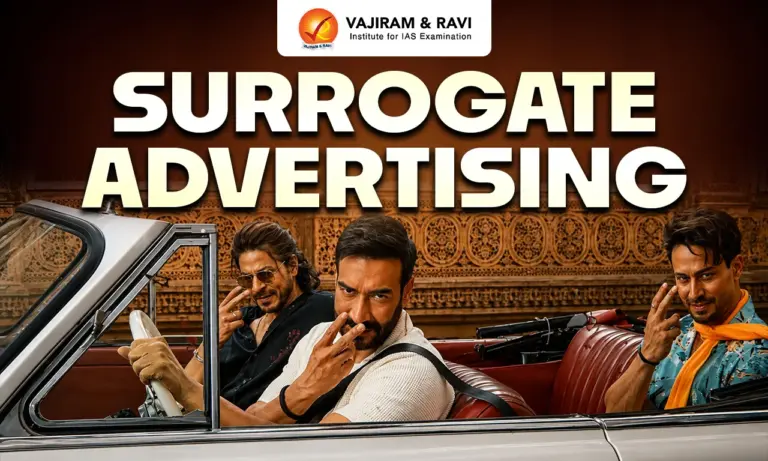
- Maharashtra’s Food and Drug Administration (FDA) issued show-cause notices to actors Shah Rukh Khan, Ajay Devgn, and Tiger Shroff, alleging that their advertisement for Vimal Elaichi amounts to surrogate advertising for the banned Vimal Pan Masala brand.
- This marks the first instance of the regulator examining surrogate advertising, even as it intensifies its crackdown on tobacco-containing products.
What Is Surrogate Advertising?
- Surrogate advertising promotes a product under a different, permitted brand name, logo, or visual style.
- It is used for goods like alcohol, tobacco, and pan masala, which face advertising bans or restrictions.
- The technique keeps the original brand visible in consumers’ minds despite the restriction.


What the FDA Notices Allege
- The FDA claims the Vimal Elaichi ad’s presentation, dialogue, product name, and market context raise a “serious question” over whether it indirectly promotes Vimal Pan Masala — a product currently prohibited in Maharashtra.
- Maharashtra has banned gutkha and pan masala containing tobacco or nicotine since 2012 under Section 30(2)(a) of the Food Safety and Standards (FSS) Act, 2006.
- This prohibition is renewed annually.
- The FDA has invoked:
- Section 24 of the FSS Act — restricts misleading and deceptive food advertisements.
- Section 53 of the FSS Act — penalty of up to Rs 10 lakh for anyone “party to the publication” of a misleading advertisement.
- The Food Safety and Standards (Advertising and Claims) Regulations, 2018.
What the Actors Have Been Asked to Do
- The FDA has given the actors 15 days to respond with written explanations and has directed them to:
- Immediately discontinue participation in and endorsement of the ad, and remove it from their social media handles.
- Submit their endorsement contracts, campaign briefs, product information, and payment details.
- Disclose details of the due diligence carried out before endorsing the product.
- Furnish evidence on whether Vimal Elaichi is an independently sold product or a surrogate/brand extension of Vimal Pan Masala.
- Disclose any material connection with the advertiser or brand owner, as required under the CCPA (Central Consumer Protection authority) Guidelines, 2022.
The Legal Framework on Misleading and Surrogate Ads
- The Central Consumer Protection Authority (CCPA), established under Section 10 of the Consumer Protection Act, 2019, notified guidelines in 2022 to curb misleading advertisements and endorsements.
- Under Section 2(28) of the Consumer Protection Act, 2019, a “misleading advertisement” includes one that falsely describes a product, gives false guarantees, implies an unfair trade practice, or conceals important information.
- The guidelines define “surrogate advertisement” as one that circumvents a legal prohibition by advertising a permitted product to indirectly promote a prohibited one.
- Penalties under Section 21 of the Consumer Protection Act, 2019:
- Up to Rs 10 lakh for a first violation, and up to Rs 50 lakh for subsequent violations.
- The CCPA can bar an endorser from making any endorsements for up to 1 year (first violation) or up to 3 years (subsequent violations).
Past Regulatory History
- In 2018, the Directorate General of Health Services (DGHS), under the Union Health Ministry, issued show-cause notices to Vishnu Pouch Packaging Pvt Ltd (the brand’s promoter) under the Cigarettes and Other Tobacco Products Act, 2003, alleging indirect tobacco advertising.
- In January 2024, the Delhi High Court dismissed DGHS’s appeals, allowing the company to continue advertising its tobacco-free product, while observing that businesses have a “fundamental right to carry on business” involving pan masala without tobacco, so long as it has constitutional sanction.
Conclusion
- The Vimal Elaichi case highlights the persistent regulatory challenge of distinguishing genuine product advertising from surrogate promotion of banned substances.
- As Maharashtra tightens enforcement against tobacco products, this episode could set an important precedent for celebrity accountability and brand-endorsement due diligence under India’s consumer protection framework.

 Last updated on Sep, 2026
→ UPSC 2027 Notification will be released on 13 January 2027 at upsconline.nic.in.
→ Asian Games 2026 are being held in Aichi-Nagoya, Japan, from 19 September to 4 October.
→ Check out the latest UPSC Syllabus here.
→ Download UPSC Model Answers for Mains 2026
→ UPSC Mains Question Paper 2026 is out now for Essay & GS Paper 1, 2, 3 & 4.
→ UPSC Calendar 2027 has been released.
→ Enroll in Vajiram & Ravi’s UPSC Mains Test Series 2027 for structured answer writing practice, expert evaluation, and exam-oriented feedback.
→ Join Vajiram & Ravi’s UPSC Mentorship Program 2027 for personalized guidance, strategy planning, and one-to-one support from experienced mentors.
→ Go through the UPSC Mains Previous Year Papers to enhance your preparation.
→ UPSC has released UPSC Toppers List 2025 with the Civil Services final result on its official website.
→ Also check Best UPSC Coaching in India
Surrogate Advertising FAQs
Q1. What is Surrogate Advertising?+
Q2. Why is Surrogate Advertising under scrutiny in Maharashtra?+
Q3. What penalties can apply to Surrogate Advertising?+
Q4. What responsibility do celebrities have regarding Surrogate Advertising?+
Q5. How does Indian law regulate Surrogate Advertising?+
Tags: mains articles Surrogate Advertising upsc current affairs upsc mains current affairs