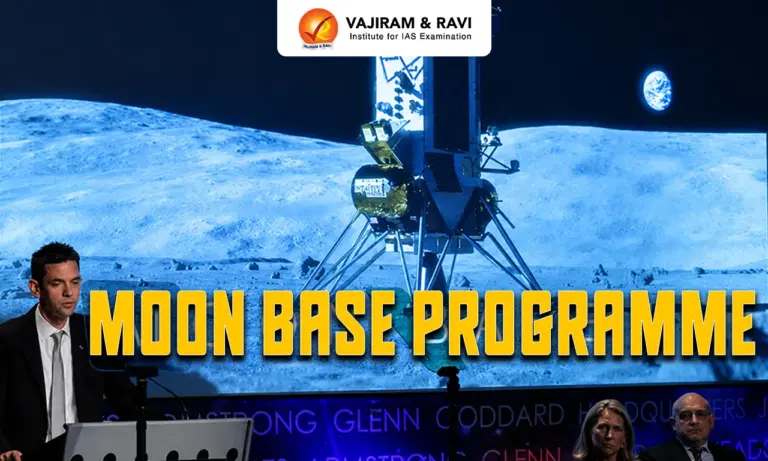
Moon Base Programme Latest News
- India has received an invitation to join NASA’s Moon Base programme, an initiative that could mark a turning point for ISRO and significantly accelerate India’s space technology development.
About the Moon Base Programme
- The Moon Base programme aims to create a permanent research station on the Moon that can be inhabited by astronauts and robots for prolonged periods.
- The base is to be built in stages over several years and is meant to facilitate lunar research while allowing exploration and exploitation of lunar resources.
- It is expected to be one of the most challenging engineering exercises ever undertaken, requiring several trips to the Moon by both crewed and robotic missions. It could also become the costliest scientific project in history.
- In scale and ambition, the programme can be compared only to the Apollo missions.
- In terms of its long-term impact on humanity and the future of the planet, it may prove far more consequential.


Why NASA Is Seeking Partners
- NASA is not in a position to execute this programme entirely on its own, nor does it intend to.
- Its budget has been significantly reduced under the current US administration, and most of its hardware production has shifted to the private sector.
- As a result, NASA is actively seeking partners from both the international community and private industry to collaborate on the project.
The Artemis Accords
- Countries that have signed the Artemis Accords have already demonstrated a willingness to participate in such collaboration.
- The Accords now include 70 nations, among them major space-faring countries such as Japan, India, South Korea, and Israel, along with several European nations. India joined as the 27th signatory in 2023.
- The Accords are essentially a set of principles and good practices that countries agree to follow while carrying out space activities.
- However, they are increasingly viewed as a US-led grouping seeking to write its own rules for space exploration and the use of extraterrestrial resources, somewhat bypassing established multilateral arrangements.
- The absence of two major space powers, Russia and China, lends weight to this perception.
- India has traditionally been reluctant to join such groupings, but its early signing of the Artemis Accords made its choice clear.
- While there is no official confirmation yet, ISRO is widely expected to accept the invitation to collaborate on the Moon Base programme.
What India Stands to Gain
- Joining the programme makes strategic sense for ISRO for several reasons.
- ISRO has its own plans for human spaceflight missions, a space station, and eventually landing humans on the Moon.
- Participating in the Moon Base programme offers the opportunity to gain valuable experience in planning and executing complex missions of this nature, allowing India to leapfrog in technology development.
- ISRO has demonstrated it can execute such missions independently, but doing so would require considerable time and enormous financial resources.
- Space exploration has reached a stage where a ten-year gap in technology development can leave a nation significantly behind. It would also make little economic sense to reinvent capabilities that already exist elsewhere.
The Economic Rationale
- ISRO’s current plans are extremely ambitious. They include:
- An independent human spaceflight programme,
- A Moon landing programme, and
- A full-fledged space station.
- While it is important for India to possess these capabilities, sustaining all of them independently raises serious economic questions.
- The Bharat Antariksh Station illustrates this well. While ISRO must have the technology to build such infrastructure, it is unlikely that India will have, within a decade, a scientific ecosystem large enough to require an entire space station for its exclusive use throughout the year.
- It will almost certainly have to function as shared infrastructure, much like the International Space Station does today.
- Similarly, while independent capabilities to send humans into space and land them on the Moon are crucial, maintaining a separate full-fledged lunar exploration programme may not be economically viable.
- The costs are prohibitively high even for the world’s largest economy. For India, which is pursuing multiple parallel development goals, allocating resources on that scale would be difficult.
Addressing Concerns About Alignment
- Concerns that India is joining a US-led bloc may be overstated.
- The Artemis Accords are not comparable to a geopolitical or military alliance. Space, at present, is not adversarial.
- If the US lands on the Moon ahead of others, it does not gain control over the area or its resources, nor does it harm the interests of China or Russia, which are pursuing similar objectives through their own partnership.
- The Moon is large enough, and its resources abundant enough, to support the efforts of all parties in the foreseeable future.
- This is why the current global trend of de-globalisation and go-it-alone approaches in critical technologies such as semiconductors, clean energy, and artificial intelligence does not apply to space. There is no domination of supply chains or control over resources in the same way.
- Importantly, signing the Artemis Accords or joining the Moon Base effort does not prevent India from continuing its long-standing space cooperation with Russia.
Caveats for ISRO
- While the opportunity is significant, ISRO must navigate it carefully.
- It needs to ensure that it does not lose sight of its own targets and objectives while collaborating with the US.
- It must also avoid becoming locked into the US technology ecosystem to the point of creating overdependence.
- The Artemis Accords do emphasise the development of interoperable systems.
- However, this is not a major restriction for ISRO, which is only beginning to develop these systems and can build interoperability in from the start.
Significance
- Space cooperation with the US represents a major opportunity for ISRO to fast-track project timelines and reach the frontiers of technology development.
- Such collaboration typically generates substantial spin-off benefits, advances in materials, robotics, life support systems, communications, and computing that can produce cascading dividends across multiple sectors of the economy.
- For a country building its scientific and industrial base, these secondary gains can be as valuable as the primary mission objectives.

 Last updated on Sep, 2026
→ UPSC 2027 Notification will be released on 13 January 2027 at upsconline.nic.in.
→ Asian Games 2026 are being held in Aichi-Nagoya, Japan, from 19 September to 4 October.
→ Check out the latest UPSC Syllabus here.
→ Download UPSC Model Answers for Mains 2026
→ UPSC Mains Question Paper 2026 is out now for Essay & GS Paper 1, 2, 3 & 4.
→ UPSC Calendar 2027 has been released.
→ Enroll in Vajiram & Ravi’s UPSC Mains Test Series 2027 for structured answer writing practice, expert evaluation, and exam-oriented feedback.
→ Join Vajiram & Ravi’s UPSC Mentorship Program 2027 for personalized guidance, strategy planning, and one-to-one support from experienced mentors.
→ Go through the UPSC Mains Previous Year Papers to enhance your preparation.
→ UPSC has released UPSC Toppers List 2025 with the Civil Services final result on its official website.
→ Also check Best UPSC Coaching in India
Moon Base Programme FAQs
Q1. What is NASA's Moon Base programme?+
Q2. When did India sign the Artemis Accords?+
Q3. How many countries are part of the Artemis Accords?+
Q4. Why is NASA seeking international partners for the programme?+
Q5. What is the main risk for ISRO in joining the programme?+
Tags: mains articles Moon Base Programme upsc current affairs upsc mains current affairs