


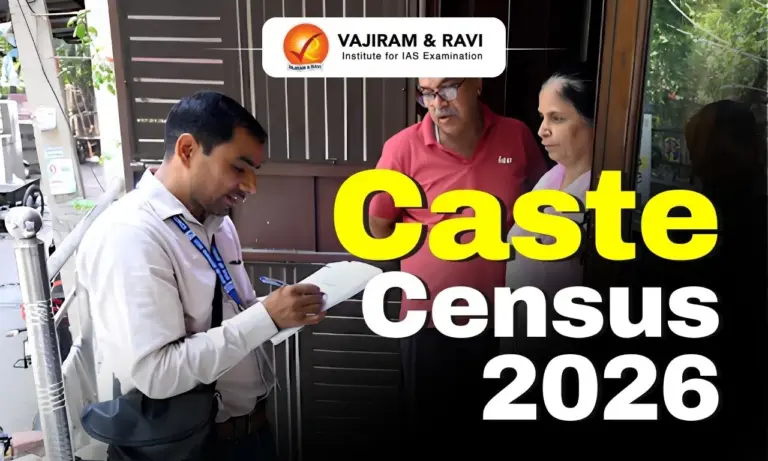
Caste Census 2026 Latest News
- The Registrar General of India has decided to use an open-ended question rather than a predetermined list of castes for the ongoing census, raising concerns that the exercise could produce unwieldy and unusable data.
Caste Enumeration in India
- Caste enumeration has a long and complicated history in India.
- The 1931 Census was the last comprehensive exercise that counted and published caste data. It recorded 4,147 castes.
- In the 1941 Census, caste details were collected but dropped from final tabulation due to wartime financial constraints.
- The then Census Commissioner wrote that with a constricted financial position and many other priorities, there was no justification for spending lakhs on that detail.
- After Independence, the 1951 Census under the Nehru government decided against caste enumeration altogether, shaped by the ideals of equality and secularism.
- Since then, the Census has continued to enumerate Scheduled Castes (SCs) and Scheduled Tribes (STs) using comprehensive official lists.
- The Ministry of Social Justice and Empowerment currently lists 1,208 SCs, with different castes categorised differently across states, while official records list 730 STs.


News Summary: How Caste Will Be Counted This Time
- The ongoing census will have no pre-given list of castes. It will be up to the respondent to state their caste, which the enumerator will record as given.
- This is expected to generate a large number of entries for what may effectively be a single caste.
- As one senior official explained, if a person identifies their caste by surname, the enumerator is duty-bound to record it as their caste.
- If the surname is misspelt, that misspelling too becomes an entry in the caste column.
The Problem of Multiple Names
- A single caste may be known by many different names, and the same name may mean different castes in different regions.
- Rajput, Thakur, Singh, and Kshatriya may be used interchangeably by respondents.
- However, “Rajput” in the Bundelkhand region, cutting across Uttar Pradesh and Madhya Pradesh, may also refer to the Other Backwards Class Lodh community. “Singh” is a surname that cuts across castes and categories entirely.
- Similarly, the surname Verma can indicate a Kayasth, a Kurmi, a Jat, or even a Sonar, depending on the region and family.
- Without a standardised list, all these variations enter the dataset as separate categories.
Lessons from the 1931 Census
- The colonial state used a similar open-ended method until 1931, and the census report from that year documents the difficulties that arose when caste became a highly subjective category.
- Assertion of New Identities
- Sections of the leather-working caste among Dalits in Punjab adopted a new religious identity as Aad Dharmis, meaning people belonging to the “original” or “pre-Aryan” religion of India.
- As many as 418,789 people enumerated themselves as Aad Dharmis, a category that did not exist in 1921. This was roughly the same number as Christians in Punjab at that time.
- Aad Dharmis constituted about 1.5% of Punjab’s population and about a tenth of the population of the so-called low castes in the province.
- Notably, literacy among Aad Dharmis was more than twice that among other members of the low castes, suggesting the shift was driven primarily by educated Dalits.
- Similar trends appeared elsewhere, with identities such as Adi Dravida, Adi Andhras, and Adi Karnatakas emerging.
- Consolidation for Status and Numbers
- The 1931 report also documented multiple castes merging into single categories to strengthen their numbers or claim higher social status.
- The report described the grazier castes as the clearest example, noting an effort to combine the Ahirs, Goalas, Gopis, Idaiyans and other milkmen castes under the term “Yadava”, a movement already effective by 1921.
- It also recorded that carpenters, smiths, goldsmiths, and others in similar occupations sought to be returned under a common name such as Vishwakarma or Jangida, usually adding a descriptor implying they belonged to one of the highest Varnas, either Brahman or Rajput.
- The report further noted that a caste which had applied in one province to be recorded as Brahman sometimes asked in another province to be called Rajput, and several castes claiming Brahman status in 1931 had claimed Rajput status a decade earlier.
The 2011 SECC Failure
- The most recent cautionary example comes from the Socio-Economic and Caste Census (SECC) of 2011.
- That exercise failed to produce usable caste data precisely because of open-ended enumeration.
- The final dataset contained nearly 46.7 lakh distinct caste names, compared with the 4,147 castes recorded in 1931.
- The Union government eventually withheld the raw caste data, rendering the entire exercise ineffective for policy purposes.
The Bihar Caste Survey Experience
- The 2023 Bihar caste survey, ordered by the then Chief Minister, took a different approach. State officials compiled a list of castes for the purpose, even though it was a pen-and-paper survey.
- An official aware of the exercise noted that not having a list would create an administrative nightmare. If some respondents say they are Bhumihar and others say Bhumihar Brahmin, two distinct categories emerge in the absence of a standard list.
- However, the Bihar exercise also faced criticism over how the lists were prepared. Objections raised included that no methodology was discussed with political parties or made public.
- In the case of Yadavs, a dozen sub-castes were consolidated under one header, while in the case of Kushwahas, the Dangi sub-caste was enumerated separately. Among the Mallah fishermen community, 10 to 11 sub-castes were split and shown separately.
- This illustrates that even with a list, the choices made in constructing it carry significant political consequences.
Suggested Solutions
- Experts have proposed practical alternatives to open-ended enumeration.
- Former Indian Council of Social Science Research chairman S.K. Thorat, who served on the expert committee reviewing caste data in Telangana, argued that a predetermined list is necessary. He noted that SC, ST, and OBC lists already exist and are recognised by the government. What is needed is a similar list of castes in the general category, which would produce an exhaustive list.
- He acknowledged this may still carry a small margin of error of 2-3%, but argued this would minimise error rather than the far larger distortions of open-ended enumeration.
- Thorat also suggested including columns for “no caste” and “no religion” for people who do not identify with these categories.
- He recommended separate questionnaires for SCs and STs, since the exclusions they face differ: untouchability in the case of SCs, and physical and geographical isolation in the case of STs. He noted that a separate questionnaire for OBCs was not required, as social and educational backwardness would be captured by the census in any case.
- Activists working on sub-categorisation have argued for questions on hierarchies and exclusions within SCs and STs, since some castes within these categories are considerably more deprived than others, and there is currently no sub-categorisation of reservation to direct benefits to the most needy groups.
Source: IE

 Last updated on Oct, 2026
→ UPSC 2027 Notification will be released on 13 January 2027 at upsconline.nic.in.
→ Check Nobel Prize 2026 Winners List here.
→ Download PIB PRiSM Monthly Magazine 2026 here.
→ Check UPSC Monthly Current Affairs Magazine The Recitals here.
→ Check out the latest UPSC Syllabus here.
→ Download UPSC Model Answers for Mains 2026
→ UPSC Mains Question Paper 2026 is out now for Essay & GS Paper 1, 2, 3 & 4.
→ UPSC Calendar 2027 has been released.
→ Enroll in Vajiram & Ravi’s UPSC Mains Test Series 2027 for structured answer writing practice, expert evaluation, and exam-oriented feedback.
→ Join Vajiram & Ravi’s UPSC Mentorship Program 2027 for personalized guidance, strategy planning, and one-to-one support from experienced mentors.
→ Go through the UPSC Mains Previous Year Papers to enhance your preparation.
→ UPSC has released UPSC Toppers List 2025 with the Civil Services final result on its official website.
→ Also check Best UPSC Coaching in India
Caste Census 2026 FAQs
Q1. How will caste be recorded in the ongoing census?+
Q2. When was the last comprehensive caste census in India?+
Q3. Why did the 2011 SECC fail to produce usable caste data?+
Q4. How many SCs and STs are officially listed in India?+
Q5. What solution have experts suggested?+
Tags: caste census 2026 mains articles upsc current affairs upsc mains current affairs








