


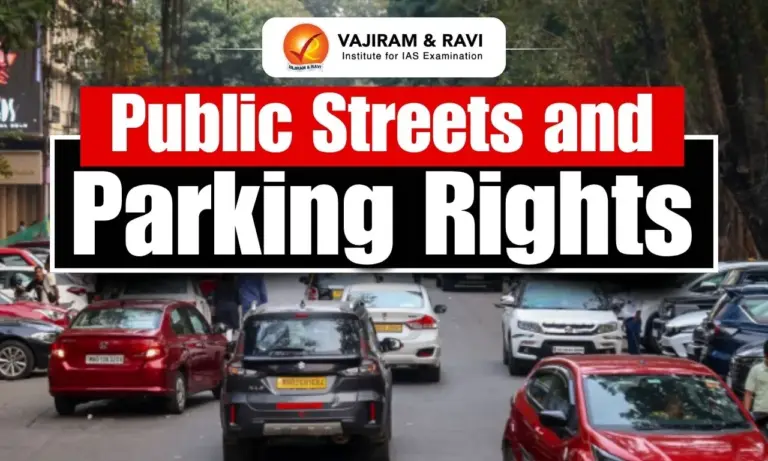
Public Streets and Parking Rights Latest News
- As Delhi Police prepares a fresh congestion-management plan, officials hves directed every traffic circle to identify at least one “problem area” marked by encroachment, roadside parking, or chronic congestion.
- This crackdown on unauthorised parking raises a key legal question: does living next to a public street give a resident any special right over the parking space outside their home?
Who Owns a Public Street?
- A public street does not belong to the homeowner whose gates open onto it.
- The Delhi Municipal Corporation Act, 1957 (DMC Act) defines a “public street” as any street that vests in the Corporation.
- Section 298 vests all public streets in the Corporation, placing them under the control of the Commissioner, who maintains, controls, and regulates them as per bye-laws.
- No provision of the DMC Act grants an adjoining resident exclusive rights over the road stretch outside their property.
- Even prolonged use of a parking spot does not create any special entitlement.


Is Roadside Parking Legal?
- Parking on a public road is not inherently illegal, but it is closely regulated:
- Section 117, Motor Vehicles Act, 1988: Empowers state governments to designate places where motor vehicles may stand, indefinitely or for specified periods.
- Section 122: Prohibits leaving a vehicle in a manner causing danger, obstruction, or undue inconvenience to other road users.
- Section 127: Allows towing or immobilising vehicles left in violation of parking rules.
Delhi-Specific Parking Rules
- The Delhi Maintenance and Management of Parking Places Rules, 2019 (framed under the Motor Vehicles Act):
- Prohibit on-street parking within 25 metres of an intersection.
- Bar parking in green areas, parks, footpaths, bus stops, and other designated locations.
- Under Rule 11, Area Parking Plans must include residential areas, developed in consultation with residents or Resident Welfare Associations (RWAs).
- Mandate that one lane in residential colony roads remain free for emergency vehicles.
- The Delhi Motor Vehicles Rules, 1993 empower the District Magistrate — in consultation with the State Transport Authority, Deputy Commissioner of Police (Traffic), and local authorities — to notify parking places within their jurisdiction.
- In essence, curbside parking is governed entirely by the public authority controlling that stretch of road, not by the adjacent resident.
What the Supreme Court Has Said
- In M.C. Mehta v Union of India (2019), a Bench of Justices Arun Mishra and Deepak Gupta examined Delhi’s parking crisis, framing it as a conflict between the rising number of vehicles and shrinking available land, with significant implications for urban planning.
- The Court directed the Delhi government to notify the 2019 Parking Rules, observing that an effective parking policy helps reduce congestion, pollution, and crime.
- It also acknowledged ground realities, noting it was “not oblivious to the hard reality” that in many colonies, some roadside parking must be permitted since vehicle numbers exceed available indoor parking space.
Conclusion
- Legally, no resident holds ownership or exclusive rights over the public road outside their home — such streets vest entirely in the municipal corporation and are governed by statutory rules under the Motor Vehicles Act and DMC Act.
- While courts have recognised the practical necessity of some roadside parking in residential areas, this remains a regulated privilege, not a private right, reinforcing that urban road space is fundamentally a shared public resource.
Source: IE

 Last updated on Oct, 2026
→ UPSC 2027 Notification will be released on 13 January 2027 at upsconline.nic.in.
→ Check Nobel Prize 2026 Winners List here.
→ Download PIB PRiSM Monthly Magazine 2026 here.
→ Check UPSC Monthly Current Affairs Magazine The Recitals here.
→ Check out the latest UPSC Syllabus here.
→ Download UPSC Model Answers for Mains 2026
→ UPSC Mains Question Paper 2026 is out now for Essay & GS Paper 1, 2, 3 & 4.
→ UPSC Calendar 2027 has been released.
→ Enroll in Vajiram & Ravi’s UPSC Mains Test Series 2027 for structured answer writing practice, expert evaluation, and exam-oriented feedback.
→ Join Vajiram & Ravi’s UPSC Mentorship Program 2027 for personalized guidance, strategy planning, and one-to-one support from experienced mentors.
→ Go through the UPSC Mains Previous Year Papers to enhance your preparation.
→ UPSC has released UPSC Toppers List 2025 with the Civil Services final result on its official website.
→ Also check Best UPSC Coaching in India
Public Streets and Parking Rights FAQs
Q1. What do Public Streets and Parking Rights mean for residents living beside a road?+
Q2. Who controls public streets under Public Streets and Parking Rights in Delhi?+
Q3. Is roadside parking a legal right under Public Streets and Parking Rights?+
Q4. What do Delhi's rules say about Public Streets and Parking Rights near intersections and footpaths?+
Q5. What has the Supreme Court said about Public Streets and Parking Rights?+
Tags: mains articles Public Streets and Parking Rights upsc current affairs upsc mains current affairs








