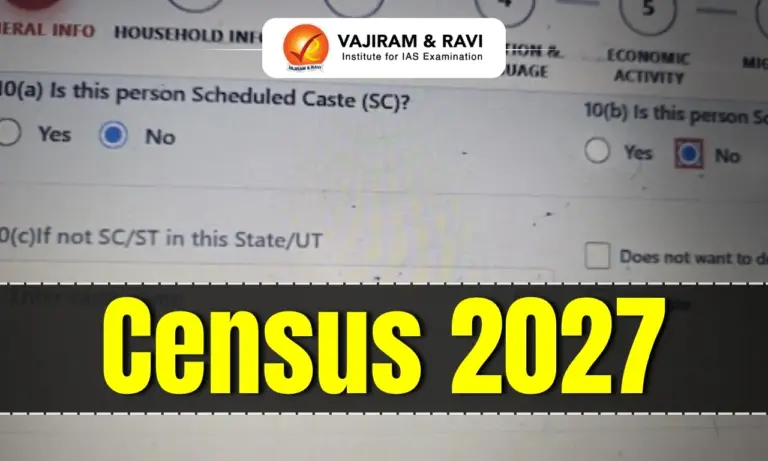
Census 2027 Latest News
- The Census 2027 population-enumeration questionnaire has attracted public debate because several of its new or modified questions overlap with information collected under the National Population Register (NPR), particularly questions relating to nationality, parents and identity documents.
Census in India
- The Census of India is the country’s largest exercise for collecting demographic, social and economic information about its population. It provides data required for public policy, planning, administration and allocation of resources.
- The Census is fundamentally a statistical exercise. Its information is used to understand population characteristics such as age, sex, literacy, education, occupation, housing conditions and other socio-economic indicators.
- The upcoming Census 2027 is significant because the population enumeration questionnaire contains 40 questions, of which 14 are new or modified compared with the 2011 Census.


Key New or Modified Questions in Census 2027
- The new or modified questions cover a relatively broad range of demographic, socio-economic and identification-related information.
- These cover spouse’s name, nationality as declared, father’s and mother’s particulars, Scheduled Caste/Scheduled Tribe/caste, literacy and digital literacy, highest educational qualification and stream, place of Covid-19 vaccination, number of bank accounts, mobile number, Aadhaar, voter ID, passport, and driving licence.
- The inclusion of caste-related information is particularly significant because Census 2027 will collect caste data, unlike the population enumeration component of the 2011 Census, which did not collect comprehensive caste information beyond the Scheduled Castes and Scheduled Tribes.
National Population Register
- The National Population Register (NPR) is a register of the country’s usual residents.
- A usual resident is a person who has lived in a particular local area for at least six months, or intends to live there for the next six months.
- Therefore, the NPR is not, by definition, a register exclusively of Indian citizens. A foreign national who satisfies the residence criterion can also fall within its scope.
- The NPR was first prepared in 2010, alongside the house-listing phase of the 2011 Census, and was subsequently updated through a door-to-door exercise in 2015.
- The proposed 2020 update of the NPR became politically contentious because of its relationship with debates surrounding citizenship.
News Summary
- Eight of these, nationality as declared, father’s and mother’s particulars, mobile number, Aadhaar, voter ID, passport, and driving licence, were also included in the National Population Register (NPR) schedule prepared for the 2020 exercise.
- The overlap has become a central point of discussion because some of these questions, particularly those relating to nationality and parents, have previously been associated with debates over citizenship verification.
Why Are Parental Details Significant?
- The NPR schedule prepared in 2020 sought information about the date and place of birth of an individual’s father and mother.
- Where parents were born outside India, the schedule also sought the country of birth.
- These questions became particularly contentious during the 2019-20 debate surrounding the NPR because of concerns that information about parental origins could potentially acquire significance in citizenship-related processes.
- The Citizenship (Registration of Citizens and Issue of National Identity Cards) Rules, 2003 provide for the preparation of a Population Register and its verification for preparing a register of Indian citizens.
- The Rules also provide for individuals whose citizenship is considered doubtful to be marked for further inquiry.
- This statutory linkage is an important distinction when examining the relationship between the NPR and citizenship-related processes.
Government’s Position
- Administrative and Policy Rationale
- A comprehensive database of residents can potentially assist governments in:
- Formulating public policies
- Planning public services
- Identifying beneficiaries
- Improving delivery of welfare schemes
- Reducing duplication in government records
- Reconciling discrepancies across databases
- Reducing paperwork for citizens
- The NPR was also envisaged as a mechanism for combining demographic information with details such as mobile numbers and identity documents.
- From an administrative perspective, therefore, collecting more comprehensive information can potentially improve the efficiency of government programmes.
- A comprehensive database of residents can potentially assist governments in:
- Clarification on Parental Information
- During the 2020 NPR debate, the government stated that the controversial questions concerning the date and place of birth of parents were optional.
- The then Information and Broadcasting Minister Prakash Javadekar stated that individuals could provide the information if they remembered it and leave the relevant fields blank if they did not.
- Former Union Minister Ram Vilas Paswan also stated that nobody would lose citizenship merely because they did not know their parents’ date or place of birth and that documentary proof would not be required for providing such information.
Privacy and Data Protection Concerns
- The debate surrounding the Census 2027 questionnaire raises a broader question about government data collection and privacy.
- Traditional Census data collection has primarily focused on demographic and socio-economic characteristics required for population statistics and planning.
- The inclusion of information such as mobile numbers and identity documents potentially creates greater possibilities for linking Census information with other government databases.
- Therefore, the central privacy question is not merely how much information is collected, but also:
- How is the information stored?
- Who can access it?
- How can it legally be used?
- Whether it can be linked with other databases?
- What safeguards exist against unauthorised access or misuse?
- These considerations are particularly important because Census data concerns virtually the entire population.
Source: IE

 Last updated on Oct, 2026
→ UPSC 2027 Notification will be released on 13 January 2027 at upsconline.nic.in.
→ Check Nobel Prize 2026 Winners List here.
→ Download PIB PRiSM Monthly Magazine 2026 here.
→ Check UPSC Monthly Current Affairs Magazine The Recitals here.
→ Check out the latest UPSC Syllabus here.
→ Download UPSC Model Answers for Mains 2026
→ UPSC Mains Question Paper 2026 is out now for Essay & GS Paper 1, 2, 3 & 4.
→ UPSC Calendar 2027 has been released.
→ Enroll in Vajiram & Ravi’s UPSC Mains Test Series 2027 for structured answer writing practice, expert evaluation, and exam-oriented feedback.
→ Join Vajiram & Ravi’s UPSC Mentorship Program 2027 for personalized guidance, strategy planning, and one-to-one support from experienced mentors.
→ Go through the UPSC Mains Previous Year Papers to enhance your preparation.
→ UPSC has released UPSC Toppers List 2025 with the Civil Services final result on its official website.
→ Also check Best UPSC Coaching in India
Census 2027 FAQs
Q1. How many questions will the Census 2027 population-enumeration questionnaire contain?+
Q2. How many of the new or modified Census questions overlap with the NPR schedule?+
Q3. Is the NPR a register of Indian citizens?+
Q4. What is the difference between NPR and NRC?+
Q5. Why have parental details in the NPR/Census questionnaire attracted attention?+
Tags: census 2027 mains articles upsc current affairs upsc mains current affairs