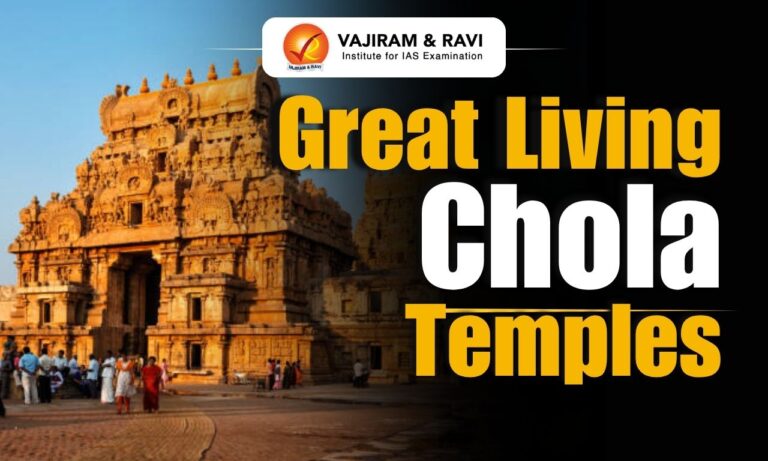
The Great Living Chola Temples are a group of historic Hindu temples in Tamil Nadu that showcase the remarkable achievements of the Chola dynasty in architecture, sculpture and art. Built mainly during the 11th and 12th centuries, these temples continue to function as active places of worship and are recognised as a UNESCO World Heritage Site, reflecting the rich cultural and architectural heritage of South India.
Great Living Chola Temples History
- The Great Living Chola Temples are a group of magnificent Hindu temples built during the rule of the Chola dynasty, one of the most powerful and influential dynasties of South India.
- The Cholas established a strong kingdom in the 9th century CE and ruled for several centuries, making major contributions to administration, military power, religion, literature and the arts.
- The three temples were mainly constructed during the 11th and 12th centuries CE, when Chola power and cultural influence were at their height.
- They reflect the remarkable progress made in temple architecture, stone sculpture, mural painting and bronze casting during this period.
- These temples are dedicated primarily to Lord Shiva and played an important role in the religious and social life of the Chola kingdom.
- Temples were not only places of worship but also important centres of culture, education, economic activity and community life.
- The term “Living Chola Temples” refers to the fact that these temples continue to be active places of worship.
- Traditional rituals, festivals and forms of temple worship that developed centuries ago are still practised, making them an important example of living cultural heritage.
- Together, the three temples demonstrate the evolution of Chola architecture and artistic traditions. They also provide valuable evidence about the history, religious beliefs, social organisation and cultural achievements of medieval Tamil society.
Three Temples of the Great Living Chola Temples
The Great Living Chola Temples comprise three magnificent temples that represent the finest achievements of Chola-era architecture and art. These temples, discussed below, are the Brihadisvara Temple at Thanjavur, Brihadisvara Temple at Gangaikondacholapuram and Airavatesvara Temple at Darasuram.
Brihadisvara Temple, Thanjavur
- The Brihadisvara Temple at Thanjavur was built by Rajaraja Chola I during the early 11th century. Dedicated to Lord Shiva, it is also known as Rajarajesvaram and Dakshina Meru and is regarded as one of the finest achievements of Chola architecture.
- The temple was constructed mainly using granite and is famous for its enormous scale, balanced design and towering vimana.
- The vimana rises to nearly 60 metres and dominates the temple complex, making it one of the most impressive examples of the Dravidian architectural tradition.
- The temple complex includes the main sanctum, mandapas, subsidiary shrines, gateways and a large surrounding enclosure.
- The sanctum contains a massive Shiva lingam, while the walls are decorated with sculptures of various Hindu deities and different forms of Shiva.
- The temple is also known for its Chola-period mural paintings, some of which depict religious themes and scenes associated with the period. Later paintings were added during subsequent periods, particularly under the Nayakas.
- Numerous Tamil inscriptions found on the temple walls record royal donations, land grants, administrative arrangements, temple activities and other details.
- These inscriptions make the temple an important source for understanding Chola administration and society.
Brihadisvara Temple, Gangaikondacholapuram
- The Brihadisvara Temple at Gangaikondacholapuram was built by Rajendra Chola I, the son and successor of Rajaraja Chola I. Rajendra established Gangaikondacholapuram as an important imperial capital after his successful military campaigns in northern India.
- The temple was constructed in the 11th century CE and was dedicated to Lord Shiva. Its overall layout and monumental character were influenced by the Brihadisvara Temple at Thanjavur, but its architecture has a more graceful and curved appearance.
- The temple’s vimana is around 53 metres high and has recessed corners with a gentle upward movement. This gives it a softer appearance compared with the more straight-sided tower of the Thanjavur temple.
- The temple is particularly famous for its exceptional stone sculptures. Important representations include Dakshinamurti, Nataraja, Ardhanari, Durga, Sarasvati, Vishnu and Ganesha, showcasing the skill of Chola sculptors.
- The temple also contains remarkable Chola bronze sculptures, including images of Bhogasakti and Subrahmanya. These works demonstrate the high level of craftsmanship achieved in metal casting during the Chola period.
- Gangaikondacholapuram is therefore important not only as a religious monument but also as evidence of the political power, artistic excellence and cultural ambitions of Rajendra Chola I.
Airavatesvara Temple, Darasuram
- The Airavatesvara Temple at Darasuram was built by Rajaraja Chola II during the 12th century. Dedicated to Lord Shiva, the temple is smaller than the Brihadisvara temples at Thanjavur and Gangaikondacholapuram but is particularly famous for its ornate architecture and intricate carvings.
- The temple is centred around a sanctum and a series of mandapas. One of its most distinctive features is the Rajagambhiran Tirumandapam, a front hall designed to resemble a stone chariot, complete with carved wheels and richly decorated pillars.
- The temple walls and pillars contain numerous finely carved sculptures depicting Hindu deities, mythical figures, dancers and religious themes.
- These sculptures demonstrate the increasing sophistication and decorative richness of later Chola architecture.
- The temple is also noted for its miniature friezes depicting the 63 Nayanmars, the celebrated Shaivite saints of Tamil tradition. These carvings provide an important link between temple art and the development of Shaivism in Tamil Nadu.
- A separate shrine dedicated to Devi or Amman was constructed later near the main temple. This reflects the growing importance of separate Amman shrines within South Indian temple complexes.


Great Living Chola Temples Architecture and Features
- The Great Living Chola Temples are outstanding examples of Dravidian temple architecture.
- Their major architectural elements include large vimanas, sanctums, mandapas, gopuras, subsidiary shrines, courtyards and intricately decorated walls.
- The vimana or sanctum tower is one of their most prominent features. The Thanjavur temple has the tallest and most monumental tower, Gangaikondacholapuram has a more graceful and curved tower, while Darasuram is distinguished by its smaller but highly ornate architectural design.
- Stone sculpture forms an important part of all three temples. The walls, pillars and entrances are decorated with detailed representations of gods, goddesses, dancers, mythical beings and scenes connected with Hindu traditions.
- The temples also demonstrate the Cholas’ mastery of bronze casting. Chola bronze images, especially those representing Shiva and other deities, are internationally recognised for their graceful forms, detailed craftsmanship and artistic quality.
- Inscriptions and mural paintings add considerable historical value to the temples. Inscriptions provide information about royal patronage, donations, land ownership, temple administration and religious activities, while the paintings offer glimpses into the artistic traditions of the period.
- The temples also showcase advanced knowledge of structural engineering and architectural planning.
- Their enormous stone structures, carefully balanced proportions and elaborate layouts demonstrate the technical capabilities of Chola architects and craftsmen.
- Another important feature is the continued connection between architecture and religious practice. The temples were designed not merely as monuments but as functioning sacred spaces where rituals, festivals and worship formed an integral part of everyday life.
UNESCO Status of Great Living Chola Temples
- The Great Living Chola Temples were inscribed on the UNESCO World Heritage Site List for their outstanding contribution to architecture, sculpture, painting and cultural traditions.
- The Brihadisvara Temple at Thanjavur was inscribed in 1987, while the temples at Gangaikondacholapuram and Darasuram were added to the property in 2004.
- UNESCO considers the three temples an exceptional group that represents the development and refinement of Chola architecture and art during the 11th and 12th centuries.
- The temples are especially significant because they preserve a remarkable combination of architectural grandeur, sculptural excellence, inscriptions, paintings and religious traditions. Together, they provide a comprehensive picture of the artistic and cultural achievements of the Chola period.
- Their status as living temples further strengthens their cultural importance. Unlike monuments that survive only as archaeological remains, these temples continue to host worship, festivals and traditional rituals, maintaining a direct connection with the religious traditions of the past.
- The Great Living Chola Temples are therefore important not only for Indian history and art, but also for understanding Tamil culture, South Indian temple traditions, Dravidian architecture and the legacy of the Chola dynasty.
Cultural Significance of Great Living Chola Temples
- The Great Living Chola Temples are an important part of Tamil cultural heritage and reflect the religious, artistic and social traditions that developed during the Chola period.
- These temples played a central role in the growth of Shaivism and temple culture in South India. Their continuing rituals, festivals and worship practices preserve traditions that have been followed for centuries.
- The temples showcase the outstanding achievements of Chola art and craftsmanship, particularly in stone sculpture, bronze casting, mural painting and temple architecture.
- The inscriptions found in the temples provide valuable information about Chola administration, donations, land grants, social life and religious practices, making them important sources for understanding medieval Tamil society.
- Their continued use as living places of worship connects present-day communities with centuries-old traditions, giving the temples significance beyond their architectural and historical value.
- The temples also represent the wider influence of Dravidian architecture and have contributed to the development of South Indian temple-building traditions.

 Last updated on Oct, 2026
→ UPSC 2027 Notification will be released on 13 January 2027 at upsconline.nic.in.
→ Check Nobel Prize 2026 Winners List here.
→ Download PIB PRiSM Monthly Magazine 2026 here.
→ Check UPSC Monthly Current Affairs Magazine The Recitals here.
→ Check out the latest UPSC Syllabus here.
→ Download UPSC Model Answers for Mains 2026
→ UPSC Mains Question Paper 2026 is out now for Essay & GS Paper 1, 2, 3 & 4.
→ UPSC Calendar 2027 has been released.
→ Enroll in Vajiram & Ravi’s UPSC Mains Test Series 2027 for structured answer writing practice, expert evaluation, and exam-oriented feedback.
→ Join Vajiram & Ravi’s UPSC Mentorship Program 2027 for personalized guidance, strategy planning, and one-to-one support from experienced mentors.
→ Go through the UPSC Mains Previous Year Papers to enhance your preparation.
→ UPSC has released UPSC Toppers List 2025 with the Civil Services final result on its official website.
→ Also check Best UPSC Coaching in India
Great Living Chola Temples FAQs
Q1. What are the Great Living Chola Temples?+
Q2. Which are the three Great Living Chola Temples?+
Q3. Who built the Brihadisvara Temple at Thanjavur?+
Q4. Who built the Brihadisvara Temple at Gangaikondacholapuram?+
Q5. Who built the Airavatesvara Temple at Darasuram?+
Q6. Why are the Chola Temples called “Living Temples”?+
Q7. What are the main architectural features of the Great Living Chola Temples?+
Q8. When were the Great Living Chola Temples added to the UNESCO World Heritage List?+
Q9. Why are the Great Living Chola Temples culturally significant?+
Q10. Why are the Great Living Chola Temples important?+
Tags: art and culture art and culture notes great living chola great living chola temples history history notes