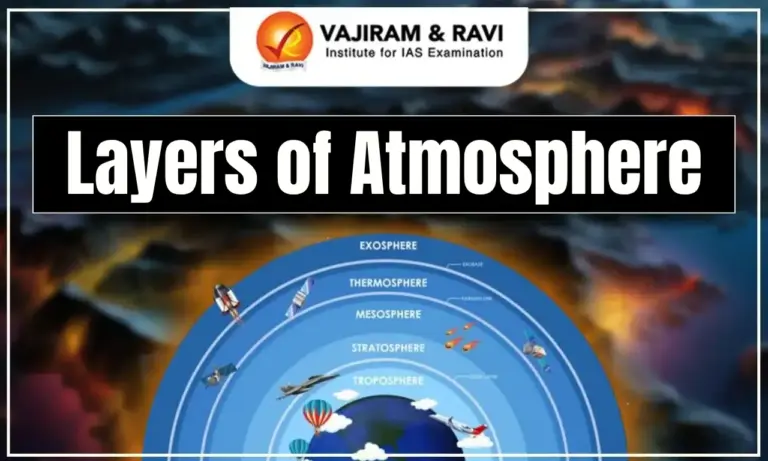
The Earth’s atmosphere is the blanket of gases surrounding our planet. It is held around the Earth by gravity and plays an important role in supporting life, regulating temperature, producing weather and protecting living organisms from harmful solar radiation. Based mainly on changes in temperature with altitude, the atmosphere is divided into five main layers: Troposphere, Stratosphere, Mesosphere, Thermosphere and Exosphere.
Layers of Atmosphere
The five layers of atmosphere differ in terms of altitude, temperature, composition and functions. The temperature does not change in the same way in all layers. It decreases in the troposphere, increases in the stratosphere, decreases again in the mesosphere and increases sharply in the thermosphere.
| Layers of Atmosphere | |||
|
Layer |
Approximate Altitude |
Temperature Trend |
Major Features |
|
Troposphere |
Surface to 8–18 km |
Decreases with altitude |
Weather, clouds and life |
|
Stratosphere |
About 12–50 km |
Increases with altitude |
Ozone layer |
|
Mesosphere |
About 50–85 km |
Decreases with altitude |
Meteors burn up |
|
Thermosphere |
About 85–600+ km |
Increases with altitude |
Auroras and ionisation |
|
Exosphere |
About 600–10,000 km |
Very high but difficult to define |
Outermost layer, transition to space |
1. Troposphere
The troposphere is the lowest layer of the atmosphere and is closest to the Earth’s surface. Its thickness varies with latitude and season. It extends roughly up to 8 km near the poles and 18 km near the equator, with an average height of about 12 km.
Key Features of Troposphere
- It is the layer in which humans, animals and plants live.
- Almost all weather phenomena, such as rainfall, thunderstorms, cyclones and winds, occur here.
- It contains most of the atmosphere’s water vapour and dust particles.
- Cloud formation and precipitation mainly take place in this layer.
- Air pressure and density are highest near the Earth’s surface.
- Temperature generally decreases with increasing altitude.
- The average rate of temperature decrease is about 6.5°C per kilometre.
The upper boundary of the troposphere is called the tropopause.


2. Stratosphere
The stratosphere lies above the troposphere and extends from roughly 12 km to 50 km above the Earth’s surface.
Key Features of Stratosphere
- It contains the important ozone layer, mainly concentrated between about 15 and 35 km.
- Ozone absorbs a significant amount of the Sun’s harmful ultraviolet (UV) radiation.
- Temperature increases with altitude because ozone absorbs ultraviolet radiation.
- The air is relatively stable, with limited vertical mixing compared with the troposphere.
- Some high-altitude aircraft operate in or near the lower stratosphere to avoid much of the turbulent weather found in the troposphere.
The upper boundary of the stratosphere is known as the stratopause.
3. Mesosphere
The mesosphere is located above the stratosphere and extends approximately from 50 km to 85 km above the Earth.
Key Features of Mesosphere
- It is generally considered the coldest atmospheric layer.
- Temperature decreases with increasing altitude.
- Most meteoroids entering the atmosphere experience intense heating and burn up in the mesosphere, producing visible meteor trails.
- Air density is extremely low compared with the lower atmosphere.
- The upper boundary of the mesosphere is called the mesopause.
Temperatures near the mesopause can fall to around −90°C, making this region one of the coldest parts of the atmosphere.
4. Thermosphere
The thermosphere lies above the mesosphere and extends from roughly 85 km to several hundred kilometres above the Earth. Its upper boundary is not sharply defined because the atmosphere gradually becomes thinner with altitude.
Key Features of Thermosphere
- Temperature increases significantly with altitude.
- It absorbs much of the Sun’s high-energy ultraviolet and X-ray radiation.
- The ionosphere overlaps a large part of the thermosphere and contains electrically charged particles.
- Auroras, including the Northern and Southern Lights, occur mainly in the upper atmosphere in this region.
- Some satellites and spacecraft operate within the thermosphere.
- Despite extremely high measured temperatures, the air is so thin that it would not feel hot to a person in the same way as dense air near the surface.
The upper boundary is generally referred to as the thermopause.
5. Exosphere
The exosphere is the outermost layer of the Earth’s atmosphere. It begins above the thermosphere and gradually merges with outer space. It can extend to around 10,000 km above the Earth, although its exact outer boundary is not sharply defined.
Key Features of Exosphere
- It contains extremely thin and sparse gases.
- Hydrogen and helium are among the major gases found at these great altitudes.
- Gas particles are so widely separated that they can travel long distances without colliding.
- Some particles can escape the Earth’s gravitational influence and move into space.
- The exosphere represents the gradual transition between the atmosphere and outer space.
- Many high-altitude satellites operate in or pass through this region.
Temperature Changes in the Layers of Atmosphere
One of the easiest ways to understand the layers of atmosphere is to study how temperature changes with altitude.
| Temperature Changes in the Layers of Atmosphere | |
|
Atmospheric Layer |
Temperature Change with Altitude |
|
Troposphere |
Temperature decreases |
|
Stratosphere |
Temperature increases |
|
Mesosphere |
Temperature decreases |
|
Thermosphere |
Temperature increases |
|
Exosphere |
Temperature is difficult to define because of extremely low density |
Why Are the Layers of Atmosphere Important?
The layers of atmosphere perform different functions that are essential for Earth and life.
- Troposphere: Supports life and contains almost all weather systems.
- Stratosphere: Contains the ozone layer, which helps protect life from harmful UV radiation.
- Mesosphere: Helps destroy many incoming meteoroids before they reach the Earth’s surface.
- Thermosphere: Absorbs high-energy solar radiation and is associated with auroras and ionospheric activity.
- Exosphere: Forms the outermost transition between the Earth’s atmosphere and space.
Difference Between the Five Layers of Atmosphere
The five layers of atmosphere differ in their altitude, temperature pattern, air density and major functions, with each layer playing a distinct role in protecting and supporting life on Earth.
| Difference Between the Five Layers of Atmosphere | |||||
|
Basis |
Troposphere |
Stratosphere |
Mesosphere |
Thermosphere |
Exosphere |
|
Position |
Lowest layer |
Above troposphere |
Above stratosphere |
Above mesosphere |
Outermost layer |
|
Altitude |
Surface to about 8–18 km |
About 12–50 km |
About 50–85 km |
About 85–600+ km |
About 600–10,000 km |
|
Temperature |
Decreases with altitude |
Increases with altitude |
Decreases with altitude |
Increases with altitude |
Extremely variable; difficult to define |
|
Air Density |
Highest |
Lower |
Very low |
Extremely low |
Extremely thin |
|
Major Feature |
Weather and clouds |
Ozone layer |
Meteors burn up |
Auroras and ionisation |
Transition to outer space |
|
Ozone |
Very little |
Main ozone layer |
Very little |
Very little |
Negligible |
|
Weather |
Almost all weather occurs here |
Very limited |
No normal weather |
No normal weather |
No weather |
|
Importance |
Supports life and weather |
Protects Earth from harmful UV radiation |
Helps burn incoming meteoroids |
Absorbs high-energy solar radiation |
Gradual transition into space |
|
Upper Boundary |
Tropopause |
Stratopause |
Mesopause |
Thermopause |
No sharply defined boundary |
What Is the Ozone Layer?
The ozone layer is a region of the stratosphere containing relatively high concentrations of ozone (O₃). It absorbs much of the Sun’s harmful ultraviolet radiation, particularly UV-B and UV-C, thereby helping protect living organisms from excessive UV exposure.
The ozone layer is therefore an important part of the stratosphere and plays a major role in maintaining conditions suitable for life on Earth.
What Is the Ionosphere?
The ionosphere is a region of the upper atmosphere where gases are ionised by solar radiation. It overlaps mainly with the thermosphere and extends into parts of the mesosphere and exosphere.
It is important for radio communication, auroras and interactions between the Earth’s atmosphere and solar activity.

 Last updated on August, 2026
→ UPSC Mains 2026 commenced on 21st August 2026 and will continue through 30th August 2026, as per the official examination schedule.
→ UPSC Mains Question Paper 2026 is out now for Essay & GS Paper 1, 2, 3 & 4.
→ UPSC Mains GS Paper 1 2026 is out now.
→ UPSC Mains GS Paper 2 2026 is out now.
→ UPSC Mains GS Paper 3 2026 is out now.
→ UPSC Mains GS Paper 4 2026 is out now.
→ UPSC Mains Indian Language Paper & English Compulsory Paper are out now.
→ Check out the latest UPSC Syllabus 2026 here.
→ UPSC Mains Admit Card 2026 is now out.
→ Enroll in Vajiram & Ravi’s UPSC Mains Test Series 2027 for structured answer writing practice, expert evaluation, and exam-oriented feedback.
→ Join Vajiram & Ravi’s UPSC Mentorship Program 2027 for personalized guidance, strategy planning, and one-to-one support from experienced mentors.
→ Go through the UPSC Mains Previous Year Papers to enhance your preparation.
→ Download UPSC Mains Essay Paper 2025, UPSC Mains GS Paper-I 2025, UPSC Mains GS Paper-II 2025, UPSC Mains GS Paper-III 2025, UPSC Mains GS Paper-IV 2025, UPSC Mains English (Compulsory) Paper 2025, UPSC Mains Hindi (Qualifying) Paper 2025 here.
→ UPSC has released UPSC Toppers List 2025 with the Civil Services final result on its official website.
→ UPSC Calendar 2027 has been released.
→ Also check Best UPSC Coaching in India
Layers of Atmosphere FAQs
Q1. How many layers are there in the atmosphere?+
Q2. Which is the lowest layer of the atmosphere?+
Q3. Which layer of the atmosphere is closest to Earth?+
Q4. Which layer contains the ozone layer?+
Q5. Which is the coldest layer of the atmosphere?+
Tags: layers layers of atmosphere