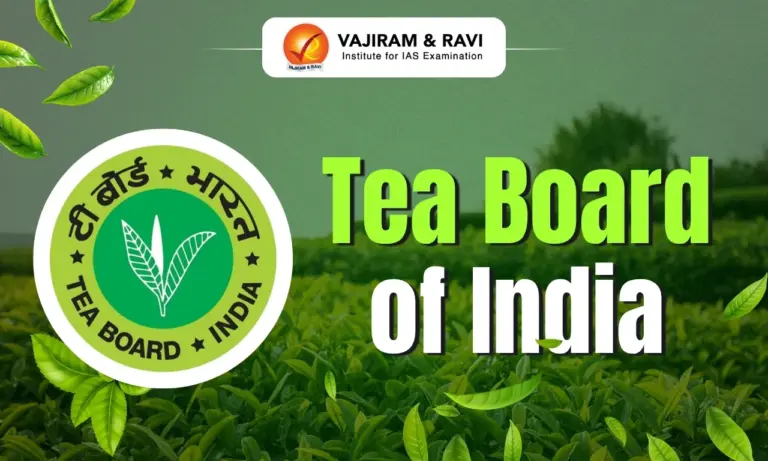
Tea Board of India is a statutory organisation under the Ministry of Commerce and Industry, Government of India, responsible for promoting and developing the Indian tea industry. It plays an important role in supporting tea cultivation, production, quality improvement, research, marketing and exports.
What is the Tea Board of India?
Tea Board of India is a statutory body established under Section 4 of the Tea Act, 1953. The present Tea Board was constituted on 1 April 1954.
The Board works under the administrative control of the Ministry of Commerce and Industry and is headquartered in Kolkata, West Bengal.
Its broad objective is to promote the growth of the tea industry in India by supporting tea cultivation, manufacturing, marketing, research, quality improvement and exports.
Tea Board of India History
The institutional history of tea promotion in India goes back to 1903, when the Indian Tea Cess Bill was introduced. The legislation imposed a cess on tea exports and the funds collected were used for promoting Indian tea in domestic and international markets.
Over the years, the institutional framework for regulating and developing the tea industry evolved.
The present Tea Board succeeded two earlier bodies:
- Central Tea Board, which functioned under the Central Tea Board Act, 1949.
- Indian Tea Licensing Committee, which functioned under the Indian Tea Control Act, 1938.
Both these earlier laws were subsequently repealed and the present Tea Board was established under the Tea Act, 1953.


Organisation of the Tea Board of India
The Board consists of 31 members, including the Chairman. Its composition represents different stakeholders associated with the tea industry and includes representatives from:
- Members of Parliament
- Tea producers
- Tea traders
- Tea brokers
- Tea consumers
- Governments of major tea-producing states
- Trade unions
Headquarters and Offices
The head office of the Tea Board of India is located in Kolkata, West Bengal.
To carry out its activities across different tea-producing regions, the Board operates through 23 offices, comprising:
- Zonal offices
- Regional offices
- Sub-Regional offices
This network enables the Board to work more closely with tea growers, producers, manufacturers and other stakeholders in different parts of the country.
Also Read:- Regulatory Bodies in India
Functions of the Tea Board of India
The Tea Board of India supports the overall development of the tea industry through financial assistance, technical support, research, marketing and quality improvement.
- Provides financial assistance for tea cultivation, manufacturing and marketing.
- Offers technical assistance to improve tea cultivation and production practices.
- Promotes Indian tea in domestic and international markets.
- Supports research and development to increase tea production.
- Works towards improving the quality of Indian tea.
- Encourages the development and growth of the tea industry.
- Supports activities aimed at improving tea productivity and competitiveness.
About Tea
Tea is one of the world’s most widely consumed beverages and an important plantation crop in India, contributing to employment, rural livelihoods, trade and exports.
- Scientific Name: Tea is obtained from Camellia sinensis, a plant belonging to the Theaceae family.
- Major Types: Tea is broadly classified into black, green, white, oolong and dark tea, depending on the processing and oxidation methods.
- Climate: Tea grows best in warm, humid conditions with well-distributed rainfall, moderate temperatures and adequate humidity.
- Soil: It requires deep, fertile, well-drained and acidic soils rich in organic matter.
- Major Producing States: Assam, West Bengal, Tamil Nadu, Kerala and Karnataka are among India’s important tea-producing states.
- Famous Tea Regions: Assam, Darjeeling, Nilgiris, Dooars and Terai are well-known tea-growing regions with distinctive varieties and flavours.
- Economic Importance: The tea industry generates employment and livelihoods, particularly in rural areas and contributes significantly to domestic trade and exports.

 Last updated on August, 2026
→ UPSC Mains 2026 commenced on 21st August 2026 and will continue through 30th August 2026, as per the official examination schedule.
→ UPSC Mains Question Paper 2026 is out now for Essay & GS Paper 1, 2, 3 & 4.
→ UPSC Mains GS Paper 1 2026 is out now.
→ UPSC Mains GS Paper 2 2026 is out now.
→ UPSC Mains GS Paper 3 2026 is out now.
→ UPSC Mains GS Paper 4 2026 is out now.
→ Check out the latest UPSC Syllabus 2026 here.
→ UPSC Mains Admit Card 2026 is now out.
→ Enroll in Vajiram & Ravi’s UPSC Mains Test Series 2027 for structured answer writing practice, expert evaluation, and exam-oriented feedback.
→ Join Vajiram & Ravi’s UPSC Mentorship Program 2027 for personalized guidance, strategy planning, and one-to-one support from experienced mentors.
→ Go through the UPSC Mains Previous Year Papers to enhance your preparation.
→ Download UPSC Mains Essay Paper 2025, UPSC Mains GS Paper-I 2025, UPSC Mains GS Paper-II 2025, UPSC Mains GS Paper-III 2025, UPSC Mains GS Paper-IV 2025, UPSC Mains English (Compulsory) Paper 2025, UPSC Mains Hindi (Qualifying) Paper 2025 here.
→ UPSC has released UPSC Toppers List 2025 with the Civil Services final result on its official website.
→ UPSC Calendar 2027 has been released.
→ Also check Best UPSC Coaching in India
Tea Board of India FAQs
Q1. What is the Tea Board of India?+
Q2. When was the Tea Board of India established?+
Q3. Where is the headquarters of the Tea Board of India?+
Q4. How many members are there in the Tea Board?+
Q5. How often is the Tea Board reconstituted?+
Q6. What are the major functions of the Tea Board?+
Tags: tea tea board tea board of india