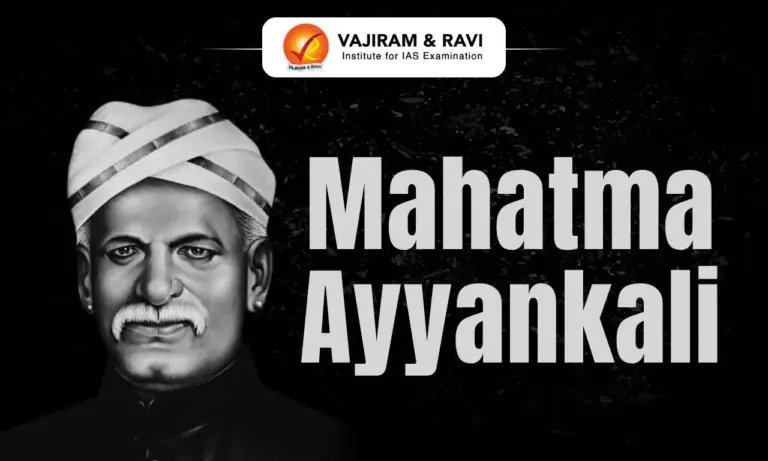
Mahatma Ayyankali was a pioneering social reformer and Dalit rights leader from Kerala who challenged caste based discrimination in Travancore. He fought for freedom of movement, access to public roads, education, labour rights and social dignity. His movements transformed the lives of oppressed communities and contributed significantly to Kerala’s social reform history.
Mahatma Ayyankali Birth Anniversary 2026
Mahatma Ayyankali Birth Anniversary 2026 will be observed on 28 August 2026 to mark his 163rd birth anniversary. He was born on 28 August 1863 in Venganoor, Kerala. Ayyankali is remembered for his lifelong struggle against caste discrimination and his efforts to secure education, public access, labour rights and social dignity for oppressed communities.
Mahatma Ayyankali Biography
Mahatma Ayyankali was born into the Pulayar community in Venganoor, Thiruvananthapuram, then part of the princely state of Travancore. His early experiences of caste discrimination shaped his lifelong social reform movement.
- Birth and family: Mahatma Ayyankali was born on 28 August 1863 to Ayyan and Mala. He was the first of eight children and belonged to the Pulayar community.
- Social conditions: Pulayars faced severe caste restrictions and were largely engaged in agricultural labour. They faced restrictions on public roads, education, clothing and other basic social rights.
- Marriage and children: Ayyankali married Chellamma in 1888. The couple had seven children. His family background remained closely connected with agricultural work.
- Early resistance: He joined fellow Pulayars in using songs and collective action to protest caste discrimination. His leadership gradually gained support among oppressed communities.
- Influences: Mahatma Ayyankali was influenced by reformers including Ayyavu Swamikal and Sree Narayana Guru. He also worked against caste discrimination alongside broader social reform movements in Kerala.


Mahatma Ayyankali Contributions
Mahatma Ayyankali converted opposition to caste discrimination into organised campaigns for public rights, education, labour dignity and political representation in Travancore.
- Villuvandi protest 1893: Mahatma Ayyankali rode a bullock cart on public roads while wearing clothing associated with upper castes. The act directly challenged restrictions imposed on oppressed communities.
- Freedom of movement: His protests asserted the right of Dalits to use public roads and public spaces. By 1900, Pulayars secured access to most roads, except roads leading to Hindu temples.
- Chaliyar Riots: Continued resistance to caste restrictions resulted in clashes in southern Kerala. These confrontations became known as the Chaliyar Riots and strengthened collective mobilisation among oppressed communities.
- Sadhu Jana Paripalana Sangham: In 1907, he founded Sadhu Jana Paripalana Sangham, or the Association for the Protection of the Poor. It promoted education and organised support for oppressed communities.
- Agricultural labour strike: Mahatma Ayyankali organised an agricultural labour strike to demand educational access for Dalit children, rest periods for workers and payment of wages in cash rather than kind.
- Education rights: The Travancore government issued an order in 1907 allowing children from untouchable communities to enter public schools. Resistance by local officials delayed implementation, with educational access becoming effective by 1910.
- Women Empowerment: His efforts supported Pulaya women’s struggle for the right to cover their upper bodies in public. This challenged caste based restrictions imposed on their clothing and dignity.
- Political representation: In 1910, Mahatma Ayyankali was nominated to the Travancore Legislative Assembly, known as the Sree Moolam Popular Assembly or Praja Sabha. He became its first Pulaya member.
- Human dignity: Despite being illiterate, Ayyankali developed a broad social vision based on equal access to education, public spaces, labour rights and dignity for oppressed communities.
Mahatma Ayyankali Death
Mahatma Ayyankali died on 18 June 1941 in the Travancore region. He was 77 years old at the time of his death. In his last time, Mahatma Ayyankali continued advocating for social equality and the rights of oppressed communities through organised movements and public representation. His work established an important foundation for social reform in Kerala.
Ayyankali’s death marked the end of the life of a major anti caste reformer whose campaigns had already produced significant changes in education, public access, labour rights and political representation.
Mahatma Ayyankali Recognitions and Honors
Mahatma Ayyankali continued to receive public recognition for his contribution to social equality, Dalit rights and the transformation of Kerala’s social structure.
- King of Pulaya: Mahatma Gandhi met Ayyankali and recognised his leadership. Gandhi referred to him as the “Pulaya king”, reflecting his influence among the Pulaya community.
- India’s greatest son: Indira Gandhi recognised Ayyankali’s historical importance and described him as “India’s greatest son”. A statue of Ayyankali was unveiled at Kowdiar Square, Thiruvananthapuram, in 1980.
- Commemorative postage stamp: The Department of Posts issued a commemorative stamp featuring Ayyankali on 12 August 2002 as part of the Personality Set on Social Reformers. The stamp had a denomination of 500 paise.
- Historical significance: Historian P. Sanal Mohan has described Ayyankali as the “most important leader of modern Kerala”. He is also remembered by the title “Kerala Spartacus”.

 Last updated on August, 2026
→ UPSC Mains 2026 commenced on 21st August 2026 and will continue through 30th August 2026, as per the official examination schedule.
→ UPSC Mains Question Paper 2026 is out now for Essay & GS Paper 1, 2, 3 & 4.
→ UPSC Mains GS Paper 1 2026 is out now.
→ UPSC Mains GS Paper 2 2026 is out now.
→ UPSC Mains GS Paper 3 2026 is out now.
→ UPSC Mains GS Paper 4 2026 is out now.
→ Check out the latest UPSC Syllabus 2026 here.
→ UPSC Mains Admit Card 2026 is now out.
→ Enroll in Vajiram & Ravi’s UPSC Mains Test Series 2027 for structured answer writing practice, expert evaluation, and exam-oriented feedback.
→ Join Vajiram & Ravi’s UPSC Mentorship Program 2027 for personalized guidance, strategy planning, and one-to-one support from experienced mentors.
→ Go through the UPSC Mains Previous Year Papers to enhance your preparation.
→ Download UPSC Mains Essay Paper 2025, UPSC Mains GS Paper-I 2025, UPSC Mains GS Paper-II 2025, UPSC Mains GS Paper-III 2025, UPSC Mains GS Paper-IV 2025, UPSC Mains English (Compulsory) Paper 2025, UPSC Mains Hindi (Qualifying) Paper 2025 here.
→ UPSC has released UPSC Toppers List 2025 with the Civil Services final result on its official website.
→ UPSC Calendar 2027 has been released.
→ Also check Best UPSC Coaching in India
Mahatma Ayyankali FAQs
Q1. Who was Mahatma Ayyankali?+
Q2. When was Mahatma Ayyankali born?+
Q3. What was the Sadhu Jana Paripalana Sangham?+
Q4. What was Ayyankali’s contribution to education?+
Q5. When did Mahatma Ayyankali die?+
Q6. Who called Ayyankali “Mahatma”?+
Tags: mahatma ayyankali mahatma ayyankali birth mahatma ayyankali birth anniversary 2026