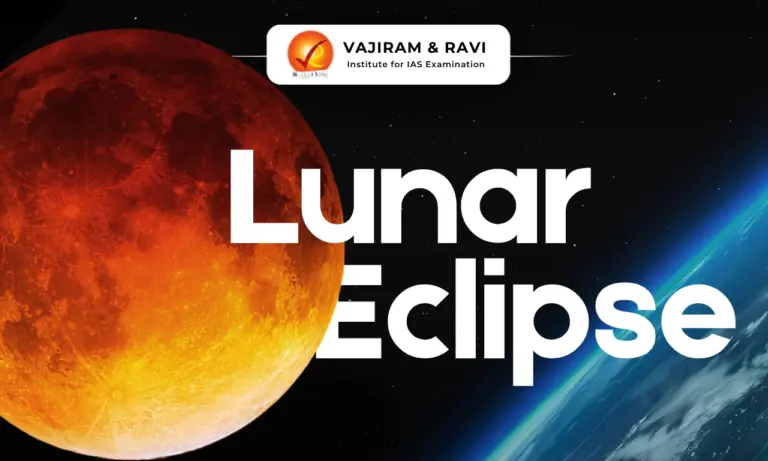
An Eclipse occurs when one celestial body blocks sunlight from reaching another body. Earth experiences two main types- Solar and Lunar Eclipses. A Solar Eclipse occurs when the Moon blocks the Sun, while a Lunar Eclipse occurs when Earth’s shadow falls on the Moon. On August 28, 2026, a deep partial lunar eclipse will occur, with 96.3% of the Moon’s disk entering Earth’s umbra.
What is a Lunar Eclipse?
A Lunar Eclipse occurs when Earth comes between the Sun and Moon and casts its shadow on the Moon. It happens during a full Moon when the three bodies are nearly aligned. A lunar eclipse can last for several hours and is safe to watch with the naked eye.
Lunar Eclipse Types and Formation Process
A Lunar Eclipse is classified according to how much of the Moon enters Earth’s shadow. Earth’s shadow has two parts, the darker umbra and the lighter penumbra.
- Total Lunar Eclipse: The entire Moon enters Earth’s umbra. Sunlight passing through Earth’s atmosphere can make the Moon appear reddish or copper coloured.
- Partial Lunar Eclipse: Only a part of the Moon enters the umbra. The shadow gradually covers part of the lunar surface while the remaining portion stays illuminated.
- Penumbral Lunar Eclipse: The Moon passes through Earth’s penumbra, the lighter outer part of its shadow. The Moon becomes slightly dimmer and the change can be difficult to notice.
- When Does Lunar Eclipse Occur?: A lunar eclipse occurs only during a full Moon. The Moon’s orbit is tilted relative to Earth’s orbit around the Sun, so an eclipse does not occur during every full Moon.
- Why Does the Moon Appear Red?: Earth’s atmosphere scatters shorter blue wavelengths more easily. Red and orange wavelengths pass through the atmosphere more effectively and can reach the Moon, producing its reddish or coppery appearance.
Also Read: Blood Moon


Lunar Eclipse 2026-27 List (Upcoming)
The upcoming Lunar Eclipse events in 2026 and 2027 include a deep partial eclipse on August 28, 2026 and a penumbral eclipse on February 20, 2027.
- August 28, 2026: A partial lunar eclipse will occur across the East Pacific, Americas, Europe and Africa.
- February 20, 2027: A penumbral lunar eclipse will be visible across the Americas, Europe, Africa, Asia and western Australia.
Also Read: Solar Eclipse
Partial Lunar Eclipse 2026 (28 August 2026)
The Partial Lunar Eclipse 2026 will occur on August 28 and will be one of the deepest partial lunar eclipses, with 96.3% of the Moon’s disk entering Earth’s umbra.
- What is the Date of Lunar Eclipse 2026?: The partial lunar eclipse occurs on August 28, 2026 in UTC. In some parts of the Americas, the event begins during the evening of August 27.
- Lunar Eclipse 2026 Timings in India: In IST, the penumbral phase begins at 6:54 am, the partial phase at 8:04 am, maximum eclipse at 9:43 am, partial phase ends at 11:21 am and the penumbral phase ends at 12:31 pm.
- Will Lunar Eclipse 2026 be Visible in India?: No. The August 28, 2026 lunar eclipse will not be visible from India because the Moon will be below the horizon during the main eclipse phases.
- Where is Lunar Eclipse 2026 Visible?: The entire eclipse will be visible across much of North and South America. Parts of Europe and Africa will also see the eclipse, but the complete sequence will not be visible from every location.
- Is Lunar Eclipse Safe to Watch?: Yes. A lunar eclipse can be viewed safely with the naked eye. Special eclipse glasses or filters are not required, while binoculars and telescopes can also be used safely.
- How Deep is the 2026 Lunar Eclipse?: At greatest eclipse, 96.3% of the Moon’s disk will be within Earth’s umbra. This makes the event a deep partial lunar eclipse rather than a total lunar eclipse.
Also Read: Total Solar Eclipse

 Last updated on August, 2026
→ UPSC Mains 2026 commenced on 21st August 2026 and will continue through 30th August 2026, as per the official examination schedule.
→ UPSC Mains Question Paper 2026 is out now for Essay & GS Paper 1, 2, 3 & 4.
→ UPSC Mains GS Paper 1 2026 is out now.
→ UPSC Mains GS Paper 2 2026 is out now.
→ UPSC Mains GS Paper 3 2026 is out now.
→ UPSC Mains GS Paper 4 2026 is out now.
→ Check out the latest UPSC Syllabus 2026 here.
→ UPSC Mains Admit Card 2026 is now out.
→ Enroll in Vajiram & Ravi’s UPSC Mains Test Series 2027 for structured answer writing practice, expert evaluation, and exam-oriented feedback.
→ Join Vajiram & Ravi’s UPSC Mentorship Program 2027 for personalized guidance, strategy planning, and one-to-one support from experienced mentors.
→ Go through the UPSC Mains Previous Year Papers to enhance your preparation.
→ Download UPSC Mains Essay Paper 2025, UPSC Mains GS Paper-I 2025, UPSC Mains GS Paper-II 2025, UPSC Mains GS Paper-III 2025, UPSC Mains GS Paper-IV 2025, UPSC Mains English (Compulsory) Paper 2025, UPSC Mains Hindi (Qualifying) Paper 2025 here.
→ UPSC has released UPSC Toppers List 2025 with the Civil Services final result on its official website.
→ UPSC Calendar 2027 has been released.
→ Also check Best UPSC Coaching in India
Lunar Eclipse FAQs
Q1. What is a Lunar Eclipse?+
Q2. When is the Lunar Eclipse in 2026?+
Q3. Will the Partial Lunar Eclipse 2026 be visible in India?+
Q4. Why does the Moon appear red during a Lunar Eclipse?+
Q5. Is it safe to watch a Lunar Eclipse with naked eyes?+
Q6. What is a Partial Lunar Eclipse?+
Tags: eclipse lunar eclipse