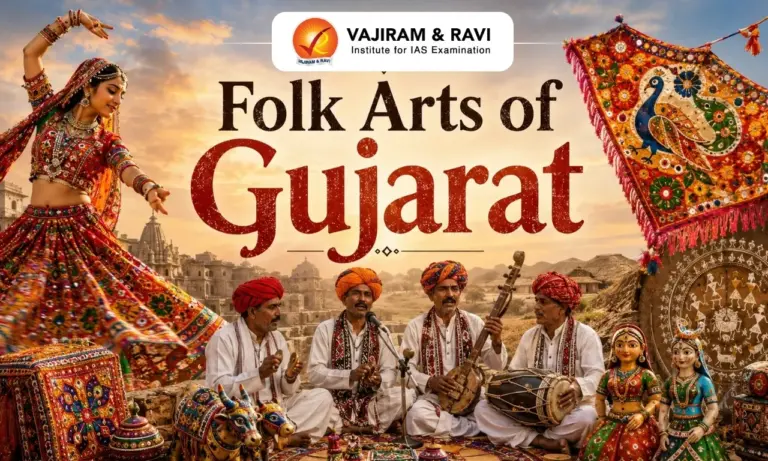
The Folk Arts of Gujarat represent the traditional creative expressions of the state’s communities. They include folk theatre, dances, paintings, embroidery, textile traditions and handicrafts, many of which remain closely connected with festivals, religious practices, occupations and community life.
Major Folk Arts of Gujarat
The major Folk Arts of Gujarat can be understood through four broad groups: folk dances and theatre, paintings and visual arts, embroidery and textile arts, and traditional handicrafts. Important examples include Garba, Bhavai, Pithora, Mata Ni Pachedi, Lippan Kaam, Rogan Art, Patan Patola and Tangaliya.
Folk Dances and Theatre of Gujarat
Gujarat’s performing Folk Arts are closely linked with festivals, religious traditions, occupations and community celebrations.
- Garba: A ritual and devotional dance performed during Navratri, traditionally around a perforated earthen pot containing a lamp or an image of Goddess Amba. Dancers move in a circle while singing and clapping. Garba of Gujarat was inscribed on UNESCO’s Representative List of Intangible Cultural Heritage in 2023.
- Dandiya Raas: A popular Gujarati folk dance performed with decorated wooden sticks called dandiyas. The dancers move rhythmically in pairs or groups, making it an important part of Navratri celebrations.
- Bhavai: Gujarat’s traditional folk theatre, combining acting, music, dance and satire. It is generally performed in an open space and uses characters and stories to provide both entertainment and social commentary. It is particularly associated with the Nayak and Bhojak communities.
- Tippani Nritya: An occupational folk dance associated with women of the Koli and Kharva communities of Saurashtra. Dancers use long wooden sticks called tippani in a rhythmic manner, reflecting its connection with traditional labour.
- Siddi Dhamal: A high-energy folk dance of the Siddi community of Gujarat, particularly associated with the Saurashtra region. It is traditionally performed by men and accompanied by percussion instruments.
- Padhar Nritya: A folk dance associated with the Padhar community around Nal Sarovar. Its movements imitate rowing boats and movements on water, reflecting the community’s traditional association with the lake environment.
Also Read:- Tribes of Gujarat
Folk Paintings and Visual Arts
The visual Folk Arts of Gujarat often depict deities, nature, community beliefs and everyday life through walls, cloth and other surfaces.
- Pithora Painting: A ritual wall-painting tradition mainly associated with the Rathwa community. It depicts Baba Pithora, horses, ancestors, animals and elements of nature and is closely connected with tribal religious practices.
- Mata Ni Pachedi: A ritual textile art associated with the Vaghari community. It functions as a cloth shrine dedicated to Goddess Shakti, with the goddess generally placed at the centre and surrounded by other deities, animals and natural elements.
- Lippan Kaam: A distinctive mud-and-mirror art of Kutch, traditionally used to decorate the walls of bhungas, the traditional mud houses of the region. Common designs include geometric patterns, animals and birds.
- Warli Painting: A tribal painting tradition found mainly in the tribal belt of western India, using simple geometric forms to depict community life, nature and rituals.
Traditional Textile and Embroidery Arts
Gujarat’s textile Folk Arts are particularly known for intricate embroidery, tie-and-dye techniques, block printing and traditional weaving.
- Rogan Art: A textile-painting tradition associated with Nirona village in Kutch and traditionally practised by the Khatri community. A thick oil-based coloured paste is applied freehand to cloth, often creating symmetrical mirror-image designs.
- Rabari Embroidery: A colourful embroidery tradition of the Rabari community, featuring motifs such as flowers, birds, animals and geometric designs. It reflects the community’s lifestyle and cultural identity.
- Ahir Embroidery: An embroidery tradition associated with Ahir women, known for colourful floral and geometric patterns and the use of mirrors.
- Soof Embroidery: A counted-thread embroidery tradition in which artisans create geometric designs through careful counting of the threads, generally without drawing the design beforehand.
- Mutwa Embroidery: A highly detailed embroidery tradition associated with Muslim pastoral communities of the Banni region of Kutch, known for fine stitches and small mirror work.
- Bandhani: A traditional tie-and-dye textile art in which small portions of fabric are tied before dyeing. The tied portions resist the dye and produce distinctive patterns. Kutch Bandhani and Jamnagari Bandhani are among Gujarat’s registered GI products.
- Patan Patola: A highly skilled double-ikat silk weaving tradition associated with Patan. Both the warp and weft are tie-dyed before weaving, allowing intricate patterns to emerge when they are precisely aligned.
- Ajrakh: A traditional block-printing art associated with Kutch, historically linked with the Sindh region. It is known for repeated geometric patterns and the traditional use of colours such as indigo blue, red and white.
- Bhujodi Weaving: A traditional weaving tradition associated with Bhujodi in Kutch, particularly known for products such as shawls, stoles and carpets.
Also Read:- Festivals of Gujarat
Traditional Handicrafts of Gujarat
The handicraft traditions within the Folk Arts of Gujarat use materials such as wood, stone, metal, wool and natural fibres and are often associated with specific craft centres.
- Tangaliya Shawl: A traditional weaving craft associated with Surendranagar and the Dangasia community. Its distinctive feature is the use of small raised dot-like patterns called daana, created through extra-weft work. It is a registered GI product.
- Sankheda Furniture: A traditional lacquered wooden furniture craft associated with Sankheda in Gujarat. It is a registered GI handicraft.
- Agates of Cambay: A traditional stone-cutting and polishing craft associated with Khambhat (Cambay). Artisans work with agate and related stones to produce jewellery and decorative objects. It is a registered GI handicraft.
- Pethapur Printing Blocks: A traditional craft of making wooden blocks used for textile printing, associated with Pethapur in Gujarat. It is a registered GI handicraft.
- Moti Bharat: Traditional beadwork using multicoloured beads to create decorative objects such as torans, jewellery and other household items.
- Khavada Pottery: A traditional pottery tradition associated with Kutch, involving the making of clay vessels and decorative objects.
- Namda Craft of Mundra: A traditional felted wool craft associated with the Mundra region of Kutch.


 Last updated on August, 2026
→ UPSC Mains Question Paper 2026 is out now for Essay & GS Paper 1, 2, 3 & 4.
→ UPSC Mains GS Paper 1 2026 is out now.
→ UPSC Mains GS Paper 2 2026 is out now.
→ UPSC Mains GS Paper 3 2026 is out now.
→ UPSC Mains GS Paper 4 2026 is out now.
→ UPSC Mains Indian Language Paper & English Compulsory Paper are out now.
→ Check out the latest UPSC Syllabus 2026 here.
→ UPSC Mains Admit Card 2026 is now out.
→ Enroll in Vajiram & Ravi’s UPSC Mains Test Series 2027 for structured answer writing practice, expert evaluation, and exam-oriented feedback.
→ Join Vajiram & Ravi’s UPSC Mentorship Program 2027 for personalized guidance, strategy planning, and one-to-one support from experienced mentors.
→ Go through the UPSC Mains Previous Year Papers to enhance your preparation.
→ Download UPSC Mains Essay Paper 2025, UPSC Mains GS Paper-I 2025, UPSC Mains GS Paper-II 2025, UPSC Mains GS Paper-III 2025, UPSC Mains GS Paper-IV 2025, UPSC Mains English (Compulsory) Paper 2025, UPSC Mains Hindi (Qualifying) Paper 2025 here.
→ UPSC has released UPSC Toppers List 2025 with the Civil Services final result on its official website.
→ UPSC Calendar 2027 has been released.
→ Also check Best UPSC Coaching in India
Folk Arts of Gujarat FAQs
Q1. What are the major Folk Arts of Gujarat?+
Q2. Which Folk Art of Gujarat is associated with the Rathwa community?+
Q3. Which Folk Art of Gujarat is associated with Navratri and UNESCO?+
Q4. Which Folk Art of Gujarat is known for double-ikat weaving?+
Q5. Which Folk Art of Gujarat is known for mud-and-mirror work?+
Tags: folk arts folk arts of gujarat