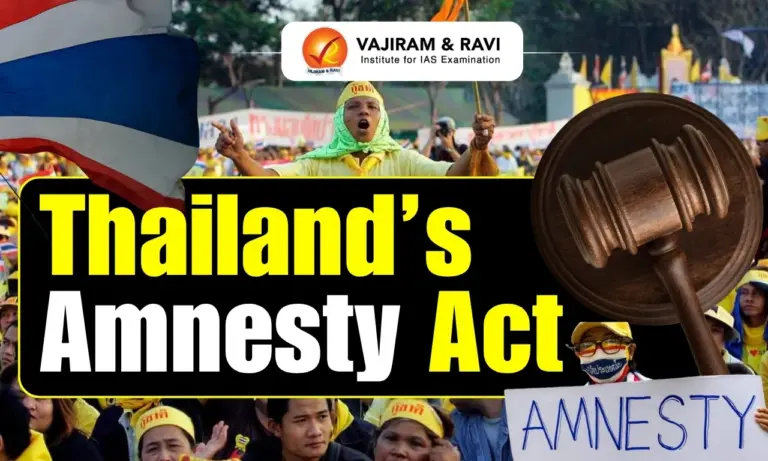
Thailand’s Amnesty Act seeks to resolve two decades of political conflict by providing legal relief to thousands of people, but its selective exclusions have raised concerns about genuine reconciliation.
About Thailand’s Amnesty Act
Thailand’s Amnesty Act, officially called the Peaceful Society Promotion Act, is a law aimed at providing legal relief to people involved in political conflicts, protests and politically motivated offences in Thailand between January 1, 2005 and July 16, 2025. It came into force on August 24, 2026
Thailand’s Amnesty Act Provisions
Major provisions of Thailand’s Amnesty Act are as follows:
- Broad coverage: The Act covers more than 40 categories of offences connected with political conflicts. These include charges related to protests and political expression, as well as serious offences such as sedition, rebellion, cybercrimes and violations of emergency regulations.
- Cases at different stages: The relief is not limited to people who have already been convicted. It can also apply to cases that are under investigation, under prosecution or pending before courts.
- Termination of legal proceedings: Where a person is found eligible, ongoing investigations and prosecutions can be brought to an end, while pending court cases can be dismissed.
- Release from imprisonment: People already serving sentences for eligible political offences can receive relief, including termination of their sentences and release from prison.
- Removal of criminal records: The Act also allows the criminal records of eligible persons to be cleared, reducing the long-term consequences of politically related cases.
- Committee-based implementation: A Peaceful Society Promotion Committee will examine the cases and determine who qualifies for amnesty. The committee is to be formed within one month of the Act coming into force and will be headed by the Prime Minister or a Deputy Prime Minister, with participation from Parliament, human rights experts and civil society representatives.
- Case-by-case assessment: The amnesty is not an automatic blanket pardon. Each case must be examined according to the conditions of the Act before legal relief is granted.
- Important exclusions: The Act does not cover lèse-majesté offences under Article 112, corruption, murder or offences causing serious bodily harm. Certain offences against private entities are also excluded depending on the circumstances.


What is Article 112?
Article 112 of Thailand’s Criminal Code is the country’s lese-majesté provision.
It criminalises defamation, insult or threats against the King, Queen, heir-apparent or regent.
The provision has become particularly controversial because pro-democracy activists have faced prosecution under it during recent political protests.
Thailand’s Amnesty Act Significance
Thailand’s New Amnesty Act is significant because it seeks to address nearly two decades of political conflict by ending criminal proceedings, releasing eligible prisoners and clearing criminal records. It can help reduce political tensions, promote reconciliation and reintegrate people affected by past political conflicts into society. However, the exclusion of Article 112 cases limits its potential to achieve broad and inclusive reconciliation.
Thailand’s Amnesty Act Shortcomings
- Exclusion of Article 112: Thailand’s new Amnesty Act excludes Article 112, the lese-majesté provision that criminalises defamation, insult or threats against the King, Queen, heir-apparent or regent.
- Impact on pro-democracy activists: Many activists prosecuted under Article 112, particularly those associated with recent pro-democracy protests, will remain outside the amnesty.
- Exclusion of minors: A proposal to grant amnesty to people who were under 18 when they committed an Article 112 offence was rejected, raising concerns about juvenile justice and rehabilitation.
- Selective reconciliation: Critics argue that the Act provides relief to several political groups while excluding people facing Article 112 charges, making reconciliation incomplete and selective.
- Election-related offences: The inclusion of certain election-fraud offences has raised concerns that individuals involved in electoral collusion could also benefit from the amnesty.
- Risk of impunity: A broad amnesty may help political reconciliation, but it can also weaken accountability if serious criminal or electoral offences are treated as political offences.

 Last updated on August, 2026
→ UPSC Mains Question Paper 2026 is out now for Essay & GS Paper 1, 2, 3 & 4.
→ UPSC Mains GS Paper 1 2026 is out now.
→ UPSC Mains GS Paper 2 2026 is out now.
→ UPSC Mains GS Paper 3 2026 is out now.
→ UPSC Mains GS Paper 4 2026 is out now.
→ UPSC Mains Indian Language Paper & English Compulsory Paper are out now.
→ Check out the latest UPSC Syllabus 2026 here.
→ UPSC Mains Admit Card 2026 is now out.
→ Enroll in Vajiram & Ravi’s UPSC Mains Test Series 2027 for structured answer writing practice, expert evaluation, and exam-oriented feedback.
→ Join Vajiram & Ravi’s UPSC Mentorship Program 2027 for personalized guidance, strategy planning, and one-to-one support from experienced mentors.
→ Go through the UPSC Mains Previous Year Papers to enhance your preparation.
→ Download UPSC Mains Essay Paper 2025, UPSC Mains GS Paper-I 2025, UPSC Mains GS Paper-II 2025, UPSC Mains GS Paper-III 2025, UPSC Mains GS Paper-IV 2025, UPSC Mains English (Compulsory) Paper 2025, UPSC Mains Hindi (Qualifying) Paper 2025 here.
→ UPSC has released UPSC Toppers List 2025 with the Civil Services final result on its official website.
→ UPSC Calendar 2027 has been released.
→ Also check Best UPSC Coaching in India
Thailand’s Amnesty Act FAQs
Q1. What is Thailand’s Amnesty Act?+
Q2. When did Thailand’s Amnesty Act come into force?+
Q3. What offences are covered under Thailand’s Amnesty Act?+
Q4. How will Thailand’s Amnesty Act be implemented?+
Q5. What relief does Thailand’s Amnesty Act provide?+
Q6. What are the major criticisms of Thailand’s Amnesty Act?+
Tags: thailands amnesty act