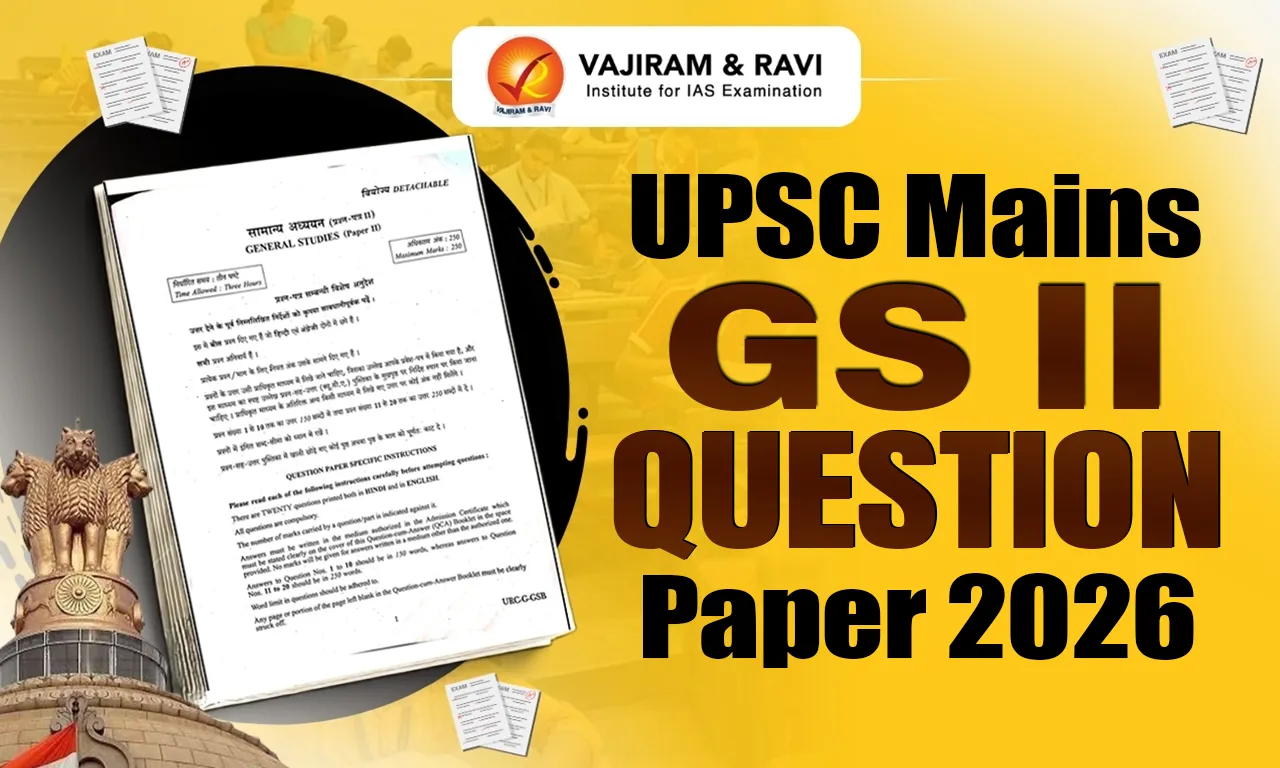
The UPSC Mains GS 2 Question Paper 2026 was conducted on August 22, 2026, in the afternoon session from 2:30 PM to 5:30 PM. As Paper-III of the Civil Services (Main) Examination 2026, GS 2 covered areas such as Indian Polity, Constitution, Governance, Social Justice and International Relations. Candidates can now download the question paper PDF and analyse the difficulty level, question pattern, syllabus coverage and important themes asked in the paper.
UPSC Mains GS 2 Question Paper 2026 PDF Download
The UPSC Mains GS 2 Question Paper 2026 PDF is available for candidates to download after the examination has been conducted on August 22, 2026. Candidates can download the PDF from the link provided below.
Also Read: UPSC Mains Model Answers 2026
Answers to Questions No. 1 to 10 should be in 150 words, whereas answers to Questions No. 11 to 20 should be in 250 words.
Q1. स्व-अभिनिर्धारण से सम्बन्धित निजता का अधिकार प्रत्येक व्यक्ति को प्रिय है तथा संविधान के अनुच्छेद 21 में भली-भाँति संरक्षित है। इस संदर्भ में, उभयलिंगी (ट्रांसजेंडर) व्यक्ति (अधिकारों का संरक्षण) अधिनियम, 2019 में 2026 के संशोधन के प्रभाव का परीक्षण कीजिए।
Right to privacy relating to self-identity is very dear to every human being and well protected under Article 21 of the Constitution. In this context, examine the effect of the amendment in 2026, to the Transgender Persons (Protection of Rights) Act, 2019. (Answer in 150 words)
Q2. “एकवर्ग के रूप में महिलाएँ न तो किसी अल्पसंख्यक समूह का अंग हैं और न ही वे पिछड़ा वर्ग बनाती मानी जाती हैं।” इस कथन के प्रकाश में,स्थानीय निकायों से संसद तक में महिला आरक्षण के क्रमिक विकास की विवेचना कीजिए ।
"Women as a class neither belong to a minority group nor are they regarded as forming a backward class." In the light of this statement, discuss the evolution of women's reservation from local bodies to Parliament. (Answer in 150 words)
Q3. वर्तमान दल बदल विरोधी व्यवस्था के अंतर्गत क्या लोकसभा अध्यक्ष का संवैधानिक पद दलगत राजनीति के कारण अतिसंवेदनशील हो गया है ? परीक्षण कीजिए। ध्रुवीकृत सदन के प्रबंधन में लोकसभा अध्यक्ष की निष्पक्षता को सुनिश्चित करने में किन संस्थागत परिवर्तनों की आवश्यकता है ?
Examine whether the constitutional office of the Lok Sabha Speaker has become vulnerable to partisan politics under the current anti-defection regime. What institutional changes are required to ensure the neutrality of the Lok Sabha Speaker in managing a polarised House? (Answer in 150 words)
Q4. क्या मताधिकार एक मौलिक अधिकार है ? निर्वाचक नामावली का पुनरीक्षण करते हुए भारत के निर्वाचन आयोग की प्रस्थिति की विवेचना कीजिए । क्या यह निर्वाचकों की नागरिकता के प्रश्न का भी परीक्षण कर सकता है ?
Is the right to vote a fundamental right? Discuss the position of the Election Commission of India while undertaking the revision of electoral rolls. Can it also examine the question of citizenship of voters? (Answer in 150 words)
Q5. वास्तविक सामाजिक समानता को सुरक्षित करने में राष्ट्रीय अनुसूचित जाति आयोग (NCSC) एवं राष्ट्रीय अनुसूचित जनजाति आयोग (NCST) जैसे संवैधानिक निकायों के पास क्या पर्याप्त प्रवर्तन शक्तियाँ हैं ? इनकी संस्थागत प्रभावशीलता को बढ़ाने हेतु उपायों को सुझाएँ।
Do constitutional bodies like the National Commission for Scheduled Castes (NCSC) and the National Commission for Scheduled Tribes (NCST) possess adequate enforcement powers to secure substantive social equality? Suggest measures to enhance their institutional effectiveness. (Answer in 150 words)
Q6. क्या भारत की जनजातीय विकास नीति सामाजिक आधार वाली और समतामूलक शासन की आकांक्षाओं को प्रतिबिंबित करती है ? अपने उत्तर के औचित्य को स्पष्ट कीजिए।
Does India's tribal development policy reflect the aspirations for a socially grounded and equity-based governance ? Justify your answer. (Answer in 150 words)
Q7. भारत में कुपोषण मात्र एक सार्वजनिकस्वास्थ्य समस्या नहीं है, बल्कि यह सामाजिक समता, मानव विकास एवं प्रभावी कल्याणकारी शासन के समक्ष भी एक गंभीर चुनौती है। विवेचना कीजिए।
Malnutrition in India is not merely a public health concern; it is also a challenge of social equity, human development and effective welfare governance. Discuss. (Answer in 150 words)
Q8. समकालीन शासन व्यवस्था में भारतीय सिविल सेवाओं की सामान्यज्ञ संरचना के लाभों और सीमाओं का विश्लेषण कीजिए।
Analyse the advantages and limitations of the generalist structure of the Indian Civil Services in contemporary governance.
(Answer in 150 words)
Q9. “आई.पी.एम.डी.ए. (इंडो-पैसिफिक पार्टनरशिप फॉर मैरीटाइम डोमेन अवेयरनेस) के लिए साझेदारी भारत के SAGAR (सेक्योरिटी एंड ग्रोथ फॉर ऑल इन द रीजन) दृष्टिकोण और क्वाड (Quad) की सामूहिक इंडो-पैसिफिक रणनीति के बीच कीखाई को पाटती है।” आई.पी.एम.डी.ए.पर केंद्रित रहते हुए इस कथन का समालोचनात्मक मूल्यांकन कीजिए।
“IPMDA (Indo-Pacific Partnership for Maritime Domain Awareness) bridges the gap between India's SAGAR (Security and Growth for All in the Region) vision and the Quad's collective Indo-Pacific strategy." Make a critical assessment of the statement focusing on IPMDA. (Answer in 150 words)
Q10. “ब्रिक्स (BRICS) वैश्विक शासन में एक शक्तिशाली संतुलनकारी शक्ति के रूप में कार्य करता है, जो वैश्विक दक्षिण की आवाज़ और प्रभाव को सक्रिय रूप से प्रबल बनाता है।” ब्रिक्स (BRICS) की भूमिका को समझाइए कि वह स्वयं को अन्य समूहों के विकल्प के रूप में कैसे प्रस्तुत करता है ?
"BRICS acts as a powerful counterweight in global governance, actively amplifying the voice and influence of the Global South." Explain the role of BRICS in projecting itself as an alternative to other groupings. (Answer in 150 words)
Q11. भारत की संघीय राज-व्यवस्था में राज्यपाल की स्थिति की विवेचना कीजिए । राज्य विधायिका द्वारा पारित विधेयक पर अनुमति देते समय उसकी शक्ति की प्रकृति कैसी है ? क्या वह अपने सभी कार्यों में अपनी मंत्रिपरिषद की सहायता व सलाह से बाध्य है ?
Discuss the position of the Governor in the federal polity of India. What is the nature of his power while giving assent to a bill passed by the State Legislature? Is he bound by the aid and advice of his Council of Ministers in all his functions? (Answer in 250 words)
Q12. न्यायिक विधान से क्या तात्पर्य है ? इसके संदर्भ में, उच्चतम न्यायालय द्वारा “निष्क्रिय इच्छामृत्यु” तथा “अग्रिम-चिकित्सा निर्देश का इच्छापत्र” को अनुमति देने वाले निर्णयों की विवेचना कीजिए ।
What is meant by judicial legislation? In this context, discuss the verdicts of the apex court allowing "passive euthanasia" and a "living will". (Answer in 250 words)
Q13. भारतीय संघीय ढाँचा कहाँ तक क्षेत्रीय एवं सांस्कृतिक विविधताओं को समायोजित करने में सफल रहा है ? असमान संघवाद की भूमिका पर प्रकाश डालिए एवं विवाद समाधान के तंत्र को और अधिक प्रभावी बनाने के लिए उपायों को सुझाइए।
How far has the Indian federal framework been successful in accommodating regional and cultural diversities? Highlight the role of asymmetric federalism and suggest measures to make dispute resolution mechanisms more effective.
(Answer in 250 words)
Q14. भारत में शक्ति पृथक्करण को संयुक्त राज्य अमेरिका के कठोर अध्यक्षीय मॉडल की तुलना में कैसे व्यवहार में लाया जा रहा है, परीक्षण कीजिए। इस प्रसंग में, भारतीय प्रधानमंत्री की वास्तविक सत्ता की संयुक्त राज्य अमेरिका के राष्ट्रपति से तुलना कीजिए।
Examine how the separation of powers is practised in India compared to the rigid presidential model of the United States of America. In this context, compare the actual authority of the Indian Prime Minister with that of the President of the USA. (Answer in 250 words)
Q15. दबाव समूह, सामाजिक आंदोलन एवं कॉर्पोरेट लॉबी किस सीमा तक बहिष्कृत हितों का प्रतिनिधित्व करते हुए भारत में बहुलवादी लोकतंत्र को गहराई प्रदान कर रहे हैं ? कॉर्पोरेट सम्पदा एवं राजनीतिक शक्ति के बढ़ते हुए गठजोड़ से क्या औपचारिक लोकतांत्रिक संस्थाओं की स्वायत्तता को ख़तरा उत्पन्न हो रहा है ? विश्लेषण कीजिए।
To what extent do pressure groups, social movements and corporate lobbies deepen pluralistic democracy in India by representing excluded interests ? Analyse whether the growing convergence of corporate wealth and political power poses a threat to the autonomy of formal democratic institutions. (Answer in 250 words)
Q16. "शासन में पारदर्शिता और जवाबदेही का उद्देश्य केवल भ्रष्टाचार को नियंत्रित करना नहीं है, बल्कि विधि के शासन (Rule of Law) और सहभागितापूर्ण शासन (Participatory Governance) का पालन करके नीति निर्माण प्रक्रिया में हितधारकों का विश्वास स्थापित करना है।" टिप्पणी कीजिए।
"Transparency and accountability in governance are not about controlling corruption but about creating the trust of stakeholders in the policy process by following the Rule of Law and Participatory Governance." Comment.
Q17. क्या अधिकार-आधारित कल्याण के संवैधानिक दायित्व को गैर-एकीकृत शासन और न्यूनतम सार्वजनिक निवेश की स्थिति में प्रभावी रूप से साकार किया जा सकता है ? परीक्षण कीजिए।
Can the constitutional mandate of rights-based welfare be effectively realised in the context of non-integrated governance and minimal public investment? Examine. (Answer in 250 words)
Q18. क्या शिक्षा को मुख्यत: राज्य की कल्याणकारी ज़िम्मेदारी के रूप में देखा जाना चाहिए या एक वैश्विक प्रतिस्पर्धी, ज्ञान-आधारित राष्ट्र के निर्माण हेतु रणनीतिक निवेश के रूप में ? समालोचनात्मक मूल्यांकन कीजिए ।
Should education be treated primarily as a welfare obligation of the state or as a strategic investment for building a globally competitive, knowledge-driven nation? Critically evaluate. (Answer in 250 words)
Q19. “भारत का वैश्विक प्रवासी समुदाय एक जीवंत सेतु की तरह कार्य करता है, वह एक महत्त्वपूर्ण आर्थिक कारक और ज्ञान-तंत्र भी है, जो सांस्कृतिक विरासत को विश्वभर में भू-राजनीतिक प्रभाव और रणनीतिक सामर्थ्य में रूपांतरित करता है।” इस कथन का समालोचनात्मक परीक्षण कीजिए।
"India's global diaspora acts as a living bridge, as a critical economic factor and knowledge network in transforming cultural heritage into geopolitical influence and strategic leverage worldwide." Critically examine this statement. (Answer in 250 words)
Q20. 'चीन के बेल्ट एंड रोड इनिशिएटिव (BRI) ने दक्षिण एशिया को एक क्षेत्रीय भू-क्षेत्र से बदलकर महाशक्तियों की प्रतिस्पर्धा के रंगमंच में परिवर्तित कर दिया है।" दक्षिण एशिया में भारत की सुरक्षा और क्षेत्रीय प्रभाव पर BRI के रणनीतिक प्रभावों का विश्लेषण कीजिए।
China's Belt and Road Initiative (BRI) has transformed South Asia from a regional space into a theatre of great power competition.” Analyse the strategic implications of the BRI for India’s security and regional influence in South Asia. (Answer in 250 words)
How to Download UPSC Mains 2026 GS 2 Question Paper PDF?
Candidates can easily download the UPSC Mains GS 2 Question Paper 2026 PDF from the official UPSC website by following the steps given below:
- Visit the official UPSC website: Open the Union Public Service Commission's official website at upsc.gov.in.
- Go to the Examination section: From the homepage, navigate to the Examinations section to access examination-related information.
- Open Previous Question Papers: Click on the Previous Question Papers option, where UPSC provides question papers for various examinations.
- Select Civil Services (Main) Examination 2026: Find the section for Civil Services (Main) Examination 2026 from the list of available examinations.
- Find the GS 2 Question Paper: Look for General Studies Paper-II (GS 2), which was conducted as Paper-III on August 22, 2026, in the afternoon session.
- Click on the PDF link: Select the relevant link to open the official UPSC Mains GS 2 Question Paper 2026 PDF.
- Download the question paper: Once the PDF opens, click the Download option and save the question paper on your device.
Also Check:
- UPSC Mains GS 1 Question Paper 2026
- UPSC Mains GS 3 Question Paper 2026
- UPSC Mains GS 4 Question Paper 2026


How to Analyse the UPSC Mains 2026 GS 2 Question Paper?
Candidates can analyse the UPSC Mains 2026 GS 2 Question Paper by reviewing the questions based on syllabus coverage, difficulty level, current affairs linkage and the type of analytical approach required. The following points can help in a systematic analysis:
- Check the difficulty level: Classify the paper as easy, moderate or difficult based on the nature and complexity of the questions.
- Analyse syllabus coverage: Identify which areas of Indian Polity, Constitution, Governance, Social Justice and International Relations have been covered.
- Identify current affairs linkage: Note questions that are directly or indirectly connected with recent national and international developments.
- Assess static vs dynamic questions: Determine the balance between questions based on static concepts and those requiring current examples and contemporary developments.
- Analyse question demand: Check whether questions require you to explain, analyse, critically examine, discuss, evaluate or comment.
- Check topic-wise weightage: Group questions under Polity, Governance, Constitution, Social Justice and International Relations to understand which areas received greater importance.
- Compare with previous years: Compare the 2026 paper with previous GS 2 papers to identify repeated themes, changing trends and newly emphasised topics.
- Evaluate answer requirements: Identify the type of constitutional provisions, Supreme Court judgments, government schemes, committees, reports and examples that could strengthen answers.
- Assess time management: Review whether the questions could have been completed within the three-hour examination duration and identify questions that may have consumed more time.
- Identify important themes: Make a list of topics that received significant attention, as these can help candidates understand the changing focus of the examination and prepare more effectively for future attempts.

 Last updated on Oct, 2026
→ UPSC 2027 Notification will be released on 13 January 2027 at upsconline.nic.in.
→ Asian Games 2026 are being held in Aichi-Nagoya, Japan, from 19 September to 4 October.
→ Check Nobel Prize 2026 Winners List here.
→ Download PIB PRiSM Monthly Magazine 2026 here.
→ Check UPSC Monthly Current Affairs Magazine The Recitals here.
→ Check out the latest UPSC Syllabus here.
→ Download UPSC Model Answers for Mains 2026
→ UPSC Mains Question Paper 2026 is out now for Essay & GS Paper 1, 2, 3 & 4.
→ UPSC Calendar 2027 has been released.
→ Enroll in Vajiram & Ravi’s UPSC Mains Test Series 2027 for structured answer writing practice, expert evaluation, and exam-oriented feedback.
→ Join Vajiram & Ravi’s UPSC Mentorship Program 2027 for personalized guidance, strategy planning, and one-to-one support from experienced mentors.
→ Go through the UPSC Mains Previous Year Papers to enhance your preparation.
→ UPSC has released UPSC Toppers List 2025 with the Civil Services final result on its official website.
→ Also check Best UPSC Coaching in India
UPSC Mains GS 2 Question Paper 2026 FAQs
Q1. When was the UPSC Mains GS 2 Question Paper 2026 conducted?+
Q2. What was the duration of the UPSC Mains GS 2 Paper 2026?+
Q3. What subjects are covered in UPSC Mains GS 2?+
Q4. Is the UPSC Mains GS 2 Question Paper 2026 PDF available?+
Q5. How can I download the UPSC Mains GS 2 Question Paper 2026 PDF?+
Q6. How can candidates analyse the GS 2 Question Paper 2026?+
Tags: gs 2 question paper 2026 pdf upsc mains gs 2 question paper upsc mains gs 2 question paper 2026