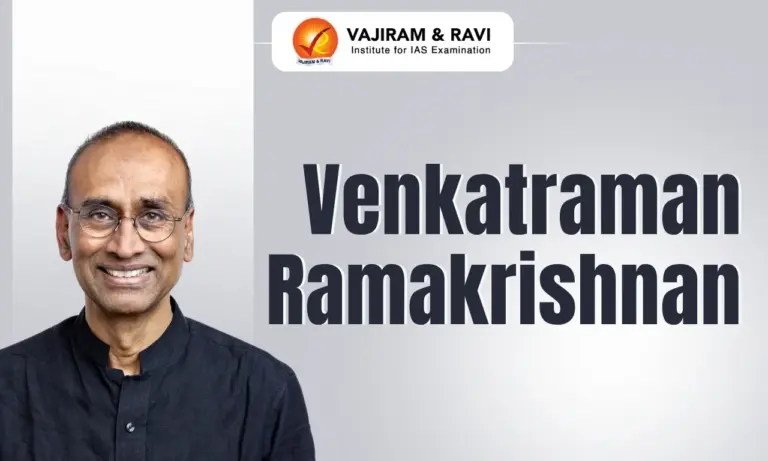
Venkatraman Ramakrishnan is an Indian-born American-British structural biologist who received the 2009 Nobel Prize in Chemistry jointly with Thomas A. Steitz and Ada E. Yonath for their studies on the structure and function of the ribosome. His scientific journey is notable for his transition from physics to biology and his pioneering work in understanding the ribosome at the atomic level.
Venkatraman Ramakrishnan Biography
Venkatraman Ramakrishnan was born in 1952 in Chidambaram, Tamil Nadu, an ancient temple town known for the Nataraja Temple. His father, C. V. Ramakrishnan, was a scientist, while his mother, R. Rajalakshmi, taught at Annamalai University. During his childhood, his family spent periods in India and abroad because of his parents’ academic and research commitments.
Ramakrishnan initially pursued physics, but his scientific interests gradually shifted towards biology. This transition ultimately led him to the study of ribosomes, one of the most important molecular machines in living cells.
Venkatraman Ramakrishnan Education
Ramakrishnan completed his Bachelor’s degree in Physics from Baroda University in 1971. He later moved to the United States and obtained a PhD in Physics from Ohio University in 1976.
After completing his doctorate, he recognised that he needed a stronger foundation in biology to pursue the questions that interested him. He therefore spent about two years studying biology at the University of California, San Diego.
This change in academic direction became an important turning point in his career. Rather than remaining confined to one discipline, he combined knowledge from physics, biology, biophysics and structural biology.


From Physics to the Study of Ribosomes
Ramakrishnan’s interest in ribosomes began during his postdoctoral work at Yale University in the laboratory of Peter Moore in the late 1970s. He joined the ribosome research project in 1978, beginning a scientific journey that would eventually lead to the Nobel Prize.
At Yale, he learned specialised techniques for working with ribosomes, including their purification, reconstitution and analysis. These methods later became extremely valuable when his research group began attempting to determine the structure of the ribosomal subunit.
What Is a Ribosome?
A ribosome is a complex molecular structure found in all living cells that is responsible for protein synthesis. It reads the genetic information carried by messenger RNA (mRNA) and uses it to assemble amino acids into proteins. Ribosomes consist mainly of ribosomal RNA (rRNA) and proteins and have two subunits that work together during translation. They are also important targets for several antibiotics, which inhibit bacterial protein synthesis.
Venkatraman Ramakrishnan Major Achievements
Venkatraman Ramakrishnan has made major contributions to structural biology, particularly in understanding the structure and function of ribosomes and their role in protein synthesis.
- Nobel Prize in Chemistry (2009) – Awarded jointly with Thomas A. Steitz and Ada E. Yonath for studies of the structure and function of the ribosome.
- 30S Ribosomal Subunit – Determined the atomic structure of the 30S ribosomal subunit, providing insights into genetic decoding and protein synthesis.
- Ribosome Research – Advanced understanding of the molecular mechanisms of translation and ribosomal function.
- Antibiotic Research – Revealed how antibiotics interact with the ribosome, contributing to understanding their mechanism of action.
- Royal Society – Served as President of the Royal Society from 2015 to 2020.
- Louis-Jeantet Prize for Medicine – Received the prestigious Louis-Jeantet Prize for Medicine in 2007.

 Last updated on August, 2026
→ UPSC Mains Question Paper 2026 is out now for Essay & GS Paper 1, 2, 3 & 4.
→ UPSC Mains GS Paper 1 2026 is out now.
→ UPSC Mains GS Paper 2 2026 is out now.
→ UPSC Mains GS Paper 3 2026 is out now.
→ UPSC Mains GS Paper 4 2026 is out now.
→ UPSC Mains Indian Language Paper & English Compulsory Paper are out now.
→ Check out the latest UPSC Syllabus 2026 here.
→ UPSC Mains Admit Card 2026 is now out.
→ Enroll in Vajiram & Ravi’s UPSC Mains Test Series 2027 for structured answer writing practice, expert evaluation, and exam-oriented feedback.
→ Join Vajiram & Ravi’s UPSC Mentorship Program 2027 for personalized guidance, strategy planning, and one-to-one support from experienced mentors.
→ Go through the UPSC Mains Previous Year Papers to enhance your preparation.
→ Download UPSC Mains Essay Paper 2025, UPSC Mains GS Paper-I 2025, UPSC Mains GS Paper-II 2025, UPSC Mains GS Paper-III 2025, UPSC Mains GS Paper-IV 2025, UPSC Mains English (Compulsory) Paper 2025, UPSC Mains Hindi (Qualifying) Paper 2025 here.
→ UPSC has released UPSC Toppers List 2025 with the Civil Services final result on its official website.
→ UPSC Calendar 2027 has been released.
→ Also check Best UPSC Coaching in India
Venkatraman Ramakrishnan FAQs
Q1. Who is Venkatraman Ramakrishnan?+
Q2. When did Venkatraman Ramakrishnan receive the Nobel Prize?+
Q3. Why did Venkatraman Ramakrishnan receive the Nobel Prize?+
Q4. Why are ribosomes important?+
Q5. What is the importance of Ramakrishnan's work?+
Tags: venkatraman ramakrishnan