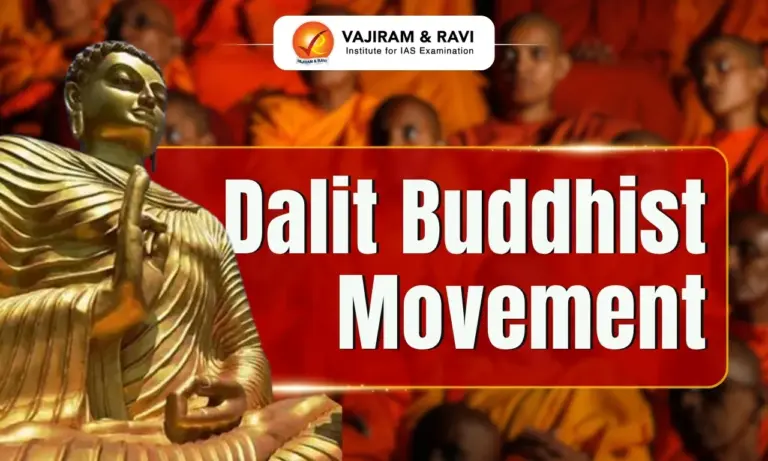
Dalit Buddhist Movement was a major anti-caste movement in modern India that sought social equality, dignity and freedom from caste-based discrimination through the adoption and reinterpretation of Buddhism.
What is the Dalit Buddhist Movement?
Dalit Buddhist Movement was an anti-caste movement led by Dr. B.R. Ambedkar, in which conversion to Buddhism became a means of rejecting caste-based inequality and asserting dignity, equality and a new social identity.
Dalit Buddhist Movement Causes
The Dalit Buddhist Movement emerged from the deep-rooted caste system and the continued practice of untouchability, which denied Dalits equality, dignity and social freedom. These conditions created the need to challenge the existing social order and search for an alternative based on equality. The major causes were:
- Caste-based hierarchy: The hereditary caste system placed Dalits at the bottom of the social order. This created the basic demand for a social system based on equality rather than birth.
- Practice of untouchability: Restrictions on access to temples, public places and other aspects of social life subjected Dalits to humiliation and exclusion. This created a strong desire to break away from the social order that sustained such practices.
- Denial of human dignity: Continuous discrimination treated Dalits as socially inferior and affected their self-respect. The search for dignity therefore became an important motivation for seeking a new social identity through conversion.
- Caste-based religious justification: Ambedkar believed that caste was supported by certain religious texts and practices. This led him to question whether equality could be achieved without moving away from the religious framework that he believed sustained caste.
- Failure of internal reform: Efforts to secure equal rights within Hindu society did not bring the fundamental destruction of caste that Ambedkar sought. This strengthened the argument that a more radical alternative was necessary.
- Need to escape the stigma of untouchability: Being identified as “untouchable” carried a deep social stigma. Conversion provided a means of rejecting this imposed identity and developing a new identity based on equality and self-respect.
- Search for an egalitarian religion: The continuing experience of caste discrimination created a need for a religious framework that recognised equal human worth. This encouraged Ambedkar and his followers to look beyond Hinduism for an alternative.
- Appeal of Buddhism: In Ambedkar’s interpretation, Buddhism emphasised prajna (understanding), karuna (compassion) and samata (equality). These principles made Buddhism an attractive alternative for those seeking a more egalitarian social order.
- Demand for social liberation: The movement was not driven by religious conversion alone but by the desire for social, economic and religious freedom. This transformed conversion into a broader movement for Dalit emancipation.


Role of Ambedkar in the Dalit Buddhist Movement
Ambedkar provided the ideological, organisational and mass leadership that transformed the search for religious freedom into a wider movement against caste.
- By the 1930s, Ambedkar increasingly argued that caste could not be destroyed through reform alone. The Yeola Declaration of 1935, where he stated that he would not die a Hindu, marked a decisive move towards conversion and a new religious identity based on equality.
- Ambedkar studied Buddhism along with other religious traditions and concluded that Buddhism offered a suitable basis for equality, reason, morality and social justice. He gave Buddhist teachings a modern interpretation centred on liberty, equality and fraternity, later associated with Navayana.
- In 1955, Ambedkar established the Bharatiya Bauddha Mahasabha to organise and promote the Buddhist movement. He also prepared The Buddha and His Dhamma to present his interpretation of Buddhism in an accessible form.
- On 14 October 1956, Ambedkar converted to Buddhism at Deekshabhoomi, Nagpur, along with a large number of followers. He first accepted the Three Refuges and Five Precepts and then administered them to his followers, followed by the 22 Vows. The conversion gave the anti-caste struggle a new collective religious identity.
- Ambedkar reinterpreted Buddhism as a path of social emancipation, giving greater emphasis to equality, liberty, fraternity, reason and social justice. This distinct interpretation came to be known as Navayana or the “New Vehicle”.
Navayana or “New Vehicle” Buddhism
Navayana, meaning the “New Vehicle”, was Ambedkar’s reinterpretation of Buddhism as a path of social emancipation and equality.
- Ambedkar rejected the idea of religion as a system of rigid rules and rituals and emphasised Dhamma as a moral way of life.
- He gave central importance to prajna (reason/understanding), karuna (compassion) and samata (equality).
- He connected Buddhist principles with the ideals of liberty, equality and fraternity, making Buddhism relevant to the struggle against caste.
Navayana therefore became more than a religious identity. It provided an ethical and social framework for challenging caste and achieving collective emancipation.
Dalit Buddhist Movement after Ambedkar
Ambedkar died on 6 December 1956, only a few weeks after his conversion. His sudden death affected the organisational development of the movement. After Ambedkar’s death in 1956, the movement lost the leadership that had given it a clear ideological and organisational direction.
- After Ambedkar’s death, the movement continued mainly in Maharashtra and later gained a foothold in parts of Uttar Pradesh
- The movement gradually became linked with wider Dalit assertion. Organisations such as the Dalit Panthers and the Bahujan Samaj Party drew upon Ambedkarite ideas, while leaders such as Kanshi Ram also used the possibility of conversion as a means of challenging caste-based social structures.
By the late twentieth century, therefore, the movement had survived less as a single organised conversion campaign and more as an important source of Dalit identity, political consciousness and anti-caste mobilisation. However, its influence remained uneven and did not produce the broad social transformation that Ambedkar had envisaged.
Dalit Buddhist Movement Significance
The Dalit Buddhist Movement was significant because it took the struggle against caste beyond demands for reform and gave it a new religious, social and political direction. Its importance can be seen in the following ways:
- Break from caste-based social order: Conversion gave Dalits a way to distance themselves from a social order that treated them as untouchable and to adopt a religious identity centred on equality and dignity.
- From reform to social liberation: Ambedkar moved from trying to secure equality within Hindu society to questioning the social order itself. Conversion therefore became a means of seeking social, economic and religious freedom.
- A new form of Buddhism: Ambedkar reinterpreted Buddhism through the ideas of prajna (reason), karuna (compassion) and equality, giving it a strong focus on social justice and human emancipation.
- Strengthened Dalit assertion: The movement gave many Dalits a stronger sense of collective identity and political consciousness. It helped bring questions of caste, dignity and equal rights more firmly into public and political debate.
- Revival of Buddhism: The Nagpur conversion of 1956 gave a major impetus to the revival of Buddhism in modern India, particularly in Maharashtra and parts of Uttar Pradesh.
- Influence on later Dalit movements: The new identity and political consciousness created by the movement influenced subsequent forms of Dalit mobilisation and strengthened demands for social and political empowerment.
Dalit Buddhist Movement Limitations
The movement brought a new sense of identity and assertion, but its reach and long-term social impact remained limited.
- Limited social reach: It remained concentrated mainly among sections of Dalits in Maharashtra and Uttar Pradesh.
- Caste did not disappear: Conversion changed religious identity, but caste-based divisions and discrimination continued.
- Limited economic impact: It improved social and political consciousness more than the material conditions of the wider Dalit population.
- Weak organisational consolidation: Ambedkar’s death soon after the 1956 conversion affected the movement’s further organisation and expansion.
- No pan-Indian mobilisation: The movement did not develop into a sustained, nationwide force among all Dalit communities.
- Uneven impact: Its strongest gains were in identity, self-respect and political consciousness, rather than in wider social and economic transformation.

 Last updated on Oct, 2026
→ UPSC 2027 Notification will be released on 13 January 2027 at upsconline.nic.in.
→ Check Nobel Prize 2026 Winners List here.
→ Download PIB PRiSM Monthly Magazine 2026 here.
→ Check UPSC Monthly Current Affairs Magazine The Recitals here.
→ Check out the latest UPSC Syllabus here.
→ Download UPSC Model Answers for Mains 2026
→ UPSC Mains Question Paper 2026 is out now for Essay & GS Paper 1, 2, 3 & 4.
→ UPSC Calendar 2027 has been released.
→ Enroll in Vajiram & Ravi’s UPSC Mains Test Series 2027 for structured answer writing practice, expert evaluation, and exam-oriented feedback.
→ Join Vajiram & Ravi’s UPSC Mentorship Program 2027 for personalized guidance, strategy planning, and one-to-one support from experienced mentors.
→ Go through the UPSC Mains Previous Year Papers to enhance your preparation.
→ UPSC has released UPSC Toppers List 2025 with the Civil Services final result on its official website.
→ Also check Best UPSC Coaching in India
Dalit Buddhist Movement in India FAQs
Q1. What is the Dalit Buddhist Movement?+
Q2. Who started the Dalit Buddhist Movement in India?+
Q3. When did Ambedkar convert to Buddhism?+
Q4. What is Navayana Buddhism?+
Q5. What was the significance of the Dalit Buddhist Movement?+
Tags: dalit buddhist movement