Shanghai Cooperation Organisation Latest News
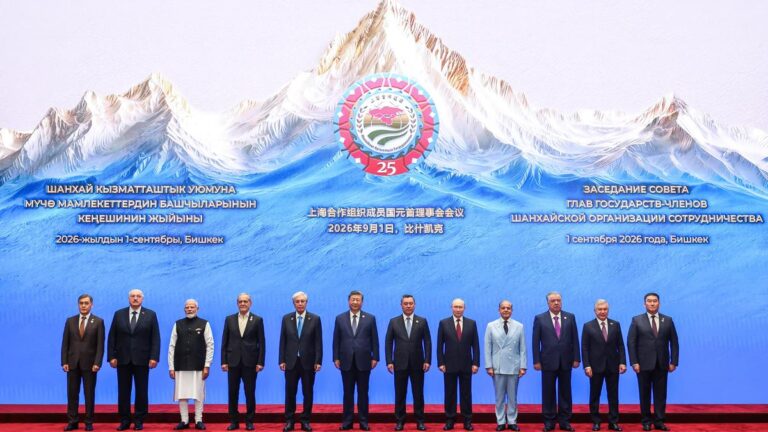
- The 26th Summit of the Shanghai Cooperation Organisation (SCO) was held in Bishkek, Kyrgyz Republic, on August 31-September 1, 2026. The summit marked 25 years of the organisation, which was established in 2001.
Shanghai Cooperation Organisation: Background
- The SCO originated from the Shanghai Five, comprising China, Russia, Kazakhstan, Kyrgyzstan and Tajikistan.
- The grouping was formally established as the SCO on June 15, 2001.
- India and Pakistan became full members in 2017, expanding the organisation’s geographical and strategic significance.
- The SCO does not have a collective defence mechanism. Instead, it functions as a platform for political dialogue, security cooperation, counter-terrorism, economic engagement and regional coordination.
- The organisation currently operates through 29 charter bodies and more than 40 working mechanisms, providing regular channels for interaction among member states.


Key Areas of SCO Cooperation
- Counter-Terrorism and Security
- Countering terrorism, separatism and extremism remains a central objective of the SCO.
- At the Bishkek Summit, the declaration strongly condemned terrorism. This was particularly significant for India, which has consistently advocated a zero-tolerance approach to terrorism and opposed double standards in counter-terrorism efforts.
- India also highlighted the importance of peace and stability in Afghanistan and called for an inclusive government in the country.
- West Asian Conflicts
- The Bishkek Declaration expressed deep concern over military strikes against Iran and reaffirmed support for Iran’s sovereignty and territorial integrity.
- The SCO also emphasised the peaceful use of atomic energy, supporting the inalienable right of states to develop nuclear energy for peaceful purposes.
- On the Palestine issue, member states stated that a just settlement of the Palestine question was essential for lasting stability in West Asia.
- Connectivity and Sovereignty
- India supported greater connectivity between markets of SCO member states, while emphasising respect for sovereignty and territorial integrity.
- This position is significant because India has consistently opposed the China-Pakistan Economic Corridor (CPEC) due to its passage through Pakistan-occupied territory.
- The SCO declaration supported the Belt and Road Initiative (BRI) and advocated its alignment with the Eurasian Economic Union. India, however, did not endorse the BRI.
News Summary: India’s Engagement with the SCO
- India has used the SCO as an important platform for pursuing its diplomatic and strategic objectives since joining in 2017.
- At the Bishkek Summit, Prime Minister Modi emphasised “no double standards” in fighting terrorism and highlighted India’s humanitarian assistance to Afghanistan. India’s position on connectivity also reflected its emphasis on territorial sovereignty.
- The summit was particularly important because Pakistan assumed the chairmanship of the SCO, with the next summit scheduled to be held in Pakistan.
- India’s participation will therefore require careful diplomatic consideration given the deterioration in India-Pakistan relations following the Pahalgam terror attack, Operation Sindoor and the subsequent decision regarding the Indus Waters Treaty.
- The SCO nevertheless provides India and Pakistan with a multilateral setting for sustained engagement. Such institutionalised interaction can help prevent bilateral tensions from escalating or spilling over into wider regional instability.
Significance of the SCO for India
- The SCO provides India with access to a multilateral platform involving China, Russia, Iran and Central Asian countries. It enables India to:
- Engage simultaneously with major Eurasian powers.
- Advance cooperation against terrorism and extremism.
- Participate in discussions on Afghanistan and regional security.
- Strengthen economic and connectivity linkages with Central Asia.
- Maintain diplomatic channels with China and Pakistan.
- Engage Russia and Iran within a broader multilateral framework.
- The organisation also provides an avenue for discussing global issues such as international security, missile defence, maritime connectivity and alternative financial mechanisms.
- The proposed establishment of an SCO Development Bank and discussions on greater use of local currencies indicate efforts towards deeper financial and economic cooperation among member states.
Challenges
- The SCO faces structural limitations because its members have significant geopolitical differences.
- India and China continue to have unresolved border issues, while India and Pakistan face deep bilateral tensions.
- Similarly, members have different positions on conflicts such as Ukraine and West Asia. The organisation’s consensus-based functioning can therefore make substantive collective action difficult.
- Nevertheless, the SCO’s survival for 25 years despite these differences demonstrates the continuing relevance of multilateral dialogue and institutionalised engagement.
Conclusion
- The Shanghai Cooperation Organisation has evolved into an important Eurasian multilateral platform.
- For India, its significance lies not only in security cooperation but also in maintaining diplomatic engagement with China, Russia, Iran, Central Asia and Pakistan.
- Despite internal differences, the SCO provides India with strategic space to pursue its interests, advocate counter-terrorism, promote regional connectivity and maintain dialogue in an increasingly fragmented international order.
Source : TH

 Last updated on Sep, 2026
→ UPSC 2027 Notification will be released on 13 January 2027 at upsconline.nic.in.
→ Check out the latest UPSC Syllabus 2026 here.
→ Download UPSC Model Answers for Mains 2026
→ UPSC Mains Question Paper 2026 is out now for Essay & GS Paper 1, 2, 3 & 4.
→ UPSC Calendar 2027 has been released.
→ Enroll in Vajiram & Ravi’s UPSC Mains Test Series 2027 for structured answer writing practice, expert evaluation, and exam-oriented feedback.
→ Join Vajiram & Ravi’s UPSC Mentorship Program 2027 for personalized guidance, strategy planning, and one-to-one support from experienced mentors.
→ Go through the UPSC Mains Previous Year Papers to enhance your preparation.
→ UPSC has released UPSC Toppers List 2025 with the Civil Services final result on its official website.
→ Also check Best UPSC Coaching in India
Shanghai Cooperation Organisation FAQs
Q1. When was the Shanghai Cooperation Organisation established?+
Q2. When did India become a member of the SCO?+
Q3. What are the three major security challenges addressed by the SCO?+
Q4. Why is the SCO important for India?+
Q5. Where will the next SCO Summit be held?+
Tags: mains articles Shanghai Cooperation Organisation upsc current affairs upsc mains current affairs