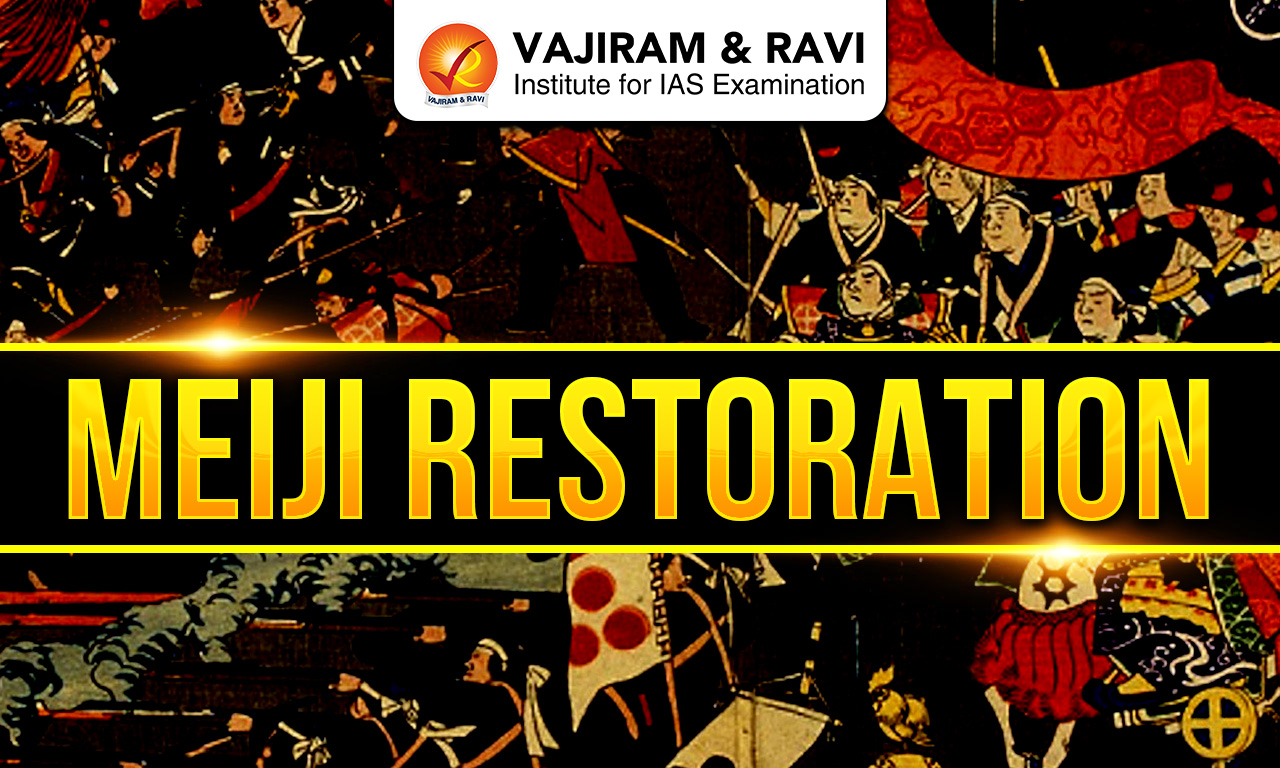
The Meiji Restoration in 1868 changed Japan from a feudal and isolated country into a modern, industrial nation. After Tokugawa Yoshinobu stepped down, Emperor Meiji’s rule was restored. The government introduced reforms under the Charter Oath, encouraging better governance, social mobility, and learning from other countries. Historians describe it as a “revolution from above”, as reforms were initiated and controlled by a small group of elites, unlike mass-based revolutions such as the French Revolution.
Meiji Restoration Background
Before 1868, Japan was governed under the feudal system of the Tokugawa Shogunate (1603-1867), which ensured political stability but limited modernization.
- Power was decentralized, with regional lords (daimyos) exercising authority over their domains, while the shogun functioned as the supreme military ruler.
- Society was rigidly divided into hierarchical classes – samurai, peasants, artisans, and merchants.
- At the core of this system was the samurai class, a hereditary warrior elite that served the daimyos and enjoyed high social status along with fixed stipends.
This stable order began to weaken in the 19th century due to both internal and external pressures.
- Internally, the declining economic condition of the samurai and the rising wealth of merchants created social imbalance.
- Externally, a major turning point came in 1853, when Matthew Perry, an American naval officer, arrived with warships known as the “Black Ships” and forced Japan to open its ports to foreign trade. The subsequent unequal treaties undermined Japan’s sovereignty by limiting its control over trade and legal jurisdiction, thereby exposing its military and technological weakness.
- At the same time, the fate of China, which had come under foreign domination, served as a warning.
These developments convinced Japanese leaders, many of them samurai, that without rapid modernization, Japan risked losing its independence.
Causes of the Meiji Restoration
The Meiji Restoration was driven by a combination of internal weaknesses and external pressures that made reform unavoidable.
- Political Weakness of the Tokugawa Shogunate: The Tokugawa system was decentralized, with significant power vested in regional domains. This limited the capacity of the central authority to respond effectively to external threats. The inability of the shogunate to resist Western pressure or protect national interests led to a decline in its legitimacy. As a result, many leaders began to advocate the restoration of imperial authority as a means of unifying the country.
- Economic Stagnation and Structural Imbalance: The feudal economy was primarily agrarian and could not generate sufficient resources for modernization. The samurai class, dependent on fixed stipends, faced economic hardship as commercial activities expanded. At the same time, merchants gained wealth but lacked social recognition. This imbalance created structural tensions and highlighted the need for economic reform and industrial development.
- Social Discontent and Erosion of Feudal Order: The rigid class hierarchy began to break down under economic and social pressures. Samurai dissatisfaction, coupled with rising aspirations among merchants and commoners, contributed to instability. The traditional system no longer reflected the changing realities of society, making transformation inevitable.
- Impact of Western Powers and Unequal Treaties: The forced opening of Japan and the imposition of unequal treaties posed a direct challenge to national sovereignty. Western powers enjoyed legal and economic privileges within Japan, which was seen as a humiliation. The fear of colonization, reinforced by developments in Asia, created a strong motivation for reform.
- Rise of Reformist Samurai Leadership: A group of progressive samurai from domains like Satsuma and Chōshū played a crucial role in overthrowing the shogunate. They recognized that Japan needed to adopt Western technology and institutions to survive. Their leadership ensured that the restoration was not merely political but also transformative in nature.


Consequences of the Meiji Restoration
The Meiji Restoration brought about a far-reaching transformation of Japan across political, social, economic, and military spheres. These changes were not isolated reforms but part of a coordinated state strategy guided by the principle of “Fukoku Kyōhei” (Rich country, strong army), which aimed to build a strong, self-reliant nation capable of competing with Western powers.
Political Consequences: Creation of a Centralized Modern State: The most immediate consequence was the dismantling of the feudal political structure and the emergence of a centralized state.
- The traditional feudal domains (han), controlled by daimyos, were abolished in 1871 and replaced by prefectures under the direct control of the central government. This eliminated regional autonomy and ensured uniform administration across Japan.
- A modern bureaucratic system was established, with officials appointed on the basis of merit rather than hereditary status. This enabled efficient governance and facilitated the implementation of nationwide reforms.
- The promulgation of the Meiji Constitution in 1889 introduced a constitutional monarchy with a parliament (Diet). However, political power remained concentrated in the hands of a small group of elites, reflecting a controlled transition to modern governance rather than full democracy.
Social Consequences: Transformation of Traditional Society: The Meiji Restoration fundamentally altered Japan’s social structure by breaking down feudal hierarchies.
- The rigid class system was abolished, and all individuals were declared equal before the law. This marked a significant shift from a status-based society to a more egalitarian legal framework.
- The samurai class, which had traditionally enjoyed privileges such as stipends and the exclusive right to bear arms, lost its special status. Many former samurai were compelled to seek new livelihoods in administration, business, or professional fields, reflecting a transition from hereditary privilege to occupational roles.
- The removal of restrictions on occupation and movement allowed greater social mobility. Individuals could now pursue careers based on ability and opportunity rather than birth, contributing to a more dynamic society.
Economic Consequences: Industrialization and Emergence of Capitalism: Economic transformation was central to the success of the Meiji reforms, as the state actively promoted industrial development.
- The government initially took the lead in industrialization by investing in infrastructure such as railways, telegraph networks, ports, and modern factories. This laid the foundation for economic growth and national integration.
- The Iwakura Mission played a crucial role in this process by studying Western economies, industries, and institutions, and bringing back knowledge that informed Japan’s modernization strategy.
- Land tax reforms converted traditional tax payments (in rice) into monetary payments, providing the government with a stable and predictable source of revenue. This financial stability was essential for funding modernization efforts.
Military Consequences: Emergence of a Modern Military Power: Military modernization was a critical component of Japan’s transformation, aimed at protecting national sovereignty and gaining international recognition.
- The introduction of universal conscription in 1872 replaced the traditional samurai-based military system. This created a national army composed of citizens, strengthening both military capacity and national integration.
- The army and navy were reorganized along Western lines, adopting modern training methods, organizational structures, and advanced weaponry. This significantly improved Japan’s military effectiveness.
- Japan’s enhanced military strength was demonstrated through its victories in the First Sino-Japanese War and the Russo-Japanese War, which established it as a major power in East Asia.
Educational and Ideological Consequences: The Meiji state recognized that modernization required not just institutional change but also a transformation of mindset.
- A national education system was established, promoting literacy, technical knowledge, and discipline. By the end of the Meiji period, a large proportion of the population had access to basic education, creating a skilled workforce.
- The state promoted nationalism and unity through ideological tools such as State Shinto, which emphasized loyalty to the emperor as a symbol of national identity.
- While Western knowledge and practices were actively adopted, efforts were made to preserve Japanese cultural traditions, ensuring continuity amidst change.
Significance of the Meiji Restoration
The Meiji Restoration represents one of the most successful examples of rapid modernization in world history. Within a few decades, Japan transformed itself from a feudal and isolated society into a modern industrial and military power. What makes this transformation particularly significant is that Japan was able to adopt Western institutions and technology while preserving its cultural identity and political independence.
- Preservation of Sovereignty: Japan successfully avoided colonization at a time when many Asian countries were falling under Western control. Unlike China, which experienced semi-colonial domination, Japan strengthened its institutions in time to maintain independence and later renegotiate unequal treaties.
- First Industrialized Nation in Asia: The Meiji reforms enabled Japan to become the first Asian country to industrialize successfully. State-led efforts in infrastructure, industry, and finance created a strong economic base, allowing Japan to compete with Western economies.
- Emergence as a Military Power: Modern military reforms transformed Japan into a formidable power. Its victories in the First Sino-Japanese War and the Russo-Japanese War demonstrated that a non-Western nation could defeat major powers, altering global power perceptions.
- Model of State-Led Modernization: The Meiji Restoration showed that strong state intervention can drive rapid modernization. The government actively led reforms in industry, education, and administration, providing a model for late-developing countries.
- Selective Adaptation of the West: Japan’s success lay in its ability to adopt Western ideas selectively rather than blindly. It combined modern institutions with traditional values, ensuring stability during rapid transformation.
The Meiji Restoration not only made Japan a global power but also influenced Asian nationalism and modernization efforts. However, its emphasis on militarization later contributed to expansionism and conflicts, including World War II.
The “Darker Side” of Meiji Modernization
While the Meiji Restoration is often celebrated as a successful model of rapid modernization, it also generated significant structural inequalities and social costs that complicate its legacy.
- The expansion of Japan into regions like Hokkaido involved colonization and forced assimilation of the Ainu, leading to land loss and cultural erosion.
- Industrialization prioritized growth over welfare, causing environmental damage and harsh working conditions, especially for women, with long hours and health risks.
- Legal equality after feudalism did not end social stratification; new inequalities arose, with discrimination against marginalized groups, economic gaps, and overcrowded urban living

 Last updated on Sep, 2026
→ UPSC 2027 Notification will be released on 13 January 2027 at upsconline.nic.in.
→ Check out the latest UPSC Syllabus 2026 here.
→ Download UPSC Model Answers for Mains 2026
→ UPSC Mains Question Paper 2026 is out now for Essay & GS Paper 1, 2, 3 & 4.
→ UPSC Calendar 2027 has been released.
→ Enroll in Vajiram & Ravi’s UPSC Mains Test Series 2027 for structured answer writing practice, expert evaluation, and exam-oriented feedback.
→ Join Vajiram & Ravi’s UPSC Mentorship Program 2027 for personalized guidance, strategy planning, and one-to-one support from experienced mentors.
→ Go through the UPSC Mains Previous Year Papers to enhance your preparation.
→ UPSC has released UPSC Toppers List 2025 with the Civil Services final result on its official website.
→ Also check Best UPSC Coaching in India
Meiji Restoration FAQs
Q1. What was the Meiji Restoration?+
Q2. Why did the Meiji Restoration take place?+
Q3. What role did the samurai play in the Meiji Restoration?+
Q4. What were the major consequences of the Meiji Restoration?+
Q5. What was the significance of the Meiji Restoration?+
Tags: meiji restoration