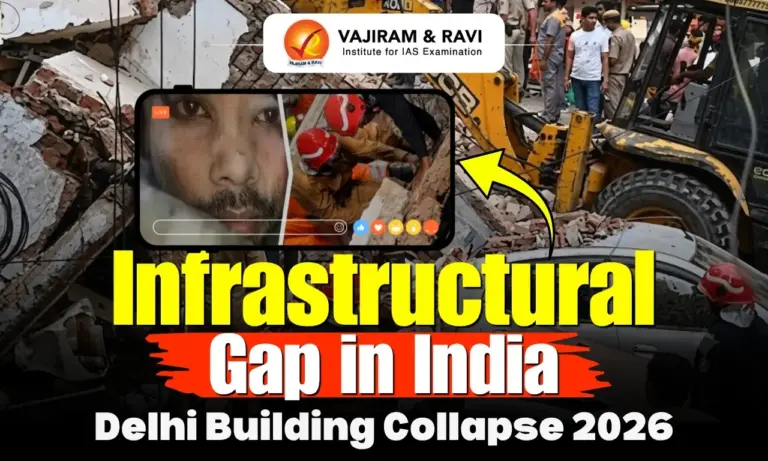
The recent Delhi building collapse in Satya Niketan has once again raised serious questions about the quality, maintenance and enforcement of urban infrastructure in India. A five-storey building being used as a paying guest accommodation collapsed on September 6, 2026, killing at least five people and leaving several others injured.
How Does the Delhi Building Collapse Reflect the Infrastructural Gap in India?
The Delhi building collapse highlights how rapid urbanisation, weak enforcement, poor maintenance and inadequate building safety mechanisms can widen India’s infrastructural gap.
- Rapid Urbanisation: Fast-growing cities increase pressure on housing and urban infrastructure.
- Weak Regulatory Enforcement: Gaps in building inspections and compliance with safety norms can increase risks.
- Poor Maintenance: Ageing or poorly maintained buildings may become vulnerable to structural failures.
- Unauthorised Construction: Unapproved alterations can compromise structural stability and building safety.
- Overcrowded Housing: Rising demand for affordable accommodation can lead to high-density and inadequately regulated housing.
- Limited Municipal Capacity: Shortages of technical staff, resources and monitoring systems can weaken local enforcement.
- Fragmented Urban Governance: Multiple agencies and unclear accountability can create coordination and implementation gaps.
Government Measures to Address the Infrastructural Gap
The government has introduced several infrastructure and urban development initiatives to improve connectivity, basic services, housing, safety and the overall quality of urban infrastructure.
- Urban Challenge Fund: The ₹1 lakh crore Urban Challenge Fund aims to catalyse urban investments and promote resilient, inclusive and sustainable urban infrastructure.
- AMRUT 2.0: The Atal Mission for Rejuvenation and Urban Transformation focuses on improving water supply, sewerage, drainage and green spaces in cities.
- National Building Code: The National Building Code of India provides standards for structural safety, fire safety, construction practices and building services.
- Smart Cities Mission: The initiative promotes technology-enabled urban planning, better civic services and improved infrastructure management.
- Pradhan Mantri Awas Yojana: Affordable housing programmes aim to reduce housing shortages and provide safer living conditions for economically weaker and low-income households.
- Infrastructure Investment: Greater public investment in roads, railways, highways, logistics and urban transport is helping expand India’s physical connectivity.
- Strengthening Urban Local Bodies: Measures aimed at improving municipal finances, technical capacity and urban planning can help local bodies manage infrastructure more effectively.
- Disaster-Resilient Infrastructure: Greater emphasis is being placed on climate-resilient and disaster-resistant infrastructure to reduce damage from floods, cyclones, earthquakes and other hazards.
- Digital Governance: GIS mapping, online building approvals and digital monitoring systems can improve transparency, track infrastructure assets and strengthen regulatory enforcement.


Challenges in Bridging the Infrastructural Gap in India
Bridging the infrastructure gap requires overcoming financial, institutional, regulatory and planning challenges while ensuring sustainable and inclusive development.
- Funding Constraints: Large infrastructure projects require substantial capital investment, while limited resources can affect development and maintenance.
- Project Delays: Land acquisition, regulatory approvals and implementation issues often increase project costs and delay completion.
- Maintenance Deficit: Inadequate inspection, repair and upkeep can lead to the deterioration of existing infrastructure.
- Weak Regulatory Enforcement: Poor implementation of building codes, safety standards and planning regulations can compromise infrastructure quality.
- Limited Municipal Capacity: Shortages of skilled manpower, technical expertise and financial autonomy weaken urban infrastructure management.
- Unplanned Urban Growth: Rapid expansion without adequate land-use planning and civic services puts pressure on housing, transport, water and sanitation.
- Regional Imbalances: Unequal infrastructure availability across states, regions and rural-urban areas makes balanced development difficult.
- Climate and Disaster Risks: Floods, cyclones, heatwaves, landslides and earthquakes can damage infrastructure and increase the need for resilient development.
Way Forward
Bridging India’s infrastructural gap requires a shift from merely creating new assets to ensuring quality, safety, resilience and effective management of existing infrastructure.
- Strengthen Urban Planning: Adopt integrated land-use and infrastructure planning to ensure housing, transport, water, sanitation and other services grow together.
- Improve Regulatory Enforcement: Ensure strict implementation of building codes, safety standards and construction regulations, supported by regular inspections.
- Focus on Maintenance: Adopt lifecycle-based infrastructure management with regular audits, preventive maintenance and timely rehabilitation.
- Empower Urban Local Bodies: Provide municipalities with greater financial resources, technical expertise and administrative capacity to manage local infrastructure.
- Promote Affordable Housing: Expand safe and affordable housing to reduce overcrowding and dependence on poorly regulated accommodation.
- Leverage Technology: Use GIS mapping, digital building records, remote monitoring and online approval systems to improve planning, transparency and enforcement.
- Build Climate-Resilient Infrastructure: Integrate disaster-risk reduction and climate resilience into infrastructure planning, design and construction.
- Ensure Coordinated Governance: Establish clear responsibilities and stronger coordination among Central, State and local authorities for efficient project implementation and accountability.

 Last updated on Sep, 2026
→ UPSC 2027 Notification will be released on 13 January 2027 at upsconline.nic.in.
→ Check out the latest UPSC Syllabus 2026 here.
→ Download UPSC Model Answers for Mains 2026
→ UPSC Mains Question Paper 2026 is out now for Essay & GS Paper 1, 2, 3 & 4.
→ UPSC Calendar 2027 has been released.
→ Enroll in Vajiram & Ravi’s UPSC Mains Test Series 2027 for structured answer writing practice, expert evaluation, and exam-oriented feedback.
→ Join Vajiram & Ravi’s UPSC Mentorship Program 2027 for personalized guidance, strategy planning, and one-to-one support from experienced mentors.
→ Go through the UPSC Mains Previous Year Papers to enhance your preparation.
→ UPSC has released UPSC Toppers List 2025 with the Civil Services final result on its official website.
→ Also check Best UPSC Coaching in India
Infrastructural Gap in India FAQs
Q1. What is the infrastructural gap in India?+
Q2. What are the major causes of the infrastructural gap in India?+
Q3. What are the major areas affected by India's infrastructure gap?+
Q4. How does rapid urbanisation contribute to the infrastructure gap?+
Q5. What is the role of Urban Local Bodies in bridging the infrastructure gap?+
Tags: delhi building collapse 2026 infrastructural gap in india