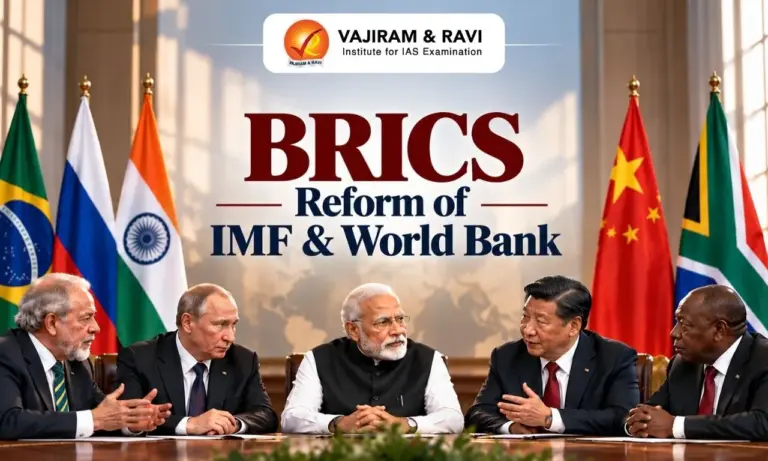
The BRICS Reform of IMF & World Bank has gained renewed attention under India’s 2026 BRICS Presidency, with member countries calling for a more representative and inclusive global financial system. BRICS has urged reforms in the Bretton Woods Institutions to give emerging markets and developing economies greater voice, voting power and representation in their governance. The grouping also supports stronger development financing through institutions such as the New Development Bank (NDB).
BRICS Demand for IMF and World Bank Reforms
BRICS has called for reforms in the IMF and World Bank to make global financial governance more representative and responsive to today’s economic realities.
- Reforming Bretton Woods Institutions: BRICS has called for reforms in the International Monetary Fund (IMF) and World Bank to make them more representative, transparent, accountable, inclusive and effective.
- Greater Voice for Developing Economies: BRICS wants emerging markets and developing economies (EMDEs) to have a stronger voice and greater representation in the decision-making processes of these institutions.
- Reflecting Changing Economic Realities: The global economy has changed significantly since the creation of the Bretton Woods institutions after World War II. BRICS wants their governance structures to reflect the current distribution of global economic power.
- IMF Quota and Voting Reform: BRICS supports increasing the quota and voting shares of emerging and developing economies in the IMF, while also protecting the interests of the poorest countries.
- Greater Representation in Leadership: BRICS has called for a merit-based, inclusive and transparent selection process for the leadership of the IMF and World Bank, with greater regional diversity and representation of EMDEs.
- World Bank Shareholding Reform: BRICS considers the World Bank Shareholding Review an opportunity to increase the voice of developing countries and address their historical under-representation.
Why Does BRICS Seek Reform of IMF and World Bank?
The demand for reform reflects BRICS’ broader objective of making the global financial system more balanced and inclusive.
- Changing Global Economic Weight: Emerging economies now account for a much larger share of global output, trade and investment, but their representation in global financial institutions has not increased at the same pace.
- Historical Under-representation: BRICS believes that many developing and emerging economies remain under-represented in the decision-making structures of the IMF and World Bank.
- Fairer Decision-Making: Greater voting power would give developing countries a stronger role in decisions related to global finance, development, debt and financial stability.
- Better Development Financing: Reforms can help make international financial institutions more responsive to the financing needs of developing countries, particularly for infrastructure and sustainable development.
- Addressing Global Challenges: Developing economies face challenges such as rising debt, infrastructure gaps, climate financing needs and financial instability. BRICS wants global institutions to respond more effectively to these concerns.
- More Inclusive Global Governance: IMF and World Bank reforms form part of BRICS’ wider effort to promote a more representative and inclusive global economic order with a stronger role for the Global South.


BRICS Proposals for Reforming the Global Financial System
Along with institutional reforms, BRICS supports strengthening alternative and complementary mechanisms for development finance and financial stability.
- IMF Quota Reform: BRICS supports changes in IMF quotas to give emerging markets and developing economies a larger share of quotas and voting rights.
- Meaningful Quota Realignment: BRICS has backed the implementation of quota increases under the 16th General Review of Quotas and meaningful quota realignment under the 17th review.
- World Bank Shareholding Reform: BRICS wants the World Bank’s shareholding structure to provide greater voice and representation to developing countries.
- Leadership Reform: The grouping supports transparent, merit-based and inclusive selection processes for senior positions in the IMF and World Bank.
- Strengthening the New Development Bank: BRICS supports a stronger role for the New Development Bank (NDB) in financing infrastructure and development projects across BRICS and the wider Global South.
- Multilateral Guarantees: BRICS supports the NDB’s Multilateral Guarantees initiative, which aims to mobilise private capital, improve the creditworthiness of development projects and reduce financing costs.
- Strengthening the Contingent Reserve Arrangement: BRICS is working to make the Contingent Reserve Arrangement (CRA) more flexible and responsive so that it can provide liquidity support to members facing balance-of-payments pressures.
- Local-Currency Financing: BRICS encourages greater use of local currencies and efficient cross-border payment mechanisms to reduce transaction costs and strengthen financial resilience.
- Stronger Global South Role: Overall, BRICS seeks to use the growing economic weight of its members to promote a more balanced global financial architecture in which developing countries have a greater role in shaping international economic decisions.

 Last updated on Sep, 2026
→ UPSC 2027 Notification will be released on 13 January 2027 at upsconline.nic.in.
→ Check out the latest UPSC Syllabus here.
→ Download UPSC Model Answers for Mains 2026
→ UPSC Mains Question Paper 2026 is out now for Essay & GS Paper 1, 2, 3 & 4.
→ UPSC Calendar 2027 has been released.
→ Enroll in Vajiram & Ravi’s UPSC Mains Test Series 2027 for structured answer writing practice, expert evaluation, and exam-oriented feedback.
→ Join Vajiram & Ravi’s UPSC Mentorship Program 2027 for personalized guidance, strategy planning, and one-to-one support from experienced mentors.
→ Go through the UPSC Mains Previous Year Papers to enhance your preparation.
→ UPSC has released UPSC Toppers List 2025 with the Civil Services final result on its official website.
→ Also check Best UPSC Coaching in India
BRICS Reform of IMF & World Bank FAQs
Q1. What is BRICS’ demand for IMF and World Bank reform?+
Q2. Why does BRICS want to reform the IMF and World Bank?+
Q3. What IMF reforms does BRICS support?+
Q4. What are BRICS proposals for World Bank reform?+
Q5. How does BRICS seek greater representation in IMF and World Bank leadership?+
Q6. What is the role of the New Development Bank in BRICS’ financial reforms?+
Tags: BRICS reform of IMF & world bank monthly current affairs 2026