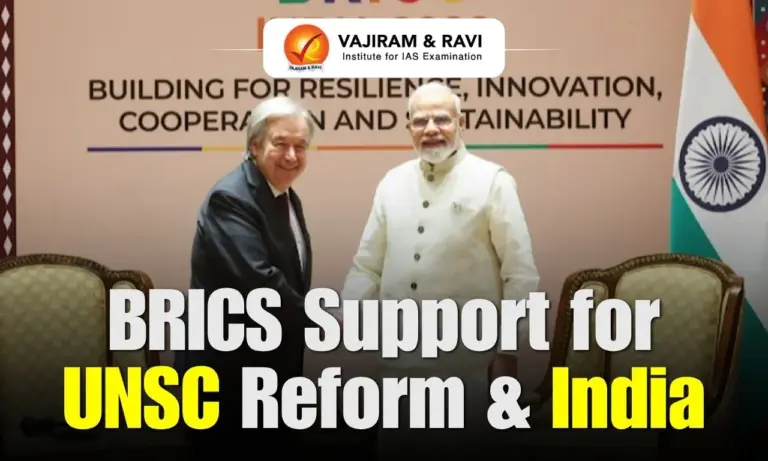
The 18th BRICS Summit, hosted by India in New Delhi on September 12-13, 2026, is expected to produce a Delhi Declaration supporting reforms in global governance institutions, stronger multilateralism and India’s bid for permanent membership of the United Nations Security Council (UNSC).
BRICS Support for UNSC Reform
According to reports on the proposed Delhi Declaration, BRICS members have reached consensus on reforming institutions of global governance, strengthening multilateralism and supporting India’s UNSC bid.
The significance of this support lies in BRICS’ growing role as a voice of the Global South. With 11 members representing around 49.5% of the global population, 40% of global Gross Domestic Product (GDP) and 26% of global trade, the grouping has increasing weight in discussions on how global institutions should be reformed.
Why is UNSC Reform Needed?
The United Nations Security Council has 15 members, including five permanent members – China, France, Russia, the United Kingdom and the United States and 10 non-permanent members.
The present structure largely reflects the geopolitical order of 1945, while the United Nations has expanded from 51 founding members to 193 members today.
- Under-representation of the Global South: Africa, Latin America and large parts of Asia lack permanent representation.
- Changing global power: Emerging economies such as India have acquired greater economic, demographic and diplomatic importance.
- Legitimacy deficit: Decisions on major international security issues require wider representation to enjoy greater credibility.
- Contemporary challenges: Climate change, terrorism, pandemics, artificial intelligence and new security threats require broader participation in global decision-making.


Why is BRICS Support Important for India?
The expected BRICS support strengthens India’s longstanding campaign for permanent membership of the UNSC and gives its candidature greater diplomatic backing.
- Connects India’s bid with the Global South: India can present its candidature not merely as a demand for greater national influence, but as part of the wider effort to give developing countries greater representation in global decision-making.
- Adds diplomatic weight: Russia and China, both permanent members of the UNSC, are also BRICS members. Their support gives discussions on UNSC reform within BRICS greater diplomatic significance.
- Strengthens India’s multilateral diplomacy: BRICS adds another major platform to India’s efforts through the G4, L.69 Group, African Union and United Nations General Assembly.
- Supports India’s bridge-building role: India can use its position within BRICS to build consensus among countries with different interests while advancing the broader case for reform.
However, BRICS support alone cannot deliver UNSC reform because any change to the Council requires a much wider consensus within the United Nations.
Why Does India Seek Permanent Membership of the UNSC?
India’s claim is based on its demographic, economic, democratic and diplomatic significance, as well as its contribution to the United Nations system.
- Demographic weight: India is the world’s most populous country and represents a substantial share of humanity.
- Economic significance: India is one of the world’s major and fastest-growing economies.
- Democratic credentials: India is the world’s largest democracy and argues that its political and institutional experience strengthens its case for a permanent role.
- UN peacekeeping contribution: India has historically been among the major contributors to United Nations peacekeeping operations.
- Global South representation: India seeks to bring the priorities and perspectives of developing countries into global decision-making.
- Growing diplomatic role: India’s participation in BRICS, the G20, G4, L.69 Group and other multilateral platforms reflects its expanding role in global affairs.
India has consistently called for the expansion of the UNSC in both permanent and non-permanent categories, rather than limiting reform to the addition of new non-permanent members.
India’s Strategy for UNSC Reform
India has adopted a coalition-based approach, using multiple platforms to build support for comprehensive UNSC reform.
- G4: India, Brazil, Germany and Japan support expansion of the UNSC in both permanent and non-permanent categories.
- L.69 Group: India works with developing countries that support comprehensive UNSC reform.
- African Union: India supports greater African representation in the UNSC, including through the Ezulwini Consensus and Sirte Declaration.
- BRICS: India uses the grouping to build wider support among emerging and developing economies.
- United Nations: India continues to participate in the Intergovernmental Negotiations on Security Council reform.
Through these platforms, India seeks to combine its own candidature with the broader demand for a more representative and effective multilateral system.
Challenges for India
India’s path to permanent UNSC membership remains difficult because the reform process involves competing interests within BRICS and the wider United Nations.
- Permanent members’ interests: Existing permanent members may have different positions on the expansion and composition of the Council.
- Veto issue: Whether new permanent members should receive veto power remains contentious.
- Regional rivalries: China’s position on India and Pakistan’s opposition add to the diplomatic challenge.
- Divergent BRICS interests: The expanded BRICS includes countries with different geopolitical priorities. Recent negotiations over the Delhi Declaration have highlighted these differences.
- Need for wider consensus: BRICS support cannot by itself reform the UNSC. Any structural change requires broad international agreement and a formal amendment process.
Way Forward
India needs to convert the growing political support for UNSC reform into a broader international consensus.
- Build a wider coalition: Continue working with developing countries to build support for comprehensive UNSC reform.
- Connect India’s bid with Global South representation: Present India’s candidature as part of the larger demand for equitable representation of developing countries.
- Strengthen existing partnerships: Continue coordination with the G4, L.69 and African Union.
- Use BRICS strategically: Build political support through BRICS while keeping the United Nations General Assembly at the centre of the reform process.
- Focus on effective reform: Work towards a UNSC that is more representative, legitimate and effective in addressing contemporary global challenges.

 Last updated on Oct, 2026
→ UPSC 2027 Notification will be released on 13 January 2027 at upsconline.nic.in.
→ Check Nobel Prize 2026 Winners List here.
→ Download PIB PRiSM Monthly Magazine 2026 here.
→ Check UPSC Monthly Current Affairs Magazine The Recitals here.
→ Check out the latest UPSC Syllabus here.
→ Download UPSC Model Answers for Mains 2026
→ UPSC Mains Question Paper 2026 is out now for Essay & GS Paper 1, 2, 3 & 4.
→ UPSC Calendar 2027 has been released.
→ Enroll in Vajiram & Ravi’s UPSC Mains Test Series 2027 for structured answer writing practice, expert evaluation, and exam-oriented feedback.
→ Join Vajiram & Ravi’s UPSC Mentorship Program 2027 for personalized guidance, strategy planning, and one-to-one support from experienced mentors.
→ Go through the UPSC Mains Previous Year Papers to enhance your preparation.
→ UPSC has released UPSC Toppers List 2025 with the Civil Services final result on its official website.
→ Also check Best UPSC Coaching in India
BRICS Support for UNSC Reform & India FAQs
Q1. What is the BRICS position on UNSC reform?+
Q2. How does BRICS support India’s UNSC bid?+
Q3. Why does India seek permanent membership of the UNSC?+
Q4. Which groups support India’s demand for UNSC reform?+
Q5. What are the major challenges to UNSC reform?+
Tags: brics support for unsc reform & india