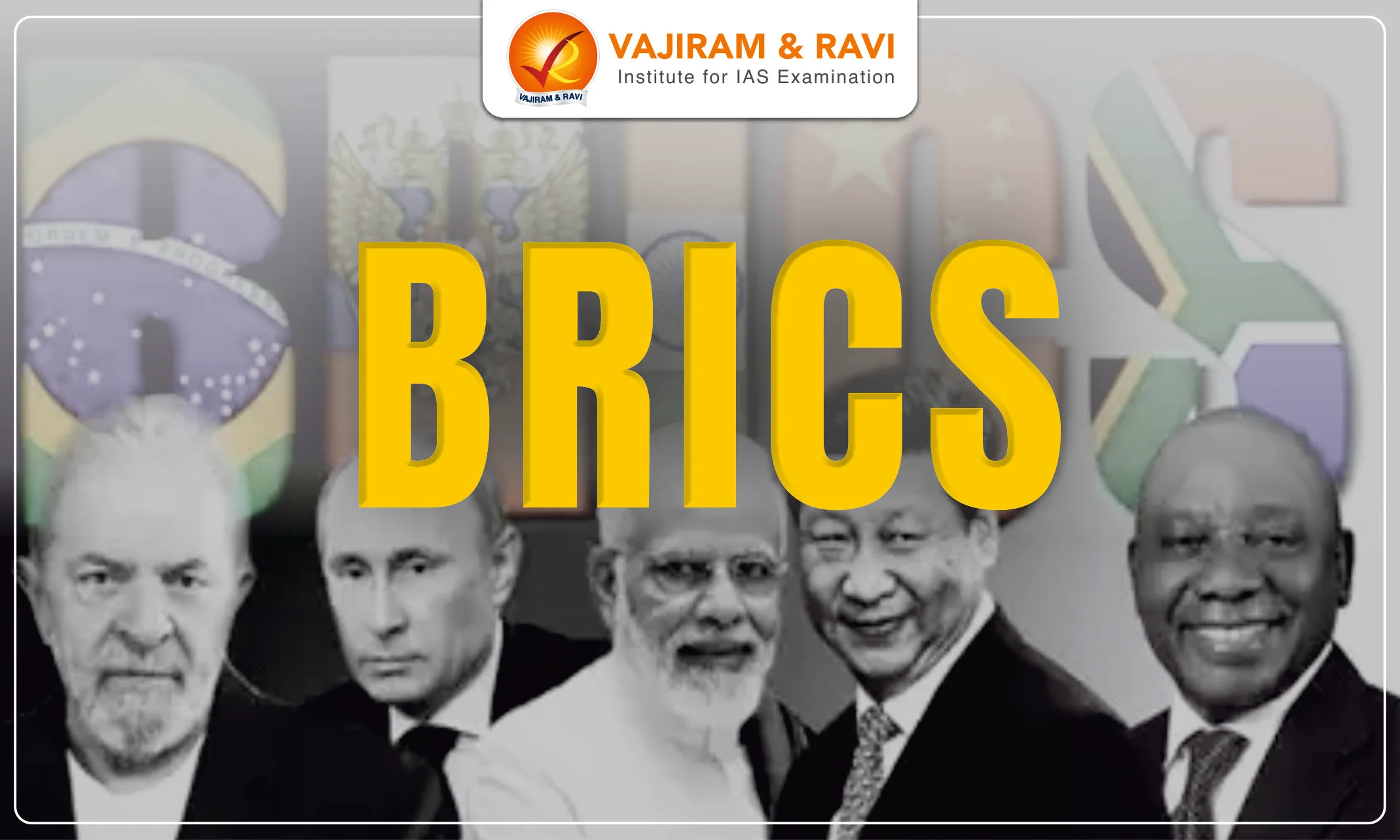
BRICS is a grouping of emerging economies focused on economic cooperation, initially comprising Brazil, Russia, India, and China, with South Africa joining in 2011. Representing 40% of the global GDP and about 49.5 per cent of the world’s population, BRICS has increasingly positioned itself as a counterbalance to Western-led forums like the Group of 7 and the World Bank.
Amid geopolitical shifts, particularly after the Ukraine conflict, BRICS has gained renewed significance. Strengthening its influence, BRICS expanded to include Egypt, Ethiopia, Iran, the United Arab Emirates, and later welcomed Indonesia as a full member.
BRICS History
BRICS is a strategic alliance of emerging economies, originally formed by Brazil, Russia, India, and China, to enhance economic cooperation, political dialogue, and global influence. The term "BRIC" was first introduced in his 2001 research paper, Building Better Global Economic BRICS, to highlight the investment potential of these emerging economies.
- First BRIC Summit: The inaugural summit, which discussed economic and financial cooperation, took place in Yekaterinburg, Russia, in 2009.
- South Africa’s Inclusion: South Africa joined in 2011, leading to the group’s renaming as BRICS.
- Three Pillars of BRICS: BRICS operates under three pillars—political and security, economic and financial, and cultural and people-to-people exchanges—focusing on multilateral cooperation.
- Key Institutions: BRICS has established institutions like the New Development Bank in 2015 to enhance economic collaboration among its members.
- Relevance Post-Ukraine Conflict: BRICS has gained significant importance, particularly after the Ukraine conflict, positioning itself as a counterweight to Western-dominated institutions like the G7 and the World Bank.
Full Form of BRICS
BRICS originally stood for Brazil, Russia, India, China and South Africa. The term “BRIC” was coined by economist Jim O’Neill in 2001. After South Africa joined in 2011, it became BRICS.
- B – Brazil
- R – Russia
- I – India
- C – China
- S – South Africa
BRICS Headquarters
BRICS does not have a permanent headquarters or central secretariat; its chairmanship rotates annually among member countries, with the chair country coordinating activities and hosting the BRICS Summit. However, the New Development Bank (NDB), a key BRICS institution, is headquartered in Shanghai, China.
BRICS Objectives
BRICS cooperation has evolved beyond economic coordination into a broad platform covering political-security, economic-financial and socio-cultural engagement. The official BRICS framework groups its cooperation under three broad areas:
- Political and Security: Strengthen political dialogue, promote peace, security and multilateralism, address terrorism and other transnational threats, and support reforms in global governance institutions such as the UN.
- Economy and Finance: Promote trade, investment and economic cooperation, strengthen financial coordination, support sustainable development and infrastructure financing through the New Development Bank (NDB), and enhance cooperation in technology, innovation and other emerging economic areas.
- Cultural and People-to-People Exchanges: Promote cooperation in education, culture, health, youth, sports and tourism while encouraging people-to-people contacts and greater mutual understanding among member countries.


BRICS Countries
BRICS has expanded from the original BRIC grouping of Brazil, Russia, India and China into an 11-member grouping, alongside a separate partner-country category. South Africa joined in 2011; Egypt, Ethiopia, Iran, Saudi Arabia and the UAE joined in the 2024 expansion, while Indonesia formally became a full member in January 2025.
- Full Members (11): Brazil, Russia, India, China, South Africa, Egypt, Ethiopia, Iran, Saudi Arabia, United Arab Emirates and Indonesia.
- Partner Countries (10): Belarus, Bolivia, Cuba, Kazakhstan, Malaysia, Nigeria, Thailand, Uganda, Uzbekistan and Vietnam. Vietnam became the 10th BRICS partner country, taking the partner category beyond the nine partners initially recognised in 2025.
BRICS Membership Expansion
The expansion of BRICS membership reflects the grouping’s transition from a five-country emerging-economy forum to a broader platform representing the Global South. The expansion has increased its demographic, economic and geopolitical weight while also creating a more diverse membership with varied national interests as follows:
- China’s Global Influence: China sees an expanded BRICS as a means to enhance its economic and diplomatic influence and strengthen cooperation among emerging economies.
- FOMO (Fear of Missing Out): Countries may seek BRICS membership because they fear being left out of a growing and influential bloc, particularly its potential benefits in trade, investment, finance and diplomatic coordination.
- Limited Alternatives: BRICS provides developing countries with an additional platform beyond Western-led institutions and alliances for pursuing their economic and strategic interests.
- Global South Unity: Expansion reflects the desire of developing countries for greater representation and a stronger collective voice in global governance.
- Strategic Autonomy: Membership enables countries to diversify their economic and diplomatic partnerships and reduce excessive dependence on any single major power or bloc.
BRICS Functions
BRICS functions translate its broad objectives into practical cooperation among member countries, particularly in political, economic, and socio-cultural spheres.
Political and Security Cooperation
To enhance cooperation and dialogue on issues of global and regional security and developments in the global political space for peace, security, and prosperity. Priorities under this pillar are the reform of the multilateral system and counter-terrorism cooperation.
- BRICS National Security Advisors’ meeting is an important component of the BRICS Political and Security Pillar of cooperation.
- Deliberations on security issues such as counter-terrorism, cyber security, peace and stability, transnational organised crime, as well as the national security of BRICS countries.
Economic and Financial Cooperation
To promote economic growth and development for mutual prosperity through the expansion of intra-BRICS cooperation in sectors such as trade, agriculture, infrastructure, small and medium enterprises, energy, finance and banking.
- Contingent Reserve Arrangement (CRA): It is a financial mechanism to protect against global liquidity pressures. CRA was established in 2015 to provide financial support to member countries that face balance of payments difficulties due to short-term liquidity pressures.
- The legal basis for the Establishment was signed at Fortaleza, Brazil, in 2014. The CRA's total lending capacity is $100 billion.
- New Development Bank (NDB): It is a multilateral development bank established by BRICS to mobilise resources for infrastructure and sustainable development projects in emerging markets and developed countries (EMDCs).
- The Agreement was signed during the BRICS Summit held in Fortaleza in 2014, and the Bank started operations in 2015.
- NDB has so far committed $32.8 billion to 96 infrastructure and sustainable development projects.
Cultural and People-to-People Contacts
To qualitatively enrich and enhance intra-BRICS people-to-people contacts in cultural, academic, youth, sports, and business through regular exchanges, such as:
- BRICS Parliamentary Forum
- BRICS Film Festival
- BRICS Youth Summit
- BRICS Academic Forum (BAF)
BRICS Currency
The idea of a BRICS currency was discussed to reduce dependence on the US dollar, lower transaction and exchange-rate costs, strengthen financial autonomy, and facilitate smoother intra-BRICS trade. However, BRICS has not adopted a common currency and currently focuses on local-currency settlements and alternative cross-border payment mechanisms.
- Digital Payments: In 2026, BRICS discussions have included possible linkages between fast-payment systems and CBDC - Central bank digital currencies, although these remain at the discussion stage.
BRICS and India
India is an important member of the BRICS group, and its participation in the organisation has been beneficial in many ways. Some of the key reasons why BRICS is important for India are:
- Strategic Cooperation: BRICS offers India a key platform for global engagement on security, terrorism, climate, and trade.
- Economic Benefits: As a BRICS member, India gains access to a large market of 3+ billion people, offering vast business opportunities. NDB funding supports India's development projects.
- Reform of Multilateral Institutions: As a member of BRICS, India has been able to work with other member countries to promote a more inclusive and equitable global order by promoting multilateral reforms.
- South-South Cooperation: India, as a leading member of BRICS, has been able to use the platform to promote South-South cooperation in areas such as trade, investment, and technology transfer.
- Pillar of the New World Order: In the fifteenth BRICS Summit, after its expansion, the leaders called BRICS the pillar of the New World Order.
- Dilemma: However, the challenge before India is to choose between a China-centric or a West-centric world order or balance the two.
BRICS Significance
BRICS is significant as an influential Global South grouping that promotes economic cooperation, strengthens multipolarity, provides alternative institutions, and amplifies developing countries’ voices in global governance.
- Practical Response to Multilateral Deadlocks: With institutions such as the WTO and UN Security Council facing prolonged deadlocks, BRICS has gained importance by focusing on practical cooperation in areas such as food security, digital governance, technology, vaccine access, and climate finance.
- Greater Representation of the Global South: The inclusion of Indonesia and the introduction of the partner-country model have expanded BRICS' reach across the Global South. This has improved its geographical representation while allowing the grouping to remain flexible.
- Strong Economic and Energy Influence: BRICS represents around 45% of the world's population and more than 35% of global GDP in purchasing power parity (PPP) terms. The presence of major energy producers such as Iran and the UAE further strengthens its influence over global growth, energy markets, and energy pricing.
- Alternative Institutions to Western-Led Systems: Institutions such as the New Development Bank (NDB) and the Contingent Reserve Arrangement (CRA) offer development financing, climate support, and emergency liquidity outside traditional IMF-centred frameworks. This has helped BRICS move beyond being merely a dialogue forum toward a more institutional and solutions-oriented platform.
- Promoting a Multipolar World Order: BRICS advocates a more balanced and multipolar global order. Its ability to maintain dialogue and cooperation during crises such as COVID-19 and the Ukraine conflict has increased its appeal among Global South countries seeking greater strategic autonomy and diplomatic flexibility.
BRICS Challenges
BRICS faces several challenges that could impact its cohesion and long-term effectiveness, ranging from economic and geopolitical differences to internal divisions. These obstacles complicate the group's ability to achieve its objectives and maintain unity in an increasingly complex global environment.
- Overlap with Other Groupings: There is a parallel grouping of democracies known as IBSA (India, Brazil, and South Africa), which can lead to overlap in mandates and pose a challenge for BRICS to manage.
- Economic Slowdown: The ongoing economic slowdown and trade disputes among member states can impact the group's ability to achieve its objectives.
- Geopolitical Tensions: The BRICS countries have different geopolitical interests and have been involved in regional conflicts and disputes.
- For example, China's Belt and Road Initiative (BRI), 'string of pearls’, and developments at the Indo-China border have raised tensions with India.
- The Dominance of Three Countries: The overwhelming influence of Russia, India, and China could potentially hinder the ability of other members, such as Brazil and South Africa, to have a meaningful impact on the group's decisions and direction.
- BRICS Currency and De-Dollarization: In the 15th Summit of BRICS, Brazil's President proposed the creation of a common currency for BRICS nations to reduce vulnerability to dollar exchange rate fluctuations.
- Difference of Opinion: While Brazil sees a common currency as a means of reducing vulnerabilities and increasing payment options, other BRICS leaders have varying opinions.
BRICS Summits
BRICS has held an annual Leaders’ Summit since 2009, serving as its highest-level platform for political, economic and strategic coordination. The latest summit is scheduled to be held in India in 2026, under India’s BRICS Chairship.
|
Summit |
Year |
Host Country |
Key Outcome / Theme |
|
1st – Yekaterinburg |
2009 |
Russia |
First BRIC Summit; called for a greater voice for emerging economies. |
|
2nd – Brasília |
2010 |
Brazil |
Strengthened economic and financial cooperation. |
|
3rd – Sanya |
2011 |
China |
South Africa joined; BRIC became BRICS. |
|
4th – New Delhi |
2012 |
India |
Focus on development and global governance reform. |
|
5th – Durban |
2013 |
South Africa |
NDB and CRA initiatives advanced. |
|
6th – Fortaleza |
2014 |
Brazil |
NDB and CRA formally established. |
|
7th – Ufa |
2015 |
Russia |
Strengthened BRICS institutions and cooperation. |
|
8th – Goa |
2016 |
India |
Focus on inclusive growth and global governance |
|
9th – Xiamen |
2017 |
China |
Emphasis on BRICS cooperation and outreach |
|
10th – Johannesburg |
2018 |
South Africa |
Focus on BRICS–Africa cooperation |
|
11th – Brasília |
2019 |
Brazil |
Focus on economic growth and innovation |
|
12th – Moscow |
2020 |
Russia |
Cooperation during COVID-19 |
|
13th – New Delhi |
2021 |
India |
Focus on intra-BRICS cooperation and counter-terrorism |
|
14th – Beijing |
2022 |
China |
Focus on global development and security |
|
15th – Johannesburg |
2023 |
South Africa |
Major expansion announced |
|
16th – Kazan |
2024 |
Russia |
First summit after expansion; new members participated |
|
17th – Rio de Janeiro |
2025 |
Brazil |
Focus on Global South cooperation and sustainable governance |
BRICS Summit 2026
The 18th BRICS Summit will be hosted by India in 2026, under India’s BRICS Chairship. India formally assumed the chairship after Brazil’s 2025 presidency, with the 2026 agenda centred on strengthening cooperation among BRICS members and advancing the interests of the Global South.
- Host: India
- Year: 2026
- Summit: 18th BRICS Summit
- Chair: India
- Theme: “Building for Resilience, Innovation, Cooperation and Sustainability”
- Logo: The 2026 logo incorporates the lotus, symbolising renewal, growth and cooperation.
- Key Focus: Global South, economic cooperation, technology and innovation, sustainable development, climate action, health and institutional reform.
- Preparatory Meetings: India has already held meetings of Sherpas, Foreign Ministers and National Security Advisers under its 2026 chairship.
BRICS Way Forward
BRICS needs to convert its growing membership and economic weight into effective, inclusive and practical cooperation, while managing differences among its diverse members.
- Strengthen Institutional Coordination: Improve coordination among members and ensure greater continuity across successive presidencies.
- Deepen Economic Cooperation: Expand intra-BRICS trade, investment and local-currency settlements while reducing transaction costs.
- Improve Payment Connectivity: Develop interoperable cross-border payment systems without rushing into a common BRICS currency.
- Reform Global Governance: Build a coordinated position on reforms of the United Nations (UN), International Monetary Fund (IMF), World Bank and WTO to enhance developing-country representation.
BRICS UPSC PYQs
Q1: India has recently signed to become a founding member of the New Development Bank (NDB) and also the Asian Infrastructure Investment Bank (AIIB). How will the role of the two Banks be different? Discuss the strategic significance of these two Banks for India. (UPSC Mains 2014)
Q2: Compare the significance of IBSA and BRICS in the context of India’s multilateral diplomacy (UPSC Mains 2012)
Q3: Consider the following statements with regard to BRICS:
- The 16th BRICS Summit was held under the Chairship of Russia in Kazan.
- Indonesia has become a full member of BRICS.
III. The theme of the 16th BRICS Summit was Strengthening Multiculturalism for Just Global Development and Security.
Which of the statements given above is/are correct? (UPSC Prelims 2025)
a) I and II
b) II and III
c) I and III
d) I only
Ans: (a)
Q4: Consider the following statements: (UPSC Prelims 2016)
- New Development Bank has been set up by APEC.
- The headquarters of the New Development Bank is in Shanghai.
Which of the statements given above is/are correct?
- 1 only
- 2 only
- Both 1 and 2
- Neither 1 nor 2
Ans: (b)
Q5: The ‘Fortaleza Declaration’, recently in the news, is related to the affairs of (UPSC Prelims 2015)
- ASEAN
- BRICS
- OECD
- WTO
Ans. (b)

 Last updated on Oct, 2026
→ UPSC 2027 Notification will be released on 13 January 2027 at upsconline.nic.in.
→ Check Nobel Prize 2026 Winners List here.
→ Download PIB PRiSM Monthly Magazine 2026 here.
→ Check UPSC Monthly Current Affairs Magazine The Recitals here.
→ Check out the latest UPSC Syllabus here.
→ Download UPSC Model Answers for Mains 2026
→ UPSC Mains Question Paper 2026 is out now for Essay & GS Paper 1, 2, 3 & 4.
→ UPSC Calendar 2027 has been released.
→ Enroll in Vajiram & Ravi’s UPSC Mains Test Series 2027 for structured answer writing practice, expert evaluation, and exam-oriented feedback.
→ Join Vajiram & Ravi’s UPSC Mentorship Program 2027 for personalized guidance, strategy planning, and one-to-one support from experienced mentors.
→ Go through the UPSC Mains Previous Year Papers to enhance your preparation.
→ UPSC has released UPSC Toppers List 2025 with the Civil Services final result on its official website.
→ Also check Best UPSC Coaching in India
BRICS FAQs
Q1. What is BRICS' main goal?+
Q2. Who is powerful, NATO or BRICS?+
Q3. Did Nigeria join the BRICS?+
Q4. What are the countries in BRICS?+
Q5. Which country refused to join BRICS?+
Tags: brics quest UPSC International Relations and Institutions Notes