Planet Mercury Latest News
Mercury may have shrunk more than scientists previously estimated, with the planet’s diameter potentially reducing by as much as 23 km, a recent study has revealed.
About Planet Mercury
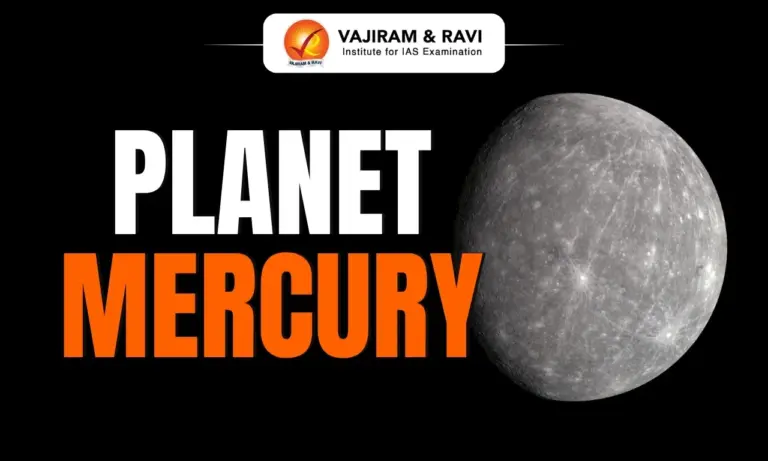
- It is the smallest planet in our solar system and the nearest to the Sun.
- It is one of the four terrestrial (rocky) planets, along with Venus, Earth, and Mars.
- As the closest planet to the Sun, it experiences extreme temperature variations at its surface, from about +450ºC (day) down to –180ºC (night).
- However, Mercury is not the hottest planet; Venus has the highest average surface temperature because of its thick atmosphere and strong greenhouse effect.
- It has permanently shadowed regions at its poles that never see sunlight and thus enables ice to exist on its floor.
- Mercury’s ancient, cratered surface shows signs of past volcanic and tectonic activity and is heavily weathered by the harsh space environment.
- The planet has huge impact basins, including the Caloris Basin, one of the largest impact features in the solar system.
- Mercury has a large iron-rich core, which occupies a substantial portion of the planet’s interior.
- Its closeness to the Sun and its smallness make it the most elusive of the planets visible to the unaided eye.
- NASA’s MESSENGER spacecraft became the first spacecraft to orbit Mercury, entering orbit in 2011 and studying the planet until 2015.
- The BepiColombo mission, a joint mission of the European Space Agency (ESA) and Japan Aerospace Exploration Agency (JAXA), is studying Mercury and is expected to enter orbit in 2026.


Planet Mercury Facts
- Diameter: 4879 km (0.38 Earths, or 1.40 Moons)
- Surface area: 74.8 million sq.km. (0.147 Earths)
- Gravity: 3.7 m/s2 (38% of Earth’s gravity)
- Mass: 3.3 × 10²³ kg (0.055 Earths)
- Density: 5430 kg/m3 (Earth: 5515 kg/m3). It is the second-highest in the Solar System after earth.
- Distance from Sun: 46001200 – 69816900 km (Earth: 149 597 900 km)
- Solar irradiance: 6272 – 14448 W/m² (Earth: 1366 W/m²)
- Day: 58 Earth days to turn once on its axis (Mercury rotation period); 176 days for the Sun to return to the same spot in the sky, as seen from a fixed point on the surface (Mercury solar day)
- Year: 88 Earth days to orbit the Sun (Mercury orbital period). It has the shortest orbital period of any planet.
- Obliquity to orbit (axial tilt): 0.01° (i.e., the equator of Mercury nearly coincides with the orbital plane of the planet)
- Atmosphere: Very thin (<10–14 bar), including oxygen (42%), sodium (29%), hydrogen (22%), helium (6%), and trace gases
- Moons: None
News: IT

 Last updated on Sep, 2026
→ UPSC 2027 Notification will be released on 13 January 2027 at upsconline.nic.in.
→ Check out the latest UPSC Syllabus here.
→ Download UPSC Model Answers for Mains 2026
→ UPSC Mains Question Paper 2026 is out now for Essay & GS Paper 1, 2, 3 & 4.
→ UPSC Calendar 2027 has been released.
→ Enroll in Vajiram & Ravi’s UPSC Mains Test Series 2027 for structured answer writing practice, expert evaluation, and exam-oriented feedback.
→ Join Vajiram & Ravi’s UPSC Mentorship Program 2027 for personalized guidance, strategy planning, and one-to-one support from experienced mentors.
→ Go through the UPSC Mains Previous Year Papers to enhance your preparation.
→ UPSC has released UPSC Toppers List 2025 with the Civil Services final result on its official website.
→ Also check Best UPSC Coaching in India
Planet Mercury FAQs
Q1. Which is the smallest planet in the Solar System?+
Q2. Why does Mercury experience extreme temperature variations?+
Q3. What are the major geological features found on Mercury's ancient surface?+
Q4. What is the major composition of Mercury's core?+
Q5. Which spacecraft became the first to orbit Mercury?+
Tags: planet mercury