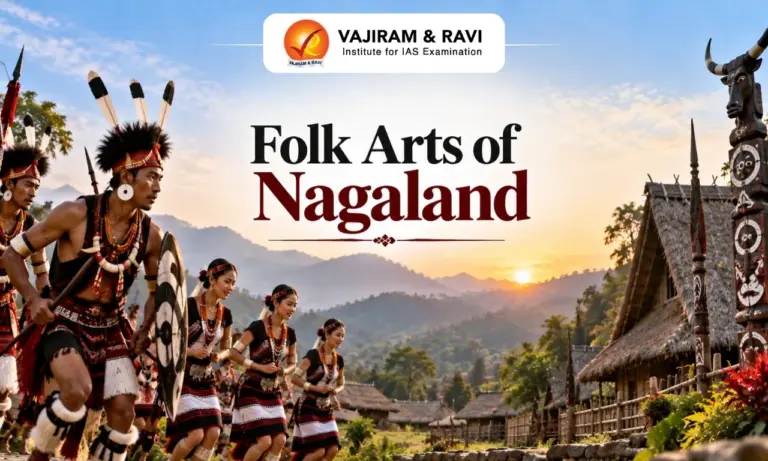
The Folk Arts of Nagaland reflect the state’s diverse tribal traditions, social life and cultural heritage. Nagaland is home to 16 major tribes, including the Angami, Ao, Konyak, Lotha, Sumi and Chakhesang, each with its own traditions of weaving, wood carving, bamboo and cane work, pottery, ornaments, music and dance. These traditions are closely connected with community life, festivals, agriculture and traditional beliefs. They have also helped Naga communities preserve their customs, social identity and cultural practices across generations.
Major Folk Arts of Nagaland
The Major Folk Arts of Nagaland include wood carving, weaving, traditional cloth painting, bamboo and cane craft, pottery, jewellery, folk music and dance. Most of these traditions developed from everyday needs but also carry information about tribal identity, social position, achievements and traditional beliefs.
Folk Dance and Music
Folk dance and music are an important part of Naga culture and are closely linked with festivals, harvest celebrations, purification rituals and other community occasions. Different Naga tribes have their own traditional songs and dances, reflecting their distinct customs and traditions.
- Changsang is associated with the Chang community and is performed during the Naknyulum Festival.
- Melo Phita is associated with the Angami community and is performed during the Sekrenyi purification festival.
- The Lotha community has the warrior-themed Rukhyo-Sharu, while Khupielili is associated with the Pochury community and the Nazu Festival.
The log drum, made from a large hollowed tree trunk, is an important traditional instrument. In the past, it was also used to send messages between villages and to call people together on important occasions. This shows that music and musical instruments were closely connected with communication and community life in Naga society.
Wood Carving
Wood carving is one of the most distinctive traditional arts of Nagaland and has traditionally been practised mainly by men.
- The Konyak, Wancho and Phom communities are particularly known for their skills in wood carving.
- Artisans carve village gates, house posts, morungs, wooden mugs, spoons, drums and grave effigies. Many objects are made from a single block of wood without joints.
- Human figures, mithun, hornbills, elephants and pythons are common motifs, with some designs reflecting the traditional warrior culture of Naga communities.
- Shangnyu village in Mon district is particularly known for its traditional carved wooden gate.
Weaving and Naga Shawls
Weaving is an important part of Naga culture and has traditionally been practised mainly by women using the backstrap loom. Different tribes have their own colours, patterns and motifs, which often reflect their tribal identity, social position and achievements.
- The Tsüngkotepsü is a traditional warrior shawl of the Ao community.
- The Rongsu, another Ao shawl, is associated with the tradition of mithun sacrifice.
- The Lohe is associated with the Angami and Chakhesang communities, while the Supong of the Sangtam and Rongkhim of the Yimchunger community are traditionally linked with wealth and social status.
Naga shawls are also decorated with cowrie shells, beads and dyed animal hair. Among these traditional textiles, the Chakhesang Naga Shawl is notable for having a Geographical Indication (GI) tag.
Traditional Cloth Painting
Nagaland has a distinctive tradition of cloth painting associated with the Tsüngkotepsü warrior shawl. The tradition is linked with the Ao, Lotha and Rengma communities.
- Traditionally, the white central band of the shawl was painted using a sharpened bamboo stick.
- Natural materials such as tree sap, fermented rice brew and bamboo-leaf ash were used to prepare the pigments.
- The motifs carried symbolic meanings related to valour, wealth and traditional Naga beliefs.
This tradition is particularly significant because it shows how painting developed as part of Naga textile culture rather than as a separate decorative art.
Bamboo and Cane Craft
Bamboo and cane are widely available in Nagaland and have long been used to make objects required in everyday life. Basketry is particularly associated with the Angami community.
The Khophi is a traditional Angami basket used for carrying everyday and agricultural items. Bamboo and cane are also used to make baskets, mats, hats, fish traps and storage containers.
Pottery
Naga pottery has traditionally been practised mainly by women and is particularly associated with the Phom community. Unlike pottery made on a wheel, traditional Naga pots are shaped entirely by hand. The designs on some pots are inspired by patterns found in Naga textiles. Traditional practices such as husk-burning and the use of boiling rice water are also associated with strengthening and seasoning newly made pots.
Naga Jewellery and Ornaments
Jewellery and ornaments form an important part of traditional Naga attire, particularly during festivals, ceremonies and other important occasions. Beads, cowrie shells, brass, animal teeth, horns and feathers are among the materials traditionally used.
Mithun horns, boar tusks and hornbill feathers may also be incorporated into ornaments. Beyond decoration, these objects can represent wealth, social position, achievements and community identity.


 Last updated on Sep, 2026
→ UPSC 2027 Notification will be released on 13 January 2027 at upsconline.nic.in.
→ Check out the latest UPSC Syllabus here.
→ Download UPSC Model Answers for Mains 2026
→ UPSC Mains Question Paper 2026 is out now for Essay & GS Paper 1, 2, 3 & 4.
→ UPSC Calendar 2027 has been released.
→ Enroll in Vajiram & Ravi’s UPSC Mains Test Series 2027 for structured answer writing practice, expert evaluation, and exam-oriented feedback.
→ Join Vajiram & Ravi’s UPSC Mentorship Program 2027 for personalized guidance, strategy planning, and one-to-one support from experienced mentors.
→ Go through the UPSC Mains Previous Year Papers to enhance your preparation.
→ UPSC has released UPSC Toppers List 2025 with the Civil Services final result on its official website.
→ Also check Best UPSC Coaching in India
Folk Arts of Nagaland FAQs
Q1. What are the major Folk Arts of Nagaland?+
Q2. Which Naga communities are particularly known for wood carving?+
Q3. What is Tsüngkotepsü?+
Q4. Which Naga shawl has a Geographical Indication tag?+
Q5. Which traditional dance is associated with the Chang community?+
Tags: folk arts folk arts of nagaland