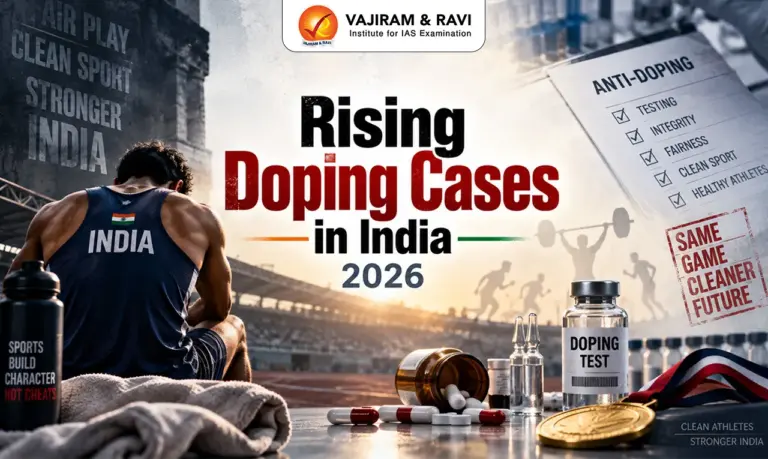
Rising Doping Cases in India have become a major concern for the country’s sporting ecosystem, with repeated violations across athletics, weightlifting, wrestling and other disciplines raising questions about athlete awareness, enforcement and the wider availability of prohibited substances.
Rising Doping Cases in India
- India recorded 42 positive doping cases in 2021, 125 in 2022, 213 in 2023 and 260 in 2024, according to government data.
- In 2026, 78 Adverse Analytical Findings (AAFs) were reported up to 15 July. An AAF means that a prohibited substance or its marker has been detected in an athlete’s sample and the finding is then examined under the anti-doping process.
- In 2026, Uttar Pradesh and Punjab recorded 13 AAFs each, followed by Madhya Pradesh with 11 and Karnataka with 9.
- In 2024, athletics recorded the highest number of positive cases at 76, followed by weightlifting with 43 and wrestling with 29.
The government has been strengthening anti-doping measures through testing, athlete education, awareness programmes and enforcement under the national anti-doping framework.
What is Doping?
Doping refers to the use of prohibited substances or methods by athletes to gain an unfair performance advantage or to violate anti-doping rules.
- Prohibited substances include anabolic agents, stimulants, hormones and other substances listed on the World Anti-Doping Agency’s Prohibited List.
- Prohibited methods include practices such as blood manipulation or other methods that can artificially enhance sporting performance.
- Doping violations can also occur when an athlete refuses testing, evades sample collection, tampers with the testing process or possesses or traffics prohibited substances.
- Coaches, doctors, trainers and other support personnel can also face anti-doping action if they provide, administer, encourage or help an athlete use prohibited substances or methods.


Major Reasons for Rising Doping Cases in India
The Major Reasons for Rising Doping Cases in India include pressure to perform, lack of awareness, unsafe supplements and easy access to prohibited substances.
- Pressure to perform: The desire to win medals, secure selection and improve performance can push athletes towards prohibited substances.
- Lack of awareness: Some athletes may not fully understand which medicines, supplements or substances are prohibited under anti-doping rules.
- Unsafe supplements: Supplements may contain prohibited substances that are not clearly mentioned on the label, putting athletes at risk of an anti-doping violation.
- Easy availability: Prohibited substances can sometimes be obtained through informal markets, online sources or people within the sporting network.
- Influence of support staff: Coaches, trainers, doctors or other support personnel may sometimes encourage or facilitate the use of prohibited substances.
- Poor awareness at the grassroots level: Young and developing athletes may not receive adequate anti-doping education before entering competitive sport.
- Weak control over supply: The availability and distribution of performance-enhancing substances can make it harder to prevent doping at its source.
- Pressure for quick results: Athletes looking for rapid improvements in strength, endurance or recovery may be tempted by performance-enhancing substances.
Impact of Rising Doping Cases in India
The persistence of doping cases raises concerns about athlete health, fair competition and India’s international sporting credibility, particularly as the country seeks to host major international sporting events, including the proposed 2036 Olympic Games.
- Athlete health: Prohibited performance-enhancing substances can expose athletes to serious health risks.
- Fair competition: Doping undermines the principle of fair play by creating an artificial performance advantage.
- Loss of medals and opportunities: Athletes found responsible can face disqualification, forfeiture of medals and prizes and periods of ineligibility, depending on the violation and applicable rules.
- Impact on young athletes: The spread of doping at junior and grassroots levels can normalise the use of performance-enhancing substances among emerging athletes.
- Institutional credibility: Repeated violations can weaken confidence in sporting federations, selection systems and anti-doping enforcement.
- International reputation: Persistent doping violations can affect India’s credibility when seeking to host major international sporting events.
- Olympic ambitions: The issue assumes greater importance as India seeks to strengthen its position in global sport and pursue the 2036 Olympic hosting ambition.
India’s Anti-Doping Framework
India has developed a legal, institutional and technological framework to prevent and detect doping.
Legal and Institutional Framework
- National Anti-Doping Agency: NADA India is the country’s national anti-doping organisation and works on testing, results management, education, research, intelligence and investigations.
- National Anti-Doping Act, 2022: The Act provides the statutory framework for regulating anti-doping activities in India and for the functioning of NADA.
- National Dope Testing Laboratory: NDTL is India’s WADA-accredited laboratory for sports dope testing and anti-doping research.
Technology, Testing and Enforcement
- NIDAMS: NADA has introduced the NADA India Data Administration and Management System to digitalise testing management and improve transparency, accountability and efficiency.
- Intelligence-led enforcement: NADA is strengthening its Intelligence and Investigations capacity and improving coordination with WADA, law-enforcement agencies and regulatory bodies for proactive detection.
- Supply-chain enforcement: The government has highlighted the need for stronger action against the trafficking and administration of prohibited substances, along with cooperation with agencies such as FSSAI and drug-control authorities.
- Scientific capacity: India is working towards strengthening its laboratory capacity, anti-doping research and testing infrastructure.
Prevention and Athlete Awareness
- Know Your Medicine: The Know Your Medicine app helps athletes and support personnel check medicines and supplements for prohibited substances.
- Anti-doping education: The government has expanded awareness programmes and plans to make anti-doping awareness sessions mandatory for athletes participating in the National Games and Khelo India competitions.
- Grassroots outreach: The government has proposed expanding anti-doping awareness to villages, schools, colleges and sporting institutions, rather than limiting education to elite athletes.
The expansion of testing and enforcement shows that India is strengthening its anti-doping system. However, the persistence of violations suggests that greater emphasis is also needed on prevention, athlete education and control of the supply chain.
Way Forward
India needs an anti-doping strategy that combines prevention, detection, enforcement and athlete education.
- Start early: Make anti-doping education a regular part of training for junior athletes, schools, colleges and Khelo India participants.
- Target the supply chain: Strengthen intelligence and coordination among NADA, law-enforcement agencies, drug regulators and sports bodies to identify the trafficking and administration of prohibited substances.
- Train support personnel: Coaches, trainers, doctors and nutritionists should receive regular training on prohibited substances, medicines and supplements.
- Use risk-based testing: Combine random testing with intelligence-led and risk-based testing to focus resources on higher-risk situations.
- Strengthen scientific capacity: Expand laboratory infrastructure, research capabilities and tools such as the Athlete Biological Passport.
- Improve supplement safety: Strengthen information and regulatory mechanisms to reduce the risk of athletes unknowingly consuming prohibited substances through contaminated supplements.
- Ensure fair adjudication: Testing should be complemented by timely, transparent and fair results management and disciplinary proceedings.

 Last updated on Sep, 2026
→ UPSC 2027 Notification will be released on 13 January 2027 at upsconline.nic.in.
→ Asian Games 2026 are being held in Aichi-Nagoya, Japan, from 19 September to 4 October.
→ Check out the latest UPSC Syllabus here.
→ Download UPSC Model Answers for Mains 2026
→ UPSC Mains Question Paper 2026 is out now for Essay & GS Paper 1, 2, 3 & 4.
→ UPSC Calendar 2027 has been released.
→ Enroll in Vajiram & Ravi’s UPSC Mains Test Series 2027 for structured answer writing practice, expert evaluation, and exam-oriented feedback.
→ Join Vajiram & Ravi’s UPSC Mentorship Program 2027 for personalized guidance, strategy planning, and one-to-one support from experienced mentors.
→ Go through the UPSC Mains Previous Year Papers to enhance your preparation.
→ UPSC has released UPSC Toppers List 2025 with the Civil Services final result on its official website.
→ Also check Best UPSC Coaching in India
Rising Doping Cases in India FAQs
Q1. What are the major reasons for rising doping cases in India?+
Q2. Which sports record the highest doping cases in India?+
Q3. What is India doing to address rising doping cases?+
Q4. Why are rising doping cases in India a concern for Indian sports?+
Q5. What is the way forward for rising doping cases in India?+
Tags: rising doping rising doping cases in india