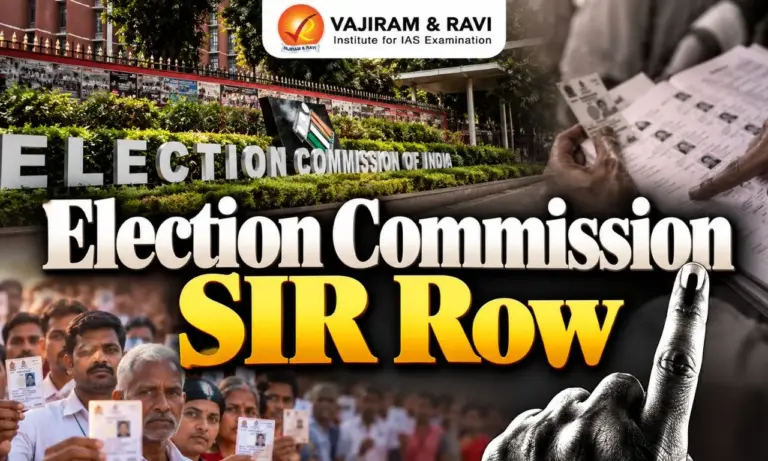
Election Commission of India (ECI) is in the news over reported differences among its three members during the Special Intensive Revision (SIR) of electoral rolls. Election Commissioners Sukhbir Singh Sandhu and Vivek Joshi raised objections at least 14 times over 10 months on issues related to voter registration, deletion and restoration of names, Form 6, electoral-roll databases and election software.
Three-Member Structure of ECI
Election Commission of India (ECI) is a multi-member body consisting of one Chief Election Commissioner (CEC) and two Election Commissioners (ECs). The three members have equal powers and status, with decisions generally taken through a majority.
- From Single to Multi-Member Body: The ECI was established in 1950 as a single-member body headed by the CEC. It became a multi-member body in October 1989 and was restored to the present three-member structure on October 1, 1993.
- Equal Powers: The CEC and Election Commissioners have equal decision-making powers within the Commission.
- Majority-Based Decisions: ECI decisions are generally taken by majority, meaning the CEC does not have a separate power to overrule the other Election Commissioners.
- Salary and Status: The CEC and Election Commissioners receive salaries and benefits as provided under law; their service conditions are governed by the Chief Election Commissioner and Other Election Commissioners Act, 2023.
How Does ECI Take Decisions?
The ECI is a three-member constitutional body consisting of the Chief Election Commissioner and two Election Commissioners. The Chief Election Commissioner (CEC) is the head of the Commission, but the other Election Commissioners also participate in decision-making.
Under Section 18 of the Chief Election Commissioner and Other Election Commissioners Act, 2023, the Commission should conduct its business as far as possible unanimously. If the members differ in opinion, the matter is decided by the majority view. Therefore, in a three-member Commission:
Two members supporting a decision = majority decision
The law also provides that the Commission’s procedure and allocation of work should be settled through a unanimous decision.


What is Form 6?
Form 6 is the application form used by an eligible person for inclusion of their name in the electoral roll. It is important because a person generally needs to be registered in the electoral roll to vote in an election.
According to the report, Election Commissioner Vivek Joshi objected to the change, saying that Form 6 could not be modified in this manner without following the applicable legal procedure. Sukhbir Singh Sandhu reportedly agreed with the objection.
The issue therefore concerns the relationship between statutory election rules and administrative changes to election forms.
Powers and Functions of Election Commission of India
Election Commission of India (ECI) is a constitutional authority responsible for supervising and conducting elections in India. Its powers cover the conduct of elections, electoral rolls, political parties, election symbols, the Model Code of Conduct and election-related compliance.
- Conduct of Elections: The ECI conducts elections to the Lok Sabha, Rajya Sabha, State Legislative Assemblies, President and Vice-President. It prepares the election schedule, supervises polling and counting, and coordinates with election officials and other authorities.
- Preparation of Electoral Rolls: The ECI supervises the preparation, revision and updating of electoral rolls. It ensures that eligible citizens can be included and that electoral records are corrected, updated or removed according to the applicable law.
- Supervision of Election Machinery: The Commission directs and supervises election officials at different levels, including Chief Electoral Officers, District Election Officers and Electoral Registration Officers, to ensure that election-related procedures are followed.
- Recognition of Political Parties: The ECI registers political parties and determines their recognition as National or State parties based on the criteria prescribed under election law.
- Allotment of Election Symbols: The Commission regulates the allotment and reservation of election symbols to political parties and candidates under the Election Symbols (Reservation and Allotment) Order, 1968.
- Model Code of Conduct: The ECI implements the Model Code of Conduct (MCC) during elections and issues directions to political parties and candidates to maintain a level playing field and ensure disciplined campaigning.
- Monitoring Election Expenditure: The Commission monitors election expenditure by candidates and political parties and takes action in cases of violations under applicable election laws.
- Advisory Functions: The ECI provides its opinion to the President or Governor on certain matters relating to the disqualification of Members of Parliament and State Legislatures, as provided under the Constitution.
- Quasi-Judicial Functions: The Commission performs certain quasi-judicial functions, including matters related to political-party recognition, election symbols and disputes involving recognised political parties.
- Ensuring Free and Fair Elections: The ECI can issue directions and take administrative measures within its constitutional and legal authority to ensure that elections are conducted in an orderly, transparent and lawful manner.
Also Read:- ECINET Form 6
Important Laws Related to ECI
Election Commission of India (ECI) functions under the Constitution and several election-related laws and rules. These laws cover electoral rolls, election conduct, voter registration, political parties and election procedures.
- Constitution of India, Articles 324-329: Part XV of the Constitution provides the basic constitutional framework for elections. Article 324 gives the ECI superintendence, direction and control over electoral rolls and elections.
- Representation of the People Act, 1950: Mainly deals with electoral rolls, voter registration, qualifications for registration and allocation of seats.
- Representation of the People Act, 1951: Covers the conduct of elections, qualifications and disqualifications of candidates, corrupt practices, election offences and election disputes.
- Registration of Electors Rules, 1960: Provides the rules and procedures for preparation, revision and correction of electoral rolls under the 1950 Act.
- Conduct of Election Rules, 1961: Provides detailed procedures for nominations, polling, counting, declaration of results and other election processes.
- Chief Election Commissioner and Other Election Commissioners Act, 2023: Provides the statutory framework concerning the appointment, service conditions and functioning of the Chief Election Commissioner and other Election Commissioners.
- Election Symbols (Reservation and Allotment) Order, 1968: Provides the framework for recognition of political parties and reservation/allotment of election symbols.
Election Commission of India Act, 2023
Election Commission Act, 2023 regulates the appointment, service conditions and functioning of the Chief Election Commissioner (CEC) and Election Commissioners (ECs).
- Appointment: President of India appoints the CEC and other Election Commissioners on the recommendation of a Selection Committee comprising the Prime Minister, Leader of Opposition in the Lok Sabha, and a Union Cabinet Minister nominated by the Prime Minister.
- Three-member structure: The Election Commission consists of the CEC and such number of Election Commissioners as the President may fix.
- Decision-making: ECI matters should, as far as possible, be decided unanimously; if members disagree, the majority view prevails.
- Service conditions: Specifies provisions relating to the term of office, salary, allowances and other conditions of service of the CEC and ECs.
Removal of Election Commissioners
Chief Election Commissioner (CEC) and other Election Commissioners have different removal protections under Article 324 of the Constitution and the 2023 Act.
- CEC: Can be removed by the President only in the same manner and on the same grounds as a Supreme Court judge.
- Other Election Commissioners: Can be removed by the President only on the recommendation of the CEC.
- Resignation: The CEC or any Election Commissioner can resign by submitting a written resignation to the President.
- Protection of tenure: These provisions are intended to provide legal safeguards for the independence of the Election Commission.
- Tenure: The CEC and other Election Commissioners hold office for 6 years or until they attain 65 years of age, whichever is earlier.

 Last updated on Sep, 2026
→ UPSC 2027 Notification will be released on 13 January 2027 at upsconline.nic.in.
→ Asian Games 2026 are being held in Aichi-Nagoya, Japan, from 19 September to 4 October.
→ Check out the latest UPSC Syllabus here.
→ Download UPSC Model Answers for Mains 2026
→ UPSC Mains Question Paper 2026 is out now for Essay & GS Paper 1, 2, 3 & 4.
→ UPSC Calendar 2027 has been released.
→ Enroll in Vajiram & Ravi’s UPSC Mains Test Series 2027 for structured answer writing practice, expert evaluation, and exam-oriented feedback.
→ Join Vajiram & Ravi’s UPSC Mentorship Program 2027 for personalized guidance, strategy planning, and one-to-one support from experienced mentors.
→ Go through the UPSC Mains Previous Year Papers to enhance your preparation.
→ UPSC has released UPSC Toppers List 2025 with the Civil Services final result on its official website.
→ Also check Best UPSC Coaching in India
Election Commission SIR Row FAQs
Q1. What is the Election Commission SIR Row?+
Q2. What is Special Intensive Revision (SIR)?+
Q3. What is Form 6?+
Q4. Who are the three members of the Election Commission?+
Q5. How does the Election Commission take decisions?+
Tags: election commission election commission sir row sir row