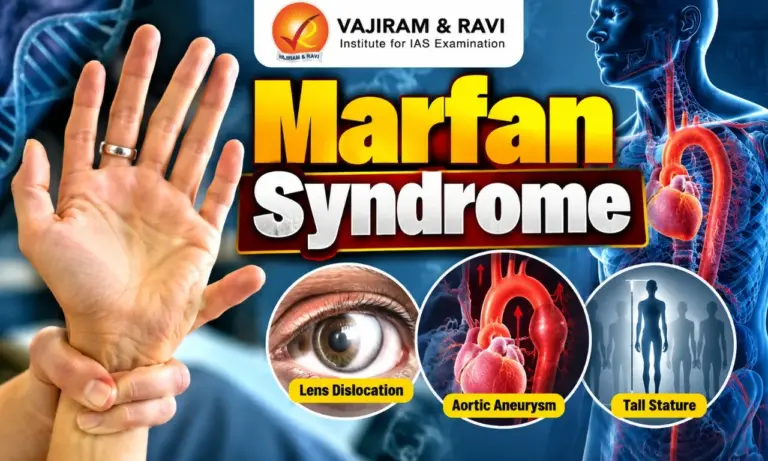
Marfan Syndrome Latest News
Researchers recently published the first molecular characterization of Marfan syndrome in domestic cats.
About Marfan Syndrome
- It is a genetic condition that affects the connective tissue in the body.
- Connective tissue helps support structures in the body, including organs, bones, and blood vessels.
- It most commonly affects the heart, eyes, blood vessels, and bones.


Marfan Syndrome Cause
- It is a hereditary condition.
- There’s a change in the fibrillin-1 or FBN1 gene that gives your cells instructions to make fibrillin, a protein.
- This protein helps connective tissue stay strong and flexible.
Marfan Syndrome Symptoms
- Some people have only mild damage caused by Marfan syndrome, but others can have serious health issues.
- The symptoms can be different from person to person, even among members of the same family.
- Common Symptoms Include:
- Tall, thin body.
- Long arms, legs, fingers, or toes.
- A chest that sticks out or sinks in.
- Crowded teeth and a high, arched roof of the mouth.
- Heart murmurs.
- Very poor eyesight or nearsightedness.
- A curved spine.
- Flat feet.
- Changes in the chest wall and spine can cause shortness of breath and back pain.
- The most serious risk is damage to the aorta, the large blood vessel that carries blood from your heart to the rest of your body.
- If the aorta becomes weak or tears, the condition can become life-threatening.
- Changes to the heart and the aorta usually do not produce symptoms until they are advanced or until an emergency occurs.
Marfan Syndrome Treatment
- There’s no cure for Marfan syndrome, so treatment focuses on managing the symptoms and reducing the risk of complications.
- Treatment usually includes medicines to keep your blood pressure low. This helps reduce the strain on your aorta.
- Many people with Marfan syndrome eventually require preventive surgery to repair the aorta.
News: PHYS

 Last updated on Sep, 2026
→ UPSC 2027 Notification will be released on 13 January 2027 at upsconline.nic.in.
→ Asian Games 2026 are being held in Aichi-Nagoya, Japan, from 19 September to 4 October.
→ Check out the latest UPSC Syllabus here.
→ Download UPSC Model Answers for Mains 2026
→ UPSC Mains Question Paper 2026 is out now for Essay & GS Paper 1, 2, 3 & 4.
→ UPSC Calendar 2027 has been released.
→ Enroll in Vajiram & Ravi’s UPSC Mains Test Series 2027 for structured answer writing practice, expert evaluation, and exam-oriented feedback.
→ Join Vajiram & Ravi’s UPSC Mentorship Program 2027 for personalized guidance, strategy planning, and one-to-one support from experienced mentors.
→ Go through the UPSC Mains Previous Year Papers to enhance your preparation.
→ UPSC has released UPSC Toppers List 2025 with the Civil Services final result on its official website.
→ Also check Best UPSC Coaching in India
Marfan Syndrome FAQs
Q1. What is Marfan syndrome?+
Q2. Which organs and body structures are commonly affected by Marfan syndrome?+
Q3. Which gene is most commonly associated with Marfan syndrome?+
Q4. What are common physical features of Marfan syndrome?+
Q5. What is the most serious cardiovascular risk associated with Marfan syndrome?+
Tags: marfan syndrome