Taiwan Latest News
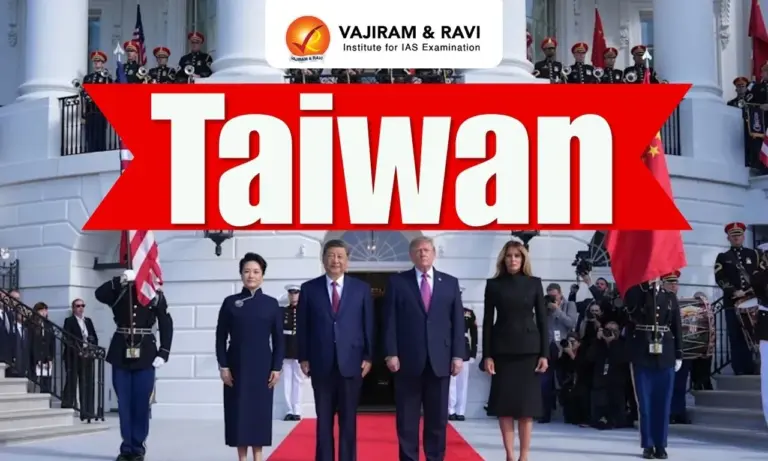
- During Chinese President Xi Jinping’s visit to the United States, issues ranging from tariffs to AI regulation were on the agenda, carrying global implications. But for China, the most significant concern is likely US policy on Taiwan.
- China has called Taiwan a “red line” that cannot be challenged. In Washington, Xi said China hopes the US will oppose “Taiwan independence” and handle the issue with caution “to lay a solid foundation for China-US strategic cooperation.”
The Larger US-China Meeting: What to Expect
- Trump’s first term (from 2017) centred on strategic competition and correcting unfair trade with China.
- His approach has since evolved — he believes personal charm can persuade autocratic leaders, a playbook used with Vladimir Putin and Kim Jong Un. It hasn’t worked with Putin, given the lack of a Ukraine agreement.
- With China, the outcome is uncertain. Trump understands the cultural importance of respect and has shown deference to Xi.
- But leverage remains a concern — during the last trade war, when China restricted rare earths, the US lost its negotiating advantage.
- Realistic outcomes: Agreement on AI principles, extended trade, or better personal rapport preventing future escalation would count as positive.


Taiwan in US Policy
- Before 1979: The US officially recognised Taiwan as representing China internationally.
- Three Joint Communiqués (through 1982): The US and mainland China agreed to recognise each other diplomatically, conditional on the US revoking recognition of Taiwan. The third communiqué stated the US would gradually decrease arms sales to Taiwan.
- The Six Assurances: A classified US memo to Taiwan clarifying that the US had not agreed to any end date on arms sales and would not negotiate with China over them — reassuring Taiwan it wasn’t being abandoned.
- Taiwan Relations Act, 1979: This remains the basis of unofficial US-Taiwan relations, with the US as Taiwan’s primary arms supplier, committed to helping Taiwan credibly deter Chinese military action.
Strategic Ambiguity: Biden vs Trump
- Strategic ambiguity is the long-standing US policy of not explicitly committing to military support for Taiwan in case of a Chinese attack.
- Joe Biden repeatedly dispensed with this ambiguity, stating the US would intervene militarily.
- Trump has softened this stance, echoing Chinese talking points such as “no one wants to go to war” and noting “Taiwan’s 9,500 miles away.”
- This shift worries Taiwan while pleasing China.
The Arms Package Controversy
- In 2025: Trump approved a $10 billion arms package to Taiwan.
- Now: A proposed $14 billion package — the largest ever — awaits Trump’s clearance.
- It remains unclear whether this package has become a “red line of red lines” for Xi, though China has likely signalled consequences if it’s approved.
Why China Wants It Held Off
- After Trump and Xi’s meeting in Beijing in May 2026, Trump gave interviews echoing Beijing’s talking points without reasserting long-standing US Taiwan policy, including arms sales.
- Xi appears to view Trump as malleable on this issue and is testing how far he can be pushed toward Beijing’s position.
Current Status
- Trump has paused the $14 billion package — possibly as a token gesture to Xi in service of securing what Trump primarily wants: trade and bilateral investment.
- Experts predict Trump will eventually approve it, but the timing will be significant, likely well after this visit. A failure to approve it would set a worrying precedent.
The Economic Stakes: TSMC and Chip Supply Chains
- Beyond geopolitics, Taiwan’s economic weight has grown sharply because TSMC, based in Taiwan, became the world’s number-one chipmaker.
- Semiconductors are essential components for nearly all modern electronics.
- Theories that China might invade specifically to seize TSMC lack strong credibility.
- Nonetheless, any conflict would severely disrupt global chip supply chains — a major concern for the US and all chip-importing countries.
- Both Trump and Xi reportedly understand that a Taiwan conflict would be disastrous.
- This has driven increased US-Taiwan discussions on supply chain resiliency, and Trump has pushed Taiwan to shift chip manufacturing to the US — leading to investments in Arizona.
Conclusion
- Taiwan sits at the exact intersection of geopolitics and economics — a small island whose chips power the world and whose fate could trigger a great-power confrontation. Trump’s willingness to soften strategic ambiguity, even as a bargaining chip, unsettles a region already hedging its bets.
- The paused $14 billion arms package is not just about weapons — it is a live signal of how much Washington is willing to trade for Beijing’s cooperation elsewhere.
Source: IE

 Last updated on Sep, 2026
→ UPSC 2027 Notification will be released on 13 January 2027 at upsconline.nic.in.
→ Asian Games 2026 are being held in Aichi-Nagoya, Japan, from 19 September to 4 October.
→ Check out the latest UPSC Syllabus here.
→ Download UPSC Model Answers for Mains 2026
→ UPSC Mains Question Paper 2026 is out now for Essay & GS Paper 1, 2, 3 & 4.
→ UPSC Calendar 2027 has been released.
→ Enroll in Vajiram & Ravi’s UPSC Mains Test Series 2027 for structured answer writing practice, expert evaluation, and exam-oriented feedback.
→ Join Vajiram & Ravi’s UPSC Mentorship Program 2027 for personalized guidance, strategy planning, and one-to-one support from experienced mentors.
→ Go through the UPSC Mains Previous Year Papers to enhance your preparation.
→ UPSC has released UPSC Toppers List 2025 with the Civil Services final result on its official website.
→ Also check Best UPSC Coaching in India
Taiwan FAQ
Q1. Why is Taiwan important in the Xi-Trump meeting? +
Q2. What is the Taiwan Relations Act? +
Q3. What is strategic ambiguity regarding Taiwan?+
Q4. Why is the proposed US arms package important for Taiwan? +
Q5. Why does Taiwan matter to global semiconductor supply chains? +
Tags: mains articles Taiwan upsc current affairs upsc mains current affairs