Enemy State Clause Latest News
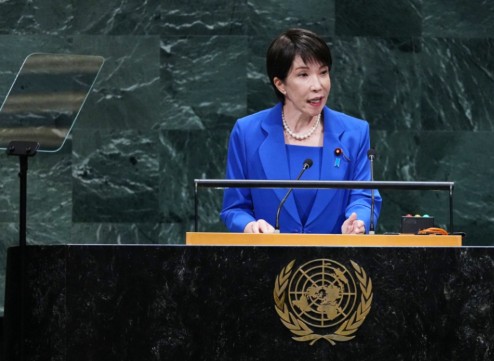
- In her first-ever address to the United Nations General Assembly (UNGA), Japan’s Prime Minister Sanae Takaichi called on the UN to remove references to “enemy states” in its Charter.
- The label has recently been used by China and Russia to attack Japan’s plans to raise defence spending.
About Enemy State Clause
- World War II (1939–45) was fought between the Allied Powers (Great Britain, the Soviet Union, the United States) and the Axis Powers (Germany, Italy, Japan).
- Japan was the last Axis power to surrender, in September 1945.
- The UN Charter, drafted toward the war’s end and in force from October 24, 1945, contains numerous references to “enemy states.”
- The Allies — who drafted the Charter and later took permanent UN Security Council (UNSC) seats — designed it as a mechanism to counter any re-emergence of militarism or fascism in the defeated Axis powers, without needing UNSC approval each time.
- In other words, the UN Charter’s “enemy state” clauses (Articles 53, 77, 107) let Allied powers take military or preventive action against defeated WWII Axis nations without needing prior UNSC authorization.
Where it Appears
- The term features in three Articles: 53, 77, and 107.
- Article 53: Permits enforcement action against an “enemy state” through regional arrangements without prior Security Council authorisation — an exception to the normal rule requiring UNSC approval for such action.
- Paragraph 2 defines enemy state as any state that was an enemy of a Charter signatory during World War II.
- Article 107: States that nothing in the Charter invalidates or blocks action taken against a WWII enemy state by the governments responsible for such action as a result of that war.
- In effect, it gives the Allied Powers a legal right to act against defeated Axis states without UNSC approval.
- Article 77(1)(b): Concerns the “trusteeship system” applied to territories detached from enemy states after WWII.
- Under the Charter, the UN was to establish an international trusteeship system (Article 75) for “trust territories” — places whose peoples had not yet attained full self-government (Article 73).
- There were 11 such territories, across Africa and the Pacific Islands.


Why Japan Wants It Removed
- The UNGA recognised the clauses as obsolete in 1995.
- A resolution in 2005 called for deleting enemy state references from the Charter.
- Japan’s call to remove this cluse is being framed within a wider appeal for UN and UNSC reform, which she called “a matter of utmost importance.
The Geopolitical Backdrop
- Japanese PM’s remarks come amid rising hostility with China and Russia, both exerting economic and military pressure on Japan.
- With China: China has restricted access to rare earth magnets needed by Japanese manufacturers.
- Chinese fighter aircraft and warships have conducted military drills near the Japanese coast.
- With Russia: Russia has conducted military exercises near Japan and criticised Japan’s plans to raise defence spending.
- In August 2026, Russian President visited the disputed southern Kuril Islands. This led to strong protest by Japan.
How The Clause is Used Against Japan Diplomatically
- China argues the clauses safeguard the postwar international order.
- Russia argues the clauses invalidate Japan’s territorial claims over the southern Kuril Islands.
Why Nothing Has Changed
- Amending the Charter requires approval from all five permanent UNSC members, not just a General Assembly vote.
- As experts explained, each P5 member must ratify the change domestically, not merely vote for it.
- Analysts pointed to a specific factor too: Japan continues to host US troops on its soil, which may fuel Chinese and Russian reservations about removing the clause.
- They add that the Big Five may fear that revising Charter language could open the door to broader demands — such as reforming UNSC composition itself — which would dilute their influence.
Conclusion
- The “enemy state” clause is legally dormant but diplomatically alive — a rhetorical weapon precisely because it was never formally deleted.
- Its survival for over eight decades reveals less about Japan’s past than about the durability of the postwar order the Big Five still control.
- Real removal would require the P5 to loosen a grip they show little sign of releasing.

 Last updated on Sep, 2026
→ UPSC 2027 Notification will be released on 13 January 2027 at upsconline.nic.in.
→ Asian Games 2026 are being held in Aichi-Nagoya, Japan, from 19 September to 4 October.
→ Check out the latest UPSC Syllabus here.
→ Download UPSC Model Answers for Mains 2026
→ UPSC Mains Question Paper 2026 is out now for Essay & GS Paper 1, 2, 3 & 4.
→ UPSC Calendar 2027 has been released.
→ Enroll in Vajiram & Ravi’s UPSC Mains Test Series 2027 for structured answer writing practice, expert evaluation, and exam-oriented feedback.
→ Join Vajiram & Ravi’s UPSC Mentorship Program 2027 for personalized guidance, strategy planning, and one-to-one support from experienced mentors.
→ Go through the UPSC Mains Previous Year Papers to enhance your preparation.
→ UPSC has released UPSC Toppers List 2025 with the Civil Services final result on its official website.
→ Also check Best UPSC Coaching in India
Enemy State Clause FAQs
Q1. What is the Enemy State Clause in the UN Charter?+
Q2. Which UN Charter articles contain the Enemy State Clause?+
Q3. Why does Japan want the Enemy State Clause removed?+
Q4. How has the Enemy State Clause been used against Japan?+
Q5. Why has the Enemy State Clause not been removed?+
Tags: Enemy State Clause mains articles upsc current affairs upsc mains current affairs