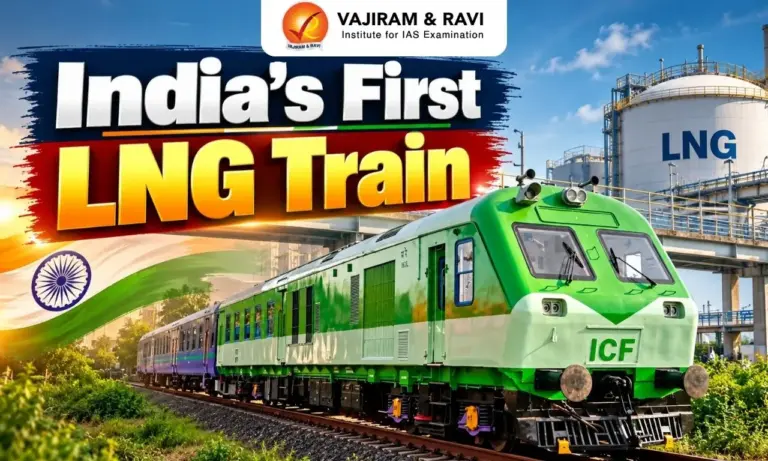
India’s first LNG-powered train was flagged off from Sabarmati Railway Station in Ahmedabad, Gujarat, on September 27, 2026, marking the introduction of liquefied natural gas (LNG) as an alternative fuel in Indian Railways. The train uses a diesel-LNG dual-fuel system, allowing LNG to partially replace conventional diesel.
Why in News?
India’s first LNG-powered train was flagged off from Sabarmati, Gujarat, by Union Home and Cooperation Minister Amit Shah and Gujarat Chief Minister Bhupendra Patel. The initiative is aimed at reducing diesel consumption, fuel costs and emissions in railway operations while promoting alternative fuels.
How Does the LNG-Diesel Dual-Fuel System Work?
The technology does not completely eliminate diesel use. Instead, LNG is used alongside diesel in the converted engine.
The system allows LNG to replace around 40% of diesel consumption. This can reduce the quantity of diesel required while retaining the operational capability of the existing diesel engine.


Benefits of India’s LNG Train
India’s LNG train can help reduce diesel consumption, fuel costs and emissions while promoting the use of alternative fuels in railway transportation.
- Reduced Diesel Consumption: The dual-fuel system allows LNG to replace a significant portion of diesel, reducing dependence on conventional diesel fuel.
- Lower Fuel Costs: Greater use of LNG can reduce operational fuel expenditure where LNG is economically competitive with diesel.
- Lower Emissions: LNG combustion generally produces lower levels of particulate matter, sulphur oxides and nitrogen oxides than conventional diesel combustion.
- Energy Diversification: It promotes the use of natural gas as an alternative transport fuel, diversifying the railway sector’s energy mix.
- Better Air Quality: Lower emissions of particulate pollutants can help reduce local air pollution, particularly around railway operations.
- Dual-Fuel Flexibility: The train can operate using both LNG and diesel, allowing continued operation when LNG availability is limited.
- Use of Existing Technology: Converting suitable diesel-powered systems to dual-fuel technology can allow partial utilisation of existing railway infrastructure.
- Transition Fuel: LNG can serve as an intermediate fuel option while India continues its broader transition towards electrification and cleaner energy sources.
Significance for Indian Railways
The LNG train is part of the broader effort to promote energy efficiency, cleaner transportation and alternative fuel technologies in the railway sector.
Indian Railways has already been pursuing electrification and renewable energy as major pathways for reducing fossil-fuel dependence. LNG can serve as an additional transition technology, particularly for railway operations where complete electrification may take time.
However, LNG is still a fossil fuel, so its use should be viewed as a transition or alternative-fuel measure rather than a zero-carbon solution.
LNG and India’s Energy Transition
LNG can act as a transition fuel in India’s energy transition by reducing dependence on more carbon-intensive fuels while the country expands renewable energy and electrification to achieve its net-zero emissions target by 2070.
- Net-Zero Target: India has committed to achieving net-zero carbon emissions by 2070.
- 2030 Emission Target: India aims to reduce the emissions intensity of its GDP by 45% from 2005 levels by 2030.
- Non-Fossil Energy Capacity: India has set a target of achieving 50% of its installed electricity generation capacity from non-fossil fuel sources by 2030.
- Energy Diversification: LNG can diversify India’s energy mix by providing an alternative to coal and petroleum-based fuels.
- Lower Local Pollution: LNG generally produces lower particulate matter, sulphur oxides and nitrogen oxides than conventional diesel and coal-based fuels.
- Transport Sector: LNG can be used as an alternative fuel in railways, heavy-duty road transport and shipping.
- Industrial Transition: Natural gas can help industries gradually shift away from more carbon-intensive fuels.
- Renewable Energy Support: Gas-based power can provide flexibility when solar and wind generation fluctuates.
- Methane Challenge: Methane leakage during extraction, processing and transportation remains an important climate concern.
- Fossil-Fuel Limitation: LNG is still a fossil fuel, so its use must be balanced with rapid expansion of renewable energy and electrification.
About Liquefied Natural Gas (LNG)
Liquefied Natural Gas (LNG) is natural gas, composed mainly of methane, that is cooled to around −162°C to convert it into a liquid, reducing its volume and making it easier to store and transport over long distances.
- Main Component: It primarily consists of methane (CH₄), with small quantities of other hydrocarbons.
- Formation: Natural gas is purified and then cooled to approximately −162°C, causing it to change from a gas into a liquid.
- Volume Reduction: LNG occupies about 1/600th of the volume of natural gas in its gaseous state, making transportation more efficient.
- Storage: It is stored in specially designed cryogenic tanks that maintain extremely low temperatures.
- Transportation: LNG can be transported through specialised LNG carriers, trucks and rail-based systems.
- Regasification: Before use as conventional natural gas, LNG is warmed and converted back into its gaseous form at regasification terminals.
- Energy Use: LNG is used in power generation, industries, transport and city gas distribution.
- Lower Air Pollutants: Compared with coal and some petroleum fuels, LNG generally produces lower levels of particulate matter and sulphur oxides during combustion.
- Fossil Fuel: LNG is not a renewable source of energy because it is derived from natural gas.
- Methane Concern: Methane leakage during extraction, liquefaction, transportation and regasification is an important environmental concern.

 Last updated on Sep, 2026
→ UPSC 2027 Notification will be released on 13 January 2027 at upsconline.nic.in.
→ Asian Games 2026 are being held in Aichi-Nagoya, Japan, from 19 September to 4 October.
→ Check out the latest UPSC Syllabus here.
→ Download UPSC Model Answers for Mains 2026
→ UPSC Mains Question Paper 2026 is out now for Essay & GS Paper 1, 2, 3 & 4.
→ UPSC Calendar 2027 has been released.
→ Enroll in Vajiram & Ravi’s UPSC Mains Test Series 2027 for structured answer writing practice, expert evaluation, and exam-oriented feedback.
→ Join Vajiram & Ravi’s UPSC Mentorship Program 2027 for personalized guidance, strategy planning, and one-to-one support from experienced mentors.
→ Go through the UPSC Mains Previous Year Papers to enhance your preparation.
→ UPSC has released UPSC Toppers List 2025 with the Civil Services final result on its official website.
→ Also check Best UPSC Coaching in India
India’s First LNG Train FAQs
Q1. What is India’s first LNG train?+
Q2. Who flagged off India’s first LNG-powered train?+
Q3. What is the fuel system used in the LNG train?+
Q4. How much diesel can the LNG train replace?+
Q5. How many power cars were converted for the project?+
Q6. What was the inaugural route of India’s first LNG train?+
Tags: first LNG train india’s first LNG train