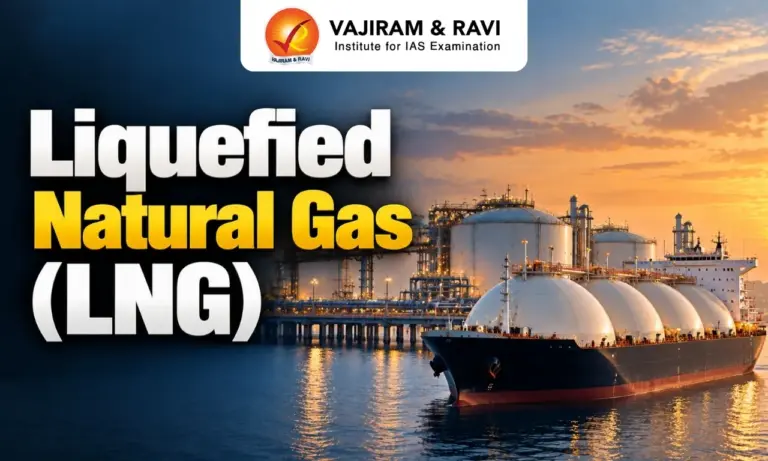
Liquefied Natural Gas (LNG) is natural gas cooled to a very low temperature so that it becomes a liquid, allowing it to be stored and transported efficiently over long distances. It is mainly composed of methane and has emerged as an important component of the global natural gas trade and energy security.
What is Liquefied Natural Gas?
Liquefied Natural Gas (LNG) is natural gas converted into liquid form by cooling it to about -161°C at atmospheric pressure.
- LNG is composed mainly of methane (CH₄), with small quantities of ethane, propane, butane and nitrogen depending on its source and processing.
- Liquefaction reduces natural gas to about 1/600th of its original volume, making large-scale transportation by specialised ships economically feasible.
- LNG is colourless and odourless in its liquid form.
- LNG should not be confused with Liquefied Petroleum Gas (LPG), which mainly consists of propane and butane.
How is LNG Produced and Used?
The LNG value chain involves extraction, processing, liquefaction, transportation, regasification and end use.
- Natural gas extraction: Natural gas is extracted from underground reservoirs.
- Gas processing: Water, carbon dioxide and other impurities are removed from the extracted gas.
- Liquefaction: The purified gas is cooled to about -161°C, converting it into a liquid and greatly reducing its volume.
- Transportation: LNG is transported in specially designed cryogenic tankers.
- Regasification: At the destination, LNG is warmed and converted back into natural gas.
- End use: Regasified natural gas is supplied for power generation, industries, cooking, transport and other applications.
Also Read:- Natural Gas


Why is LNG Important?
LNG is important because it allows natural gas to be traded globally rather than being dependent only on fixed pipeline networks.
- Energy security: LNG enables countries to diversify their sources of natural gas and reduce dependence on a single supplier or pipeline route.
- Flexible transportation: Liquefaction allows natural gas to be transported by sea over long distances.
- Industrial use: LNG-derived natural gas is used in sectors such as fertilisers, chemicals, refining and other industries.
- Power generation: Natural gas can be used for electricity generation and can complement variable renewable energy sources.
- Urban energy supply: Regasified LNG can enter gas distribution networks for domestic and commercial consumption.
- Global energy trade: LNG has enabled countries without domestic gas resources to access international natural gas markets.
LNG and the Energy Transition
LNG can support the energy transition by providing a flexible energy source alongside variable renewable energy, but it remains a fossil fuel.
- Lower emissions than coal: Natural gas generally produces fewer greenhouse gas emissions than coal, although this advantage depends on methane leakage.
- Supports renewable energy: LNG-based power generation can provide electricity when solar or wind generation is unavailable.
- Not a zero-emission fuel: LNG remains a fossil fuel and cannot by itself provide a net-zero energy solution.
- Methane emissions: Methane leakage during extraction, processing, transportation and regasification can reduce LNG’s climate advantage.
- Higher lifecycle emissions: Liquefaction and long-distance transportation require additional energy, increasing the overall emissions of LNG.
LNG can support the transition while renewable energy capacity expands, but its full lifecycle environmental impact must be considered.
Environmental Concerns Associated with LNG
The lower carbon emissions of natural gas compared with coal do not eliminate the environmental concerns associated with LNG.
- Methane leakage: Methane can escape during natural gas production, processing, transportation, LNG shipping and regasification.
- Energy-intensive liquefaction: Converting natural gas into LNG requires substantial energy.
- Shipping emissions: Long-distance transportation adds to the overall lifecycle emissions of LNG.
- Fossil-fuel dependence: Continued investment in LNG infrastructure can prolong dependence on fossil fuels.
- Boil-off gas: A small quantity of LNG can evaporate during storage and transportation, creating a need for appropriate management.
- Infrastructure lock-in: Large LNG terminals and associated infrastructure can have long operating lifetimes, raising questions about their compatibility with long-term decarbonisation goals.
The IEA’s 2026 assessment estimates that the global average emissions intensity of LNG from production through regasification was 18.6 g CO₂ equivalent per megajoule of delivered LNG in 2025. It also identifies methane abatement, improved efficiency, electrification, reduced flaring and carbon capture as options for reducing emissions across the LNG supply chain.
Also Read:- India’s First LNG Train
LNG in India
India is an important LNG-importing country because domestic natural gas production does not fully meet its demand. LNG therefore plays a significant role in diversifying India’s energy supply.
- India has developed LNG import and regasification terminals along its western and eastern coasts.
- According to the Petroleum and Natural Gas Regulatory Board (PNGRB), India had eight operational onshore LNG terminals with a combined regasification capacity of about 52.7 million tonnes per annum (MMTPA) in 2025.
- Imported LNG is converted back into natural gas through regasification before being supplied to consumers.
- Regasified LNG is used in fertiliser plants, industries, power generation and city gas distribution networks.
- LNG imports help India diversify natural gas supplies and strengthen energy security.
- However, dependence on imported LNG exposes India to international gas prices, shipping costs, exchange-rate fluctuations and geopolitical disruptions.
LNG, Energy Security and Renewable Energy
For India, LNG has strategic importance because it provides access to natural gas from international markets and helps diversify energy supplies.
- Energy security: LNG imports diversify supply sources and provide greater flexibility in meeting natural gas demand.
- Supply risks: Dependence on imported LNG exposes India to international gas prices, shipping costs, exchange-rate movements and geopolitical disruptions.
- Infrastructure needs: Greater benefits require improvements in domestic gas production, storage, pipeline connectivity, terminal utilisation and supply diversification.
- Renewable energy support: LNG-based power generation can complement solar and wind power when renewable generation fluctuates.
- Transition fuel: LNG can support the energy transition, but it is not a zero-carbon solution because methane leakage and emissions from liquefaction and transportation affect its overall climate impact.
Way Forward
The future role of LNG requires balancing energy security, affordability and environmental sustainability.
- Improve methane monitoring and leak reduction across the LNG supply chain.
- Increase the efficiency of liquefaction, shipping and regasification.
- Diversify LNG suppliers and supply routes to strengthen energy security.
- Improve utilisation of existing LNG infrastructure before creating excessive additional capacity.
- Integrate natural gas strategically with renewable energy expansion.
- Assess LNG projects through their full lifecycle emissions, rather than only emissions from final combustion.
- Use technological solutions such as electrification, reduced flaring and carbon capture where technically and economically feasible.

 Last updated on Sep, 2026
→ UPSC 2027 Notification will be released on 13 January 2027 at upsconline.nic.in.
→ Asian Games 2026 are being held in Aichi-Nagoya, Japan, from 19 September to 4 October.
→ Check out the latest UPSC Syllabus here.
→ Download UPSC Model Answers for Mains 2026
→ UPSC Mains Question Paper 2026 is out now for Essay & GS Paper 1, 2, 3 & 4.
→ UPSC Calendar 2027 has been released.
→ Enroll in Vajiram & Ravi’s UPSC Mains Test Series 2027 for structured answer writing practice, expert evaluation, and exam-oriented feedback.
→ Join Vajiram & Ravi’s UPSC Mentorship Program 2027 for personalized guidance, strategy planning, and one-to-one support from experienced mentors.
→ Go through the UPSC Mains Previous Year Papers to enhance your preparation.
→ UPSC has released UPSC Toppers List 2025 with the Civil Services final result on its official website.
→ Also check Best UPSC Coaching in India
Liquefied Natural Gas (LNG) FAQs
Q1. What is Liquefied Natural Gas (LNG)?+
Q2. What is the difference between LNG and LPG?+
Q3. Why is LNG important for India’s energy security?+
Q4. Is LNG a clean fuel?+
Q5. How does LNG support the energy transition?+
Tags: liquefied natural gas liquefied natural gas (LNG)