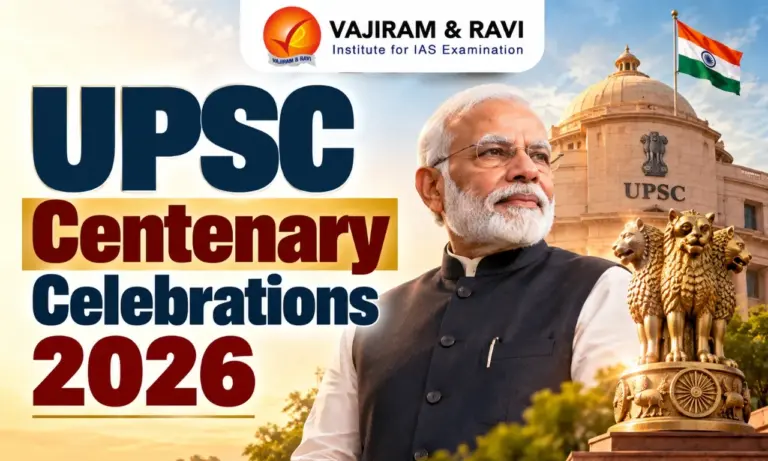
Union Public Service Commission (UPSC) is completing 100 years of its institutional journey in 2026. To mark this milestone, the Commission is organising its Centenary Celebrations at Bharat Mandapam, New Delhi, on October 1, 2026.
Prime Minister Narendra Modi is participating in the centenary celebrations and addressing the gathering. He is also scheduled to release a UPSC Centenary Commemorative Coin, a Commemorative Stamp and a book titled “100 Landmark Judgements – Shaping the Policies of UPSC and Public Service Commissions in India.”
The event marks 100 years since the establishment of the first Public Service Commission in India in 1926. The celebrations are also an opportunity to look at the institution’s historical journey, constitutional role and future reforms.
UPSC Completes 100 Years
The first Public Service Commission in India was established on October 1, 1926. Its establishment followed the provisions of the Government of India Act, 1919 and the recommendations of the Lee Commission (1924).
What is the Union Public Service Commission?
Union Public Service Commission (UPSC) is a constitutional body established under Article 315 of the Indian Constitution. It conducts competitive examinations for recruitment to various Central Government services and posts. It also advises the government on matters related to recruitment, promotions, transfers and disciplinary actions. The Commission aims to ensure merit-based, fair and impartial recruitment to public services.


History of UPSC
The history of the Union Public Service Commission (UPSC) is closely linked with the evolution of merit-based recruitment to public services in India. Its institutional journey began during the British period and gradually developed into an independent constitutional body after India became a Republic.
- 1855 – Beginning of Competitive Recruitment: The system of competitive recruitment to the Indian Civil Service (ICS) was introduced in 1855, replacing the earlier system of nomination by the East India Company. Initially, the examination was conducted in London, which made it difficult for Indians to participate.
- 1919 – Government of India Act: The Government of India Act, 1919 provided for the establishment of a Public Service Commission. Section 96C envisaged a body that would deal with matters related to the recruitment and control of public services in India. However, the Commission was not immediately established.
- 1924 – Lee Commission: The Royal Commission on the Superior Civil Services in India, headed by Lord Lee, submitted its report in 1924. It strongly recommended the early establishment of a statutory Public Service Commission in India.
- 1926 – First Public Service Commission: On 1 October 1926, the first Public Service Commission was established in India. Sir Ross Barker became its first Chairman. The Commission initially had limited advisory powers and was mainly consulted on matters relating to recruitment and public services.
- 1926 – Initial Structure: The Commission consisted of a Chairman and four Members. It was initially located at Metcalfe House in Delhi. Its functions were governed by the Public Service Commission (Functions) Rules, 1926, framed under the Government of India Act, 1919.
- 1935 – Government of India Act: The Government of India Act, 1935 provided a broader framework for public service commissions and strengthened the institutional arrangement for recruitment to public services.
- 1937 – Federal Public Service Commission: On 1 April 1937, the Public Service Commission was renamed the Federal Public Service Commission under the Government of India Act, 1935. Its role expanded as the system of public service recruitment developed.
- 1938 – Combined Competitive Examinations: Combined competitive examinations were introduced for several services, marking an important step towards a unified recruitment system for multiple public services.
- 1947 – Independence: After India became independent, the Federal Public Service Commission continued its recruitment-related responsibilities during the transition to the new administrative system. H.K. Kripalani became the first Indian Chairman of the Commission. The first examination after Independence was held in December 1947, with the ICS gradually giving way to the Indian Administrative Service (IAS).
- 1950 – Constitutional Status: With the Constitution coming into force on 26 January 1950, the Federal Public Service Commission became the Union Public Service Commission. It was given constitutional status under Part XIV of the Constitution, covering Articles 315 to 323.
- 1950–51 – Recruitment to All-India Services: The Commission conducted regular recruitment to the newly established All-India Services. In the first recruitment under the constitutional framework, 29 candidates were recommended for the IAS and 31 for the IPS.
- 1966–67 – Indian Forest Service: The Indian Forest Service (IFoS) became the third All India Service in 1966, with the first selection taking place in 1967.
- 1976 – Kothari Committee: The D.S. Kothari Committee recommended changes in the examination system, including a three-stage structure. This became an important step in the later development of the Civil Services Examination.
- 1978–79 – Modern Examination System: The Commission began using computers for processing applications, answer sheets and records in 1978. In 1979, the three-stage examination system comprising Preliminary Examination, Main Examination and Interview was introduced.
- 2025–26 – Centenary Year: The Commission began its Centenary Year celebrations on 1 October 2025, marking 100 years since the establishment of the first Public Service Commission in 1926. The celebrations continued until 1 October 2026.
- 2026 – Completion of 100 Years: On 1 October 2026, the Commission completes 100 years of its institutional journey. Its evolution from an advisory Public Service Commission in 1926 to an independent constitutional body reflects the development of India’s public recruitment system.
Constitutional Provisions Related to UPSC
Union Public Service Commission (UPSC) is a constitutional body governed by Part XIV of the Indian Constitution, particularly Articles 315 to 323, which deal with its establishment, composition, functions, independence and reporting responsibilities.
- Article 315 – Public Service Commissions: Provides for the establishment of a Public Service Commission for the Union and a separate commission for each State.
- Article 316 – Appointment and Term of Office: Deals with the appointment of the Chairman and other members of the Commission and their tenure.
- Article 317 – Removal and Suspension: Specifies the conditions and procedure for the removal or suspension of the Chairman or members of the Commission.
- Article 318 – Regulations: Gives the President the power to determine the number of members and staff of the Commission and their conditions of service through regulations.
- Article 319 – Restrictions on Future Employment: Places restrictions on the future employment of the Chairman and members of Public Service Commissions after completing their term.
- Article 320 – Functions: Specifies the major functions of the Commission, including conducting examinations, recruitment and advising the government on specified service-related matters.
- Article 321 – Extension of Functions: Allows Parliament to extend the functions of the Commission through legislation.
- Article 322 – Expenses: Provides that the expenses of the Commission are charged on the Consolidated Fund of India, supporting its financial independence.
- Article 323 – Annual Reports: Requires the Commission to submit an annual report to the President, who places it before Parliament along with a memorandum explaining cases where its advice was not accepted.
Major Functions of UPSC
Union Public Service Commission (UPSC) performs recruitment and advisory functions for the Union Government, helping ensure a fair, merit-based and transparent system for selecting candidates for public services.
- Conducts Competitive Examinations: Conducts examinations for recruitment to various Central Government services and posts, including the Civil Services Examination, Engineering Services Examination, CDS, NDA & NA and Combined Medical Services Examination.
- Direct Recruitment: Makes direct recruitment to various services through competitive examinations, interviews or selection processes as prescribed by the government.
- Advises on Recruitment Methods: Advises the government on suitable methods and procedures for recruitment to different civil services and posts.
- Advises on Appointments and Promotions: Provides advice on matters related to appointments, promotions and transfers from one service to another.
- Disciplinary Matters: Advises the government on certain disciplinary cases involving civil servants, including matters related to penalties and misconduct.
- Frames and Amends Recruitment Rules: Is consulted while framing or amending recruitment rules and service conditions for various posts and services.
- Conducts Departmental Examinations: May conduct or assist in conducting departmental examinations for government employees.
- Advisory Role: The Commission advises the government on matters referred to it under the Constitution, laws or regulations.

 Last updated on Sep, 2026
→ UPSC 2027 Notification will be released on 13 January 2027 at upsconline.nic.in.
→ Asian Games 2026 are being held in Aichi-Nagoya, Japan, from 19 September to 4 October.
→ Check out the latest UPSC Syllabus here.
→ Download UPSC Model Answers for Mains 2026
→ UPSC Mains Question Paper 2026 is out now for Essay & GS Paper 1, 2, 3 & 4.
→ UPSC Calendar 2027 has been released.
→ Enroll in Vajiram & Ravi’s UPSC Mains Test Series 2027 for structured answer writing practice, expert evaluation, and exam-oriented feedback.
→ Join Vajiram & Ravi’s UPSC Mentorship Program 2027 for personalized guidance, strategy planning, and one-to-one support from experienced mentors.
→ Go through the UPSC Mains Previous Year Papers to enhance your preparation.
→ UPSC has released UPSC Toppers List 2025 with the Civil Services final result on its official website.
→ Also check Best UPSC Coaching in India
UPSC Centenary Celebrations 2026 FAQs
Q1. When was the first Public Service Commission established in India?+
Q2. Why are UPSC Centenary Celebrations being organised in 2026?+
Q3. Where are the UPSC Centenary Celebrations 2026 being held?+
Q4. Will PM Modi address the UPSC Centenary Celebrations 2026?+
Q5. What will PM Modi release during the UPSC Centenary Celebrations?+
Tags: 100 years upsc centenary celebrations 2026 upsc centenary celebrations upsc centenary celebrations 2026