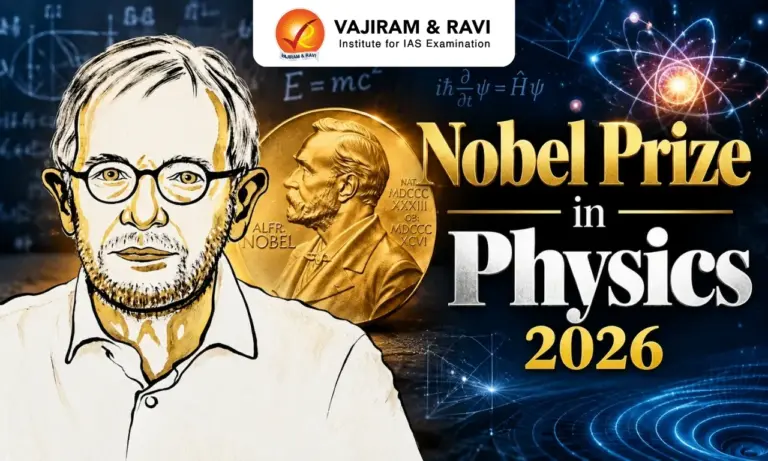
Nobel Prize in Physics 2026 has been awarded to Francis Halzen for his decisive contributions to the IceCube Neutrino Observatory and the discovery of high-energy neutrinos of astrophysical origin. The award was announced by the Royal Swedish Academy of Sciences on 6 October 2026.
Halzen’s work has transformed the study of neutrinos and opened a new way of observing the universe through extremely high-energy particles arriving from distant cosmic sources.
Nobel Prize in Physics 2026 Key Highlights
The key highlights related to the Nobel Prize 2026 in Physics have been shared below.
- Winner: Francis Halzen
- Award: Nobel Prize in Physics 2026
- Awarded for: Decisive contributions to the IceCube Neutrino Observatory and the discovery of high-energy neutrinos of astrophysical origin
- Major project: IceCube Neutrino Observatory
- Location: South Pole, Antarctica
- Key scientific subject: Neutrinos and particle astrophysics
- Announcement date: 6 October 2026
- Observatory size: About one cubic kilometre of Antarctic ice
Who is Francis Halzen?
Francis Halzen is a physicist whose work has played a major role in developing the IceCube Neutrino Observatory at the South Pole. He recognised that the clear Antarctic ice could be used to detect and track neutrinos passing through the Earth.
His scientific vision and leadership were fundamental to the development of IceCube, which uses a huge volume of Antarctic ice as a detector for elusive particles arriving from the universe.


What is the Nobel Prize in Physics 2026 Awarded For?
The Nobel Prize in Physics 2026 has been awarded to Francis Halzen for his decisive contributions to the IceCube Neutrino Observatory and the discovery of high-energy neutrinos of astrophysical origin.
IceCube has made it possible for scientists to detect high-energy neutrinos originating from extreme astrophysical environments. These observations provide information about distant cosmic events and objects that cannot always be studied effectively through conventional astronomical observations.
What is the IceCube Neutrino Observatory?
The IceCube Neutrino Observatory is a large scientific detector located deep beneath the ice at the South Pole.
It uses approximately one cubic kilometre of Antarctic ice and thousands of light sensors to detect the faint flashes of light produced when neutrinos interact with matter.
The observatory has more than 5,000 light sensors embedded in the ice. Scientists analyse the light patterns to estimate the energy and direction of neutrinos and investigate their possible cosmic sources.
What are Neutrinos?
Neutrinos are extremely small, electrically neutral particles that interact very weakly with matter.
They can travel enormous distances through space and even pass through large amounts of matter without being stopped. This makes them valuable for studying energetic processes occurring far away in the universe.
High-energy neutrinos can carry information about their astrophysical sources, helping scientists understand some of the most powerful processes in the cosmos.
Why is Ice Used to Detect Neutrinos?
Antarctic ice provides a large and exceptionally clear medium for detecting the tiny flashes of light produced when neutrinos interact with matter.
When a neutrino interacts with particles in the ice, it can produce charged particles that generate faint light. The sensors embedded in the ice detect this light.
Scientists then use these signals to reconstruct the energy and direction of the neutrino and investigate where it came from.
Significance of the Nobel Prize in Physics 2026
The work recognised by the Nobel Prize in Physics 2026 is important because it has expanded the way scientists observe and study the universe.
- It has enabled the detection of high-energy astrophysical neutrinos.
- It has provided a new method for studying extreme cosmic environments.
- It has strengthened the field of neutrino astronomy.
- IceCube observations can provide information about cosmic sources that are difficult to study using electromagnetic radiation alone.
- The observatory has helped scientists identify astrophysical neutrino sources and study neutrinos from the Milky Way.
- It demonstrates how a naturally occurring resource such as Antarctic ice can be converted into a large-scale scientific detector.
Also Read:- Nobel Prize in Physiology or Medicine 2026
IceCube Neutrino Observatory and Neutrino Astronomy
The discovery of astrophysical neutrinos has contributed to the development of neutrino astronomy, a field that studies the universe using neutrinos.
Unlike light, neutrinos can travel through dense environments and across vast cosmic distances with relatively little interaction. Their detection therefore provides an additional way of investigating energetic events and objects in the universe.
The IceCube Observatory has detected astrophysical neutrinos and contributed to identifying cosmic sources associated with them.
IceCube Upgrade 2026
The IceCube Observatory also received a major upgrade in 2026. The upgrade added more than 600 new and enhanced light sensors and calibration instruments through five additional strings installed deep in the Antarctic ice.
The upgraded observatory is expected to improve the precision of neutrino measurements and help scientists study neutrino oscillations, cosmic rays, supernovae and other astrophysical phenomena.

 Last updated on Oct, 2026
→ UPSC 2027 Notification will be released on 13 January 2027 at upsconline.nic.in.
→ Asian Games 2026 are being held in Aichi-Nagoya, Japan, from 19 September to 4 October.
→ Check out the latest UPSC Syllabus here.
→ Download UPSC Model Answers for Mains 2026
→ UPSC Mains Question Paper 2026 is out now for Essay & GS Paper 1, 2, 3 & 4.
→ UPSC Calendar 2027 has been released.
→ Enroll in Vajiram & Ravi’s UPSC Mains Test Series 2027 for structured answer writing practice, expert evaluation, and exam-oriented feedback.
→ Join Vajiram & Ravi’s UPSC Mentorship Program 2027 for personalized guidance, strategy planning, and one-to-one support from experienced mentors.
→ Go through the UPSC Mains Previous Year Papers to enhance your preparation.
→ UPSC has released UPSC Toppers List 2025 with the Civil Services final result on its official website.
→ Download PIB PRiSM Monthly Magazine 2026 here.
→ Also check Best UPSC Coaching in India
Nobel Prize in Physics 2026 FAQs
Q1. Who won the Nobel Prize in Physics 2026?+
Q2. Why did Francis Halzen win the Nobel Prize in Physics 2026?+
Q3. What is IceCube Neutrino Observatory?+
Q4. What are high-energy astrophysical neutrinos?+
Q5. Why is the Nobel Prize in Physics 2026 important?+
Q6. When was the Nobel Prize in Physics 2026 announced?+
Tags: nobel prize nobel prize 2026 nobel prize in physics nobel prize in physics 2026