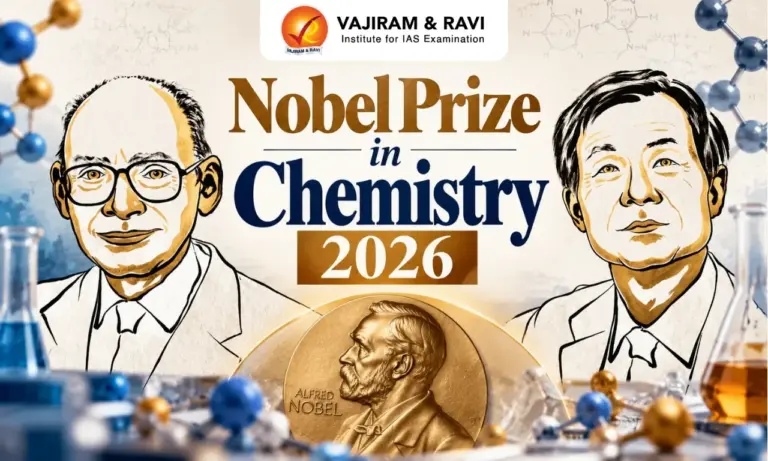
Nobel Prize in Chemistry 2026 has been awarded to Henri B. Kagan and Kenso Soai for their discovery of non-linear effects and autocatalysis in asymmetric organic synthesis. Their work has significantly advanced the understanding of how chemical reactions can produce molecules with a specific handedness, an important concept in modern organic chemistry.
Nobel Prize in Chemistry 2026 Key Highlights
The key highlights related to the Nobel Prize 2026 in Chemistry have been tabulated below.
| Nobel Prize in Chemistry 2026 Key Highlights | |
|
Particulars |
Details |
|
Award |
Nobel Prize in Chemistry 2026 |
|
Laureates |
Henri B. Kagan and Kenso Soai |
|
Awarded for |
Discovery of non-linear effects and autocatalysis in asymmetric organic synthesis |
|
Field |
Organic chemistry and asymmetric synthesis |
|
Announcement |
7 October 2026 |
|
Awarding body |
Royal Swedish Academy of Sciences |
Nobel Prize in Chemistry 2026 Winners
Henri B. Kagan and Kenso Soai are the recipients of the Nobel Prize in Chemistry 2026. Their discoveries concern how chemical reactions can generate and amplify molecular asymmetry, particularly through asymmetric synthesis and autocatalysis.
- Henri B. Kagan is associated with Université Paris-Sud, Orsay, France.
- Kenso Soai is associated with the Tokyo University of Science, Japan.
- Their combined work helped establish important principles of non-linear effects and asymmetric autocatalysis.
- Their discoveries have contributed to understanding how one molecular handedness can become dominant over its mirror-image form.


Henri B. Kagan’s Contribution
Henri B. Kagan discovered a new way of manipulating chemical reactions that could produce a greater excess of one specific mirror-image molecule than previously expected.
His research on non-linear effects in asymmetric catalysis demonstrated that the relationship between the composition of a chiral catalyst and the chirality of the resulting product does not always have to be proportional.
This provided important insights into how small differences in molecular chirality can be amplified during chemical reactions.
Kenso Soai’s Contribution
Kenso Soai developed the chemical reaction known as the Soai reaction, which became a landmark example of asymmetric autocatalysis.
The reaction can amplify a small initial preference for one mirror-image form and produce more molecules with the same handedness. This demonstrated how chemical reactions can create and strengthen molecular asymmetry.
Also Read:- Nobel Prize in Physiology or Medicine 2026
What is Asymmetric Organic Synthesis?
Asymmetric organic synthesis is a branch of chemistry that aims to produce molecules in which one particular three-dimensional arrangement, or enantiomer, is formed preferentially over its mirror-image counterpart.
This is important because two mirror-image molecules can have very different properties when interacting with biological systems. Therefore, controlling molecular handedness is an important aspect of pharmaceutical and organic chemistry.
What are Non-Linear Effects in Chemistry?
Non-linear effects occur when the relationship between the composition of a catalyst or reaction mixture and the resulting product is not directly proportional.
In asymmetric catalysis, a small change in the proportion of different forms of a chiral catalyst can sometimes produce a much larger change in the handedness of the resulting product. Kagan’s research helped establish and explain these effects as an important area of asymmetric catalysis.
What is Autocatalysis?
Autocatalysis is a chemical process in which a product of a reaction also acts as a catalyst for the same reaction.
This creates a self-reinforcing process because the formation of more product can accelerate the production of additional product.
In asymmetric chemistry, autocatalysis can be particularly important because it can help amplify a small initial imbalance in molecular handedness.
What is Asymmetric Autocatalysis?
Asymmetric autocatalysis occurs when a chiral product helps catalyse the formation of more molecules with the same molecular handedness.
Kenso Soai’s research on asymmetric autocatalysis demonstrated how a very small initial chiral preference could be amplified through successive chemical reactions. This provided important insights into the mechanisms through which molecular asymmetry can develop and increase.
Also Read:- Nobel Prize in Physics 2026
Significance of the Nobel Prize in Chemistry 2026
The work recognised by the Nobel Prize in Chemistry 2026 is significant because it has deepened the understanding of chirality, asymmetric synthesis, non-linear effects and autocatalytic chemical reactions.
- It improved understanding of asymmetric catalysis.
- It demonstrated how small molecular asymmetries can be amplified.
- It advanced the study of chiral molecules.
- It provided important tools for understanding complex organic reactions.
- It contributed to broader research into how molecular handedness can emerge and become dominant.
- The principles are relevant to modern organic chemistry and the synthesis of molecules with controlled three-dimensional structures.
Pharmaceutical Importance of Asymmetric Synthesis
The ability to control molecular handedness is particularly important in pharmaceutical chemistry. Different enantiomers of a molecule can interact differently with biological targets.
Modern asymmetric synthesis allows chemists to produce molecules with a preferred configuration more precisely. This can support the development and manufacturing of single-enantiomer medicines and other valuable chemical products.

 Last updated on Oct, 2026
→ UPSC 2027 Notification will be released on 13 January 2027 at upsconline.nic.in.
→ Asian Games 2026 are being held in Aichi-Nagoya, Japan, from 19 September to 4 October.
→ Check Nobel Prize 2026 Winners List here.
→ Download PIB PRiSM Monthly Magazine 2026 here.
→ Check UPSC Monthly Current Affairs Magazine The Recitals here.
→ Check out the latest UPSC Syllabus here.
→ Download UPSC Model Answers for Mains 2026
→ UPSC Mains Question Paper 2026 is out now for Essay & GS Paper 1, 2, 3 & 4.
→ UPSC Calendar 2027 has been released.
→ Enroll in Vajiram & Ravi’s UPSC Mains Test Series 2027 for structured answer writing practice, expert evaluation, and exam-oriented feedback.
→ Join Vajiram & Ravi’s UPSC Mentorship Program 2027 for personalized guidance, strategy planning, and one-to-one support from experienced mentors.
→ Go through the UPSC Mains Previous Year Papers to enhance your preparation.
→ UPSC has released UPSC Toppers List 2025 with the Civil Services final result on its official website.
→ Also check Best UPSC Coaching in India
Nobel Prize in Chemistry 2026 FAQs
Q1. Who won the Nobel Prize in Chemistry 2026?+
Q2. Why did Henri B. Kagan and Kenso Soai win the Nobel Prize in Chemistry 2026?+
Q3. What is the Nobel Prize in Chemistry 2026 awarded for?+
Q4. What is asymmetric organic synthesis?+
Q5. What are non-linear effects in asymmetric synthesis?+
Q6. What is autocatalysis?+
Q7. What is asymmetric autocatalysis?+
Q8. What is molecular chirality?+
Tags: nobel prize nobel prize 2026 nobel prize in chemistry nobel prize in chemistry 2026