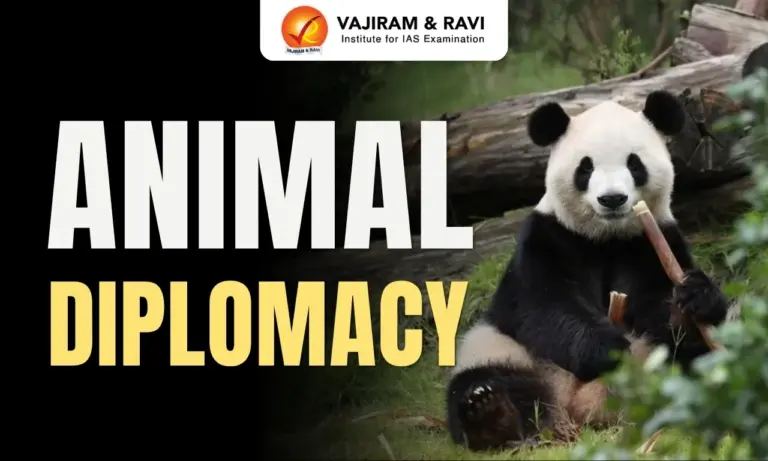
Animal diplomacy is the strategic use of living animals as gifts, loans, exchanges or national symbols by governments to strengthen international relations, project soft power and create public goodwill. Animals involved in such diplomacy often have cultural significance or are indigenous to the gifting country, making them influential instruments for communicating friendship and building international connections.
What is Animal Diplomacy?
Animal diplomacy involves giving or lending animals between countries as a sign of friendship, goodwill or cooperation. The animals may represent important cultural values, national identity or the unique biodiversity of the country that provides them.
Animal diplomacy can take several forms:
- Diplomatic gifts: Animals are presented to another country as symbols of friendship.
- Animal loans: Animals are temporarily provided to foreign zoos or conservation institutions.
- Wildlife exchanges: Countries exchange animals as part of cultural or conservation cooperation.
- National symbols: Iconic species are used to represent a country’s identity and values.
- Conservation partnerships: Countries cooperate on breeding, research and protection of endangered species.
History of Animal Diplomacy
The history of animal diplomacy goes back centuries. Ancient, medieval and Renaissance rulers exchanged exotic animals to demonstrate wealth, authority, friendship and their ability to control or access rare species.
During the Middle Ages and Renaissance, European kings frequently exchanged animals such as lions and tigers. These animals were not merely gifts; they could demonstrate a ruler’s power and authority over nature.
Giraffes also played an important role in historical animal exchanges. During the 14th and 15th centuries, giraffes associated with ancient Egyptian rulers reached regions as far as Samarkand, demonstrating the long-distance movement of exotic animals as diplomatic symbols.
A later example came in 1827, when Muhammad Ali Pasha sent a female giraffe to King Charles X of France. The animal became famous in France as “la belle africaine” and attracted considerable public attention.
These historical examples show that the use of animals in diplomacy predates the modern concept of soft power. What has changed is the purpose and institutional framework surrounding such exchanges.


Evolution of Animal Diplomacy into Soft Power
In earlier periods, exotic animals were primarily used to demonstrate wealth, prestige and political authority. In the modern era, animal diplomacy has increasingly become associated with soft power, public diplomacy and conservation.
Governments can use charismatic animals to:
- Generate positive public attention.
- Improve their international image.
- Strengthen bilateral relationships.
- Promote national culture and biodiversity.
- Encourage conservation cooperation.
- Create people-to-people connections.
The shift from permanent gifts to regulated loans is also significant. It allows countries to maintain diplomatic engagement while giving greater importance to conservation, animal welfare and scientific cooperation.
Examples of Animal Diplomacy in Recent Times
Modern animal diplomacy can be seen in several countries, with panda diplomacy, orangutan diplomacy, elephant diplomacy and koala diplomacy being notable examples.
Panda Diplomacy of China
Panda diplomacy is one of the best-known examples of modern animal diplomacy. China has a long history of using giant pandas in international relations, with the practice tracing back to the Tang Dynasty (618-907 CE).
China’s approach changed significantly by the 1980s. Instead of permanently gifting pandas, the country increasingly adopted a loan model, under which pandas could be provided to foreign institutions for a specified period, traditionally around 10 years, for a substantial annual fee.
This shift allowed China to retain greater control over the animals while continuing to use pandas to:
- Promote China’s image abroad.
- Build diplomatic goodwill.
- Strengthen international relationships.
- Support conservation and research.
- Encourage cooperation between zoos and scientific institutions.
The popularity of giant pandas makes them particularly effective instruments of public diplomacy and soft power.
Orangutan Diplomacy of Malaysia
Malaysia has proposed orangutan diplomacy as a way to strengthen its international image and demonstrate its commitment to wildlife protection.
The approach seeks to position Malaysia as a champion of orangutan conservation while also encouraging cooperation with other countries.
It can also be connected with discussions around sustainable palm oil production, since palm oil cultivation and habitat conservation are closely linked to orangutan protection.
Elephant Diplomacy in Asia
Elephants have strong cultural and symbolic importance across Asia. They are widely associated with wisdom, strength, prosperity and good luck, making them powerful diplomatic symbols.
India has historically used elephants as part of its international outreach and has gifted elephants to more than 20 countries. Other Asian countries, including China, Thailand, Vietnam and Sri Lanka, have also used elephants in cultural and soft-power diplomacy.
Elephant diplomacy demonstrates how an animal can carry cultural meaning beyond its biological significance and become a representation of a country’s heritage.
Koala Diplomacy of Australia
Australia has used its iconic wildlife as an instrument of international engagement. Koala diplomacy combines Australia’s distinctive wildlife with cultural and diplomatic outreach.
To commemorate 50 years of diplomatic relations, Australia loaned four koalas, Paddle, Pellita, Chan and Idalia to the Singapore Zoo.
Such initiatives can generate public interest in Australia’s wildlife while strengthening people-to-people connections between Australia and other countries.
India and Animal Diplomacy
India’s biodiversity and cultural traditions provide several opportunities for animal diplomacy. The country’s elephants, peacocks and other iconic species have been used to represent Indian culture and strengthen international goodwill.
One notable example is India’s gifting of a baby elephant named Indira to Japan, which represented friendship between the two countries.
India has also presented five peacocks to the United Nations in Geneva. The peacock, India’s national bird, can serve as a representation of the country’s cultural identity and biodiversity.
India’s experience demonstrates that animal diplomacy does not necessarily depend on a single species or a formal programme. It can emerge through cultural exchanges, diplomatic gifts and international conservation cooperation.
Significance of Animal Diplomacy
Animal diplomacy strengthens international relations by combining soft power, cultural exchange, public engagement and wildlife conservation, while using iconic animals as symbols of friendship and cooperation.
- Cultural Exchange: Promotes understanding and appreciation of the cultural and natural heritage of different countries.
- Soft Power: Helps countries build a positive international image through the appeal of charismatic wildlife.
- Environmental Diplomacy: Encourages countries to cooperate on endangered species protection, habitat conservation and wildlife research.
- Public Diplomacy: Creates direct engagement with citizens through zoos, wildlife exhibitions, adoption programmes and conservation initiatives.
- Bilateral Relations: Animal gifts and loans can become long-term symbols of friendship and cooperation between countries.
- Conservation Awareness: Increases public awareness about endangered species and the need for biodiversity protection.
Role of CITES in Animal Diplomacy
CITES provides an international regulatory framework for the movement and trade of listed wildlife species, ensuring that animal diplomacy does not threaten species survival or undermine conservation efforts.
- Regulates International Trade: Controls international trade in species covered by the Convention.
- Permit Requirements: Certain animals and their specimens require appropriate CITES permits and documentation.
- Protects Endangered Species: Prevents international trade from contributing to the decline of threatened wildlife.
- Supports Sustainable Use: Ensures that permitted international wildlife trade is conducted sustainably.
- Promotes International Cooperation: Provides a common framework for countries dealing with cross-border wildlife movement.
- Complements National Laws: CITES requirements operate alongside the domestic wildlife and animal welfare laws of individual countries.
Challenges of Animal Diplomacy
Animal diplomacy can strengthen goodwill, but it also raises ethical, conservation, legal and practical challenges, particularly when live animals are transported or kept outside their natural habitats.
- Animal Welfare: Transportation, relocation and captivity may cause stress or health problems.
- Conservation Risks: Improper transfers can negatively affect endangered species and wild populations.
- Legal Compliance: Countries must follow CITES requirements and relevant domestic wildlife laws.
- High Maintenance Costs: Food, housing, veterinary care and specialised facilities can be expensive.
- Ethical Concerns: Using sentient animals for diplomatic purposes raises questions about captivity and political symbolism.
- Disease Transmission: Cross-border movement of animals can create veterinary and biosecurity risks.
- Political Sensitivity: Changes in bilateral relations can affect long-term animal loan or exchange arrangements.
Way Forward
The future of animal diplomacy should focus on animal welfare, conservation, scientific cooperation and responsible soft power, rather than treating animals merely as diplomatic gifts.
- Ensure strict compliance with CITES and national wildlife laws.
- Conduct scientific and veterinary assessments before animal transfers.
- Prioritise humane transportation and long-term animal welfare.
- Promote joint wildlife research and conservation programmes.
- Strengthen international veterinary and breeding cooperation.
- Ensure transparency in animal gifting and loan agreements.
- Avoid transfers that could threaten wild populations.
- Use animal diplomacy to promote biodiversity awareness and environmental cooperation.

 Last updated on Oct, 2026
→ UPSC 2027 Notification will be released on 13 January 2027 at upsconline.nic.in.
→ Asian Games 2026 are being held in Aichi-Nagoya, Japan, from 19 September to 4 October.
→ Check Nobel Prize 2026 Winners List here.
→ Download PIB PRiSM Monthly Magazine 2026 here.
→ Check UPSC Monthly Current Affairs Magazine The Recitals here.
→ Check out the latest UPSC Syllabus here.
→ Download UPSC Model Answers for Mains 2026
→ UPSC Mains Question Paper 2026 is out now for Essay & GS Paper 1, 2, 3 & 4.
→ UPSC Calendar 2027 has been released.
→ Enroll in Vajiram & Ravi’s UPSC Mains Test Series 2027 for structured answer writing practice, expert evaluation, and exam-oriented feedback.
→ Join Vajiram & Ravi’s UPSC Mentorship Program 2027 for personalized guidance, strategy planning, and one-to-one support from experienced mentors.
→ Go through the UPSC Mains Previous Year Papers to enhance your preparation.
→ UPSC has released UPSC Toppers List 2025 with the Civil Services final result on its official website.
→ Also check Best UPSC Coaching in India
Animal Diplomacy FAQs
Q1. What is Animal Diplomacy?+
Q2. Why is Animal Diplomacy important?+
Q3. What is Panda Diplomacy?+
Q4. What are some examples of Animal Diplomacy?+
Q5. How does Animal Diplomacy promote soft power?+
Q6. What is the role of CITES in Animal Diplomacy?+
Tags: animal diplomacy