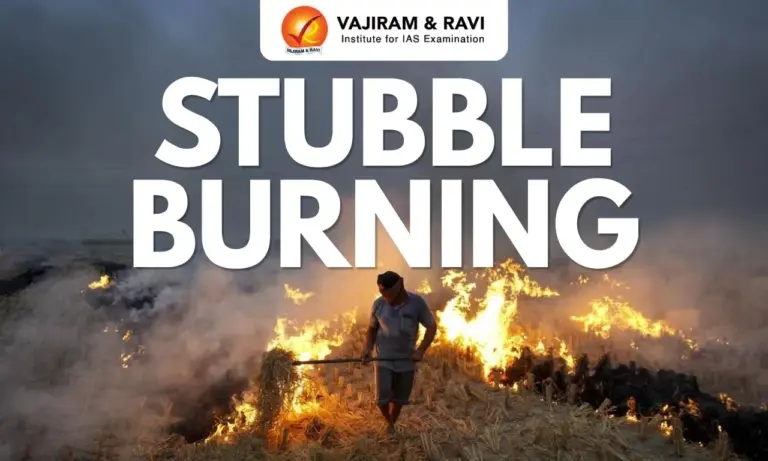
Stubble Burning Latest News
- Every year around this time, air pollution in North India, particularly Delhi, dominates public discourse. Stubble burning by farmers is one of the most cited reasons for the worsening Air Quality Index (AQI).
- Experts argue that the practice is not simply a farmer’s bad choice — it is the result of legal, technological and economic factors interacting together.
What Is Stubble Burning?
- Stubble burning means setting fire to crop residue — the lower parts of plants left after harvesting.
- It is prevalent from early October to late November across northwest India, especially Punjab, Haryana, and parts of Uttar Pradesh.
- It is mainly associated with paddy straw, and Punjab and Haryana together produce around 29 million metric tons of it.
Why It Matters for Health and Soil
- Releases large amounts of particulate matter, carbon monoxide, volatile organic compounds (VOCs), and other carcinogenic substances, forming a thick smog.
- Causes loss of soil fertility by depleting nitrogen, sulphur, potash, phosphorus and other micronutrients.
- The heat generated causes loss of soil moisture and organic content, which in turn increases fertiliser use in the next crop cycle.
Not A New Practice
- Stubble burning has existed in Punjab since the late 1970s and early 1980s, following the introduction of combine harvesters, which leave plant residue behind.
- What has changed is its timing — now coinciding with winter months, following the enactment of the Punjab Preservation of Sub-Soil Water Act, 2009 (PPSSWA 2009).


The Water Crisis That Triggered a Law
- In 2012, nearly 73% of Punjab’s cropped area was irrigated using groundwater. There was a deficit of 14.31 billion cubic metres, met through excessive groundwater withdrawal.
- Groundwater levels in Punjab declined at an alarming 0.36 metres annually between 1999 and 2009.
- A landmark NASA GRACE satellite study (2009) found the Punjab-Haryana-Rajasthan region lost 109 cubic kilometres of groundwater between 2002 and 2008 alone — then considered the largest groundwater depletion event in the world.
How PPSSWA 2009 Unintentionally Caused the Timing Shift
- The Act aimed to prevent rapid groundwater depletion by prohibiting early paddy sowing and transplantation before the monsoon arrived.
- Farmers were barred from sowing paddy before May 10 and transplanting before June 10. Stringent punishments were prescribed for this.
- These sowing restrictions pushed the paddy harvest to late October/early November, leaving farmers just a 10–15-day window to prepare fields for wheat.
- The high-yielding PUSA-44 variety, which takes 150–160 days to harvest, narrowed this window further. Combine harvesters leave about a foot of stubble behind, and manual clearing is time-consuming and expensive.
- Together, these factors made stubble burning almost a necessity.
Why Farmers Keep Growing Paddy and Wheat Anyway
- The deeper question: why do farmers persist with these crops despite strict laws and falling groundwater? The answer lies in the incentive structure.
- Paddy procurement (2012–2024 average): 37% nationally, but 87% in Punjab and 74% in Haryana — more than double the national average.
- Wheat procurement: 30% nationally, versus 70% in Punjab and 63% in Haryana.
- These national averages already include Punjab and Haryana — excluding them would make the gap even starker.
- This assured procurement provides guaranteed income, discouraging diversification.
- Additionally, power is free in Punjab and almost free in Haryana, further encouraging water-intensive paddy and wheat cultivation via groundwater extraction.
Technical Solutions and Their Limits
- In-Situ Measures: Crop Residue Management (CRM) machines — Happy Seeders, Super Seeders, Rotavators; Short-duration rice varieties and direct seeding of rice.
- Ex-situ Measures: Converting residue into bio-ethanol and compressed biogas.
- The problem with both:
- Happy Seeders/Super Seeders need an expensive 60-HP tractor, often idle for most of the year. Even hiring one costs ₹10,000 with a long waiting period.
- Ex-situ measures cost ₹1,500–₹2,500 per acre — a significant expense for many farmers.
Policy Responses: Punjab vs Haryana
- National Green Tribunal (2018): Ruled that farmers who burn stubble could be excluded from MSP policy. The Supreme Court upheld this in 2023.
- In 2025, CPCB deployed 31 flying squads across 18 districts of Punjab and 13 of Haryana, involving 10,500 field functionaries in Punjab and 10,000 in Haryana.
- CAQM has directed complaints to be filed against officials for inadequate monitoring.
- However, the Parliamentary Committee on air quality recommended that penalising farmers should be a last resort, instead suggesting a minimum price covering all costs for selling stubble for ex-situ use.
Punjab’s Approach
- Relied mostly on in-situ CRM-based measures, with limited ex-situ initiatives.
- CAQM noted in 2025 that Punjab still needs improvement in timely CRM machinery availability, support for CBG (compressed biogas) plants, and better enforcement.
Haryana’s Approach
- Adopted an incentive-based model, aligned with the Parliamentary Panel’s recommendations:
- ₹1,000/acre for CRM use.
- ₹4,000/acre for direct seeding of rice.
- ₹7,000/acre for diversification to alternate crops.
- Additional incentives to panchayats for good performance.
The Measurement Problem
- Punjab and Haryana reportedly achieved a 90% reduction in stubble-burning incidents during 2025 paddy harvesting compared to 2022. But this figure needs caution.
Why The Data May Be Misleading
- The CREAMS protocol (Consortium for Research on Agroecosystem Monitoring and Modeling from Space) relies on NASA’s MODIS and VIIRS satellites — polar satellites observing India only between 10:30 am and 1:30 pm, capturing only active fires at that moment, not total fires over 24 hours.
- A 2025 report, using multiple satellites, found the actual reduction was more gradual — around 30%, not 90%.
- A November 2025 study, led by ISRO scientists, found farmers have shifted to burning stubble in the evening specifically to avoid polar satellite detection windows.
Conclusion
- Stubble burning survives not because farmers lack alternatives, but because the system rewards exactly the behaviour it then punishes — assured procurement and free power push farmers toward paddy, while a water-conservation law compresses their harvest window to days.
- Haryana’s incentive-based model shows a more promising direction than Punjab’s penalty-heavy approach, but even the headline “90% reduction” may be a measurement artifact, not a real one.
- A lasting fix needs genuine crop diversification, better residue economics, and satellite monitoring that farmers can’t simply outrun by burning after dark.

 Last updated on Oct, 2026
→ UPSC 2027 Notification will be released on 13 January 2027 at upsconline.nic.in.
→ Check Nobel Prize 2026 Winners List here.
→ Download PIB PRiSM Monthly Magazine 2026 here.
→ Check UPSC Monthly Current Affairs Magazine The Recitals here.
→ Check out the latest UPSC Syllabus here.
→ Download UPSC Model Answers for Mains 2026
→ UPSC Mains Question Paper 2026 is out now for Essay & GS Paper 1, 2, 3 & 4.
→ UPSC Calendar 2027 has been released.
→ Enroll in Vajiram & Ravi’s UPSC Mains Test Series 2027 for structured answer writing practice, expert evaluation, and exam-oriented feedback.
→ Join Vajiram & Ravi’s UPSC Mentorship Program 2027 for personalized guidance, strategy planning, and one-to-one support from experienced mentors.
→ Go through the UPSC Mains Previous Year Papers to enhance your preparation.
→ UPSC has released UPSC Toppers List 2025 with the Civil Services final result on its official website.
→ Also check Best UPSC Coaching in India
Stubble Burning FAQs
Q1. Why does stubble burning continue despite government restrictions?+
Q2. How did the Punjab Preservation of Sub-Soil Water Act affect stubble burning? +
Q3. How does stubble burning affect human health and soil fertility? +
Q4. How do Punjab and Haryana differ in addressing stubble burning? +
Q5. Why might reported reductions in stubble burning be misleading? +
Tags: mains articles stubble burning upsc current affairs upsc mains current affairs