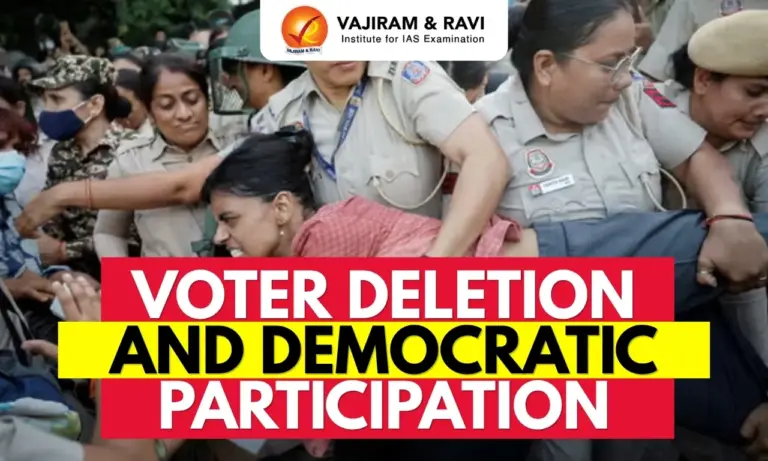
The right to vote is a cornerstone of Indian democracy. It enables citizens to elect their representatives, influence public policies, and hold governments accountable. However, voter deletion and errors in electoral rolls can prevent eligible citizens from exercising their voting rights, raising concerns about democratic participation and electoral fairness.
Electoral roll revision is necessary to remove duplicate entries, deceased voters, and other legally ineligible entries. However, wrongful deletion caused by administrative errors, inadequate verification, or communication gaps can lead to electoral exclusion in India. The challenge is to maintain accurate voter lists without denying eligible citizens their opportunity to participate in elections.
Why Is Voter Deletion a Concern for Democratic Participation?
Voter deletion can affect individual voting rights, political representation, and public trust in electoral institutions. In a country as large and diverse as India, even administrative errors can have serious consequences when they affect many eligible voters.
- Denial of voting rights: Eligible citizens whose names are missing from the electoral roll may be unable to vote, particularly if they discover the problem on polling day.
- Exclusion of vulnerable groups: Migrant workers, homeless persons, women who relocate after marriage, senior citizens, and persons with disabilities may face additional difficulties in maintaining or correcting their voter registration.
- Unequal political representation: If wrongful deletions disproportionately affect particular communities, their participation in choosing representatives and influencing public policy may decline.
- Erosion of public trust: Unexplained or inadequately communicated deletions can create doubts about the fairness and transparency of electoral administration.
- Weakening of electoral legitimacy: Accurate electoral rolls are essential for credible elections. Both wrongful inclusion and wrongful exclusion can undermine confidence in the electoral process.
Why Does Voter Deletion Occur in India?
Voter deletion may result from legitimate electoral roll revision or administrative shortcomings. Understanding the causes is essential to preventing electoral exclusion.
- Routine electoral roll revision: Electoral rolls are updated to account for deaths, duplicate registrations, changes in eligibility, and other legally valid grounds. Errors during verification can sometimes result in the wrongful removal of eligible voters.
- Migration and change of residence: People moving for employment, education, or marriage may face difficulties updating their registration. Temporary absence should not automatically be treated as proof that a person has lost eligibility.
- Data entry and identity-matching errors: Similar names, spelling variations, incorrect personal details, and unreliable database matching can result in mistaken deletions.
- Inadequate notice and verification: If voters are not properly informed about proposed deletions or are not given a meaningful opportunity to respond, errors may remain uncorrected.
- Limited awareness of voter registration: Some citizens may not regularly check their electoral roll details or understand the procedure for restoring a missing entry.
- Administrative capacity constraints: High workloads, insufficient staffing, limited training, and poor coordination can increase errors during electoral roll preparation and revision.


Constitutional and Legal Framework for Electoral Rolls in India
India’s electoral system is governed by constitutional provisions and election laws that establish the foundation for voter eligibility, electoral roll preparation, and the conduct of elections.
- Article 324: Vests the Election Commission of India with the superintendence, direction, and control of elections to Parliament, state legislatures, and the offices of the President and Vice-President, within the constitutional framework.
- Article 325: Provides for one general electoral roll for every territorial constituency and prohibits exclusion from electoral rolls on grounds only of religion, race, caste, or sex.
- Article 326: Establishes elections to the Lok Sabha and state legislative assemblies on the basis of adult suffrage, subject to constitutional and legal qualifications.
- Representation of the People Act, 1950: Provides the legal framework for electoral rolls, voter qualifications, registration, and related matters, including the conditions and procedures governing inclusion and deletion.
- Representation of the People Act, 1951: Governs the conduct of elections and addresses election-related offences, candidate qualifications and disqualifications, and election disputes.
What Is Form 6, and How Does It Help Prevent Electoral Exclusion?
Form 6 is the prescribed application form for the inclusion of a name in the electoral roll for eligible Indian citizens. It is commonly used by first-time voters and eligible applicants seeking registration in a constituency where they are ordinarily resident.
Key features of Form 6 include:
- First-time voter registration: Eligible Indian citizens who have attained the qualifying age can apply to have their names included in the electoral roll.
- Application for inclusion: Eligible citizens whose names are missing can approach the electoral authorities and apply for inclusion, subject to verification and the applicable procedure.
- Online application: Applicants can use the Election Commission’s official Voters’ Services Portal to access Form 6 and submit an application.
- Offline application: Form 6 can also be submitted through the designated electoral registration authorities using the prescribed offline procedure.
- Verification of details: Applicants must provide the required personal information and supporting documents. Electoral officials verify the application before deciding on inclusion.
- Application tracking: Applicants can use the official voter services system to check the status of their application, where the facility is available.
How Can India Prevent Electoral Exclusion?
Preventing electoral exclusion requires a combination of accurate records, transparent procedures, accessible registration services, and institutional accountability.
- Ensure transparent voter deletion: Every deletion should have a legally valid basis and adequate verification. Authorities should maintain clear records of the reasons for deletion, follow prescribed procedures, and provide affected voters with the required notice and opportunity to respond.
- Strengthen Booth Level Officer (BLO) verification: Provide BLOs with adequate training, resources, and clear guidelines to verify voter details, identify errors, and assist citizens with registration and correction procedures.
- Use technology responsibly: Digital tools can help identify duplicate entries and inconsistencies, but uncertain identity matches should undergo appropriate human review. Systems should maintain audit trails, protect personal information, and flag unusual deletion patterns for investigation.
- Improve registration for migrant workers: Simplify lawful procedures for registration and transfer between constituencies, provide clear guidance on ordinary residence, and ensure that temporary movement does not automatically result in wrongful deletion.
- Strengthen grievance redressal: Establish accessible and time-bound procedures for voters to challenge incorrect deletions, submit supporting documents, track applications, and seek review or appeal where available.
- Conduct regular electoral roll audits: Use sample-based audits and complaint data to identify unusual deletion patterns, procedural failures, and recurring errors. Publish relevant aggregate information while protecting personal data.
- Increase voter awareness: Encourage citizens to check their names on official electoral rolls before elections and explain how to apply for inclusion, correction, or transfer through local-language campaigns, public announcements, and digital platforms.
- Protect vulnerable communities: Provide accessible services for women who relocate after marriage, homeless persons, senior citizens, persons with disabilities, and remote communities that may face documentation or access barriers.
Challenges in Preventing Electoral Exclusion
India faces several administrative and technological challenges in ensuring that electoral rolls remain accurate and inclusive.
- Large and mobile population: Frequent migration makes it difficult to keep voter records updated across constituencies.
- Inaccurate personal data: Spelling differences, incomplete records, and mistaken identity matching can lead to wrongful deletions.
- Digital divide: Online-only services may exclude people with limited internet access, digital literacy, or access to devices.
- Administrative workload: High volumes of applications and verification requests can delay corrections and increase the risk of errors.
- Limited awareness: Citizens may not discover that their names are missing until shortly before polling day.
- Weak grievance mechanisms: Delays in resolving complaints may prevent eligible voters from correcting their registration in time.
- Concerns about impartiality: Unexplained or inconsistent deletion practices can weaken public confidence in electoral institutions.
What Should Citizens Do If Their Name Is Missing From the Voter List?
Citizens who discover that their names are missing from the electoral roll should check their registration status and contact the relevant electoral authorities promptly.
- Check the electoral roll: Use the Election Commission of India’s official voter services or the relevant state Chief Electoral Officer’s website to verify registration details.
- Contact the concerned authority: Approach the Booth Level Officer or Electoral Registration Officer to understand why the name is missing.
- Submit the appropriate application: Follow the prescribed procedure for inclusion, correction, or other applicable relief, depending on the circumstances.
- Keep records: Retain application acknowledgements, notices, and supporting documents for future reference.
- Follow up on complaints: Use official grievance channels and the applicable review or appeal procedure if the issue remains unresolved.
Conclusion
Voter deletion in India is not merely an administrative issue; it is closely linked to democratic participation, political equality, and public trust. While accurate electoral rolls are essential for free and fair elections, wrongful deletion can prevent eligible citizens from exercising their voting rights and weaken representative democracy.
India can prevent electoral exclusion through transparent verification, responsible use of technology, accessible grievance redressal, regular audits, and greater public awareness.

 Last updated on Oct, 2026
→ UPSC 2027 Notification will be released on 13 January 2027 at upsconline.nic.in.
→ Check Nobel Prize 2026 Winners List here.
→ Download PIB PRiSM Monthly Magazine 2026 here.
→ Check UPSC Monthly Current Affairs Magazine The Recitals here.
→ Check out the latest UPSC Syllabus here.
→ Download UPSC Model Answers for Mains 2026
→ UPSC Mains Question Paper 2026 is out now for Essay & GS Paper 1, 2, 3 & 4.
→ UPSC Calendar 2027 has been released.
→ Enroll in Vajiram & Ravi’s UPSC Mains Test Series 2027 for structured answer writing practice, expert evaluation, and exam-oriented feedback.
→ Join Vajiram & Ravi’s UPSC Mentorship Program 2027 for personalized guidance, strategy planning, and one-to-one support from experienced mentors.
→ Go through the UPSC Mains Previous Year Papers to enhance your preparation.
→ UPSC has released UPSC Toppers List 2025 with the Civil Services final result on its official website.
→ Also check Best UPSC Coaching in India
Voter Deletion and Democratic Participation FAQs
Q1. What is voter deletion?+
Q2. How does voter deletion affect democratic participation?+
Q3. What are the main causes of wrongful voter deletion in India?+
Q4. Which constitutional articles protect electoral participation in India?+
Q5. How can India prevent electoral exclusion?+
Tags: democratic participation voter deletion voter deletion and democratic participation