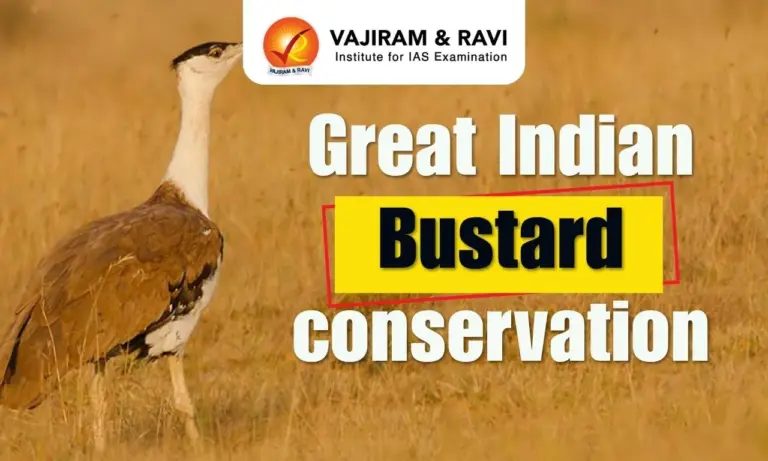
Great Indian Bustard conservation Latest News
- Recently, India achieved a conservation milestone — two captive-bred male Great Indian Bustards (GIBs) were released into the wild for the first time, at Desert National Park, near Jaisalmer, Rajasthan.
- This rewilding pilot is part of Project GIB, run by the Centre, Wildlife Institute of India (WII), and the governments of Rajasthan and Gujarat. While historic, experts caution that population recovery remains a long-term challenge.
The Great Indian Bustard: Why It Matters
- The GIB is a large, ground-dwelling bird found in savannahs, grasslands, and deserts.
- Until the late 19th/early 20th century, it was spread across 11 states — from Haryana in the north to Tamil Nadu in the south, and Rajasthan in the west to Odisha in the east.
Causes of Decline
- Hunting and egg poaching.
- Conversion of open habitats into croplands and mining areas.
- Collisions with renewable energy power lines — the GIB’s poor frontal vision and heavy body make it hard to detect or avoid overhead wires.
Population Collapse
- From an estimated 1,260–1,400 birds in the early 1970s, numbers have crashed to just around 150 today.
- Of these, around 130 (±20) are in Rajasthan — the rest scattered across Gujarat, Maharashtra, Karnataka, Telangana, and Andhra Pradesh, facing local extinction risk.


Project GIB: The Conservation Breeding Effort
- A long-term bustard and lesser florican conservation project was launched by the Centre and Rajasthan government in 2012–13, expanded from 2014 with funding for a conservation breeding programme.
- From 2019, wild GIB eggs were collected from Desert National Park and nearby areas, artificially incubated at two centres — Sam and Ramdevra (Rajasthan) — and hand-reared.
- These hand-reared birds have since bred at the centres, producing 98 birds so far.
- Of these: 2 released (Oct 4, 2026); 11 earmarked for future wild release; the rest remain in captivity for continued breeding.
What Does Rewilding Involve?
- Rewilding means transitioning captive-bred birds back into natural habitats.
- Key steps taken:
- A rewilding aviary was set up at Ramdevra Centre, and a soft-release facility developed by WII inside Desert National Park.
- Unlike hand-reared adult birds (used to humans), chicks aged 3–4 months were released here, allowing them to adapt naturally without human imprinting.
- Released birds are fitted with transmitters, sending location/movement alerts three times daily; teams also monitor them remotely.
- Release sites were chosen for their grassland cover and freedom from human/technological interference.
Challenges to Long-Term Recovery
- Scaling Beyond Rajasthan: Similar rewilding efforts will be needed in Maharashtra, Madhya Pradesh, Karnataka, and Andhra Pradesh — but only after habitat improvement.
- Experts noted that grassland restoration and protection outside Rajasthan is crucial for wider revival, with Gujarat likely to follow if the Rajasthan pilot succeeds.
The Grassland Protection Gap
- Unlike forests, grasslands are not traditionally treated as “protected areas” in public or policy perception, making them vulnerable to land-use conversion.
- This also affects livelihoods of pastoralists and livestock-rearing communities.
- Bustard expert had flagged this concern as early as 2008 in Hornbill magazine — warning that forest departments, not graziers, posed the bigger threat by converting grasslands into forests through afforestation and artificial waterhole creation, misunderstanding the bustard’s actual habitat needs.
Legal Safeguards and Persistent Threats
- Following a landmark Supreme Court case on GIB protection, the Court accepted an expert panel’s recommendations and ordered:
- Demarcation of “priority areas” — 14,013 sq km in Rajasthan and 740 sq km in Gujarat.
- Undergrounding of 80 km of power lines in Rajasthan, to be completed between 2027 and 2028.
- Creation of “powerline corridors” to accommodate re-routed overhead lines.
Remaining Threats
- Experts warn rewilding won’t be sustainable unless power lines are undergrounded soon.
- Limestone mining threatens the open, flat terrain bustards need — the Supreme Court did not order specific anti-mining measures, and mining operations are proposed on the northern side of Desert National Park, near the release site itself.
Conclusion
- The release of two captive-bred bustards marks a symbolic breakthrough, but survival of the species hinges on far more than breeding success — it depends on protecting grasslands long dismissed as “wastelands,” undergrounding power lines on schedule, and curbing mining in critical habitats.
- Unless these systemic threats are addressed with the same urgency as captive breeding, rewilding risks becoming a short-lived experiment rather than a lasting recovery.
Source: IE

 Last updated on Oct, 2026
→ UPSC 2027 Notification will be released on 13 January 2027 at upsconline.nic.in.
→ Check Nobel Prize 2026 Winners List here.
→ Download PIB PRiSM Monthly Magazine 2026 here.
→ Check UPSC Monthly Current Affairs Magazine The Recitals here.
→ Check out the latest UPSC Syllabus here.
→ Download UPSC Model Answers for Mains 2026
→ UPSC Mains Question Paper 2026 is out now for Essay & GS Paper 1, 2, 3 & 4.
→ UPSC Calendar 2027 has been released.
→ Enroll in Vajiram & Ravi’s UPSC Mains Test Series 2027 for structured answer writing practice, expert evaluation, and exam-oriented feedback.
→ Join Vajiram & Ravi’s UPSC Mentorship Program 2027 for personalized guidance, strategy planning, and one-to-one support from experienced mentors.
→ Go through the UPSC Mains Previous Year Papers to enhance your preparation.
→ UPSC has released UPSC Toppers List 2025 with the Civil Services final result on its official website.
→ Also check Best UPSC Coaching in India
Great Indian Bustard Conservation FAQ
Q1. Why is Great Indian Bustard conservation important?+
Q2. What is Project GIB?+
Q3. What does rewilding involve in Great Indian Bustard conservation?+
Q4. What are the major threats to Great Indian Bustard conservation? +
Q5. What measures are needed to strengthen Great Indian Bustard conservation?+
Tags: Great Indian Bustard conservation mains articles upsc current affairs upsc mains current affairs