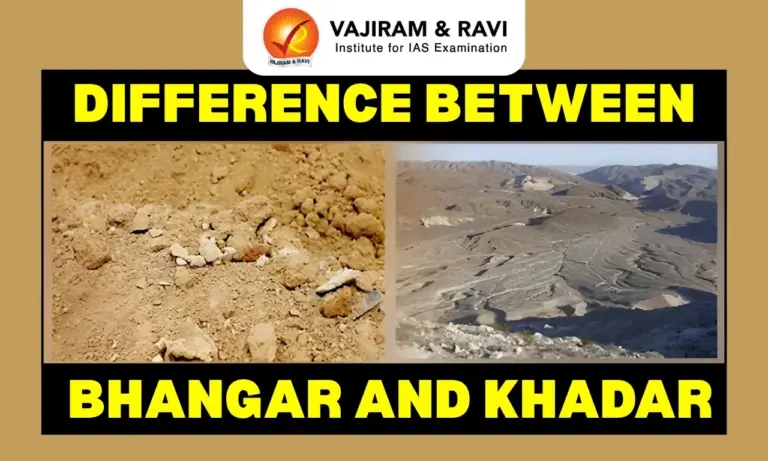
Bhangar and Khadar are two major types of alluvial soil found in the Northern Plains of India. They are formed by the deposition of sediments brought by rivers, but they differ in age, location, fertility and the frequency of deposition.
The main difference between Bhangar and Khadar is that Bhangar is older alluvial soil found on higher areas of the floodplains, while Khadar is newer alluvial soil deposited by rivers during floods.
What is Bhangar?
Bhangar is the older alluvial soil found in the Northern Plains of India. It lies above the active floodplains and is generally found on slightly elevated terraces.
- Formation: It is formed by the deposition of alluvial sediments over a long period.
- Location: It is found on higher areas of the Northern Plains, away from the active floodplains.
- Soil composition: It often contains calcareous deposits called kankar, which are nodules of calcium carbonate.
- Fertility: It is generally less fertile than Khadar because it does not receive fresh alluvial deposits every year.
- Flooding: It is usually less affected by annual floods due to its elevated position.
- Agriculture: It supports agriculture, but soil quality varies depending on local conditions and irrigation.
What is Khadar?
Khadar is the newer alluvial soil deposited by rivers in their active floodplains. Rivers replenish this soil by bringing fresh sediments during floods.
- Formation: It is formed through the repeated deposition of fresh alluvium by rivers.
- Location: It is found in low-lying floodplains along rivers such as the Ganga, Yamuna and their tributaries.
- Soil composition: It generally contains fine sand, silt, clay and other river-borne sediments.
- Fertility: It is generally more fertile because of the regular addition of fresh alluvial material.
- Flooding: It is more frequently affected by floods because it lies close to river channels.
- Agriculture: It is suitable for crops such as wheat, rice, sugarcane and other crops, depending on regional conditions.


Difference Between Bhangar and Khadar
Bhangar is older alluvial soil found on elevated terraces of the Northern Plains, while Khadar is newer alluvial soil deposited by rivers in active floodplains, generally making it more fertile.
| Difference Between Bhangar and Khadar | ||
|
Basis |
Bhangar |
Khadar |
|
Meaning |
Older alluvial soil |
Newer alluvial soil |
|
Location |
Elevated terraces of floodplains |
Low-lying, active floodplains |
|
Age |
Older deposits |
Relatively recent deposits |
|
Fresh deposition |
Generally does not receive regular fresh alluvium |
Receives fresh alluvium during floods |
|
Soil composition |
Often contains calcareous nodules called kankar |
Generally contains sand, silt and clay |
|
Fertility |
Generally less fertile than Khadar |
Generally more fertile due to fresh sediments |
|
Flooding |
Comparatively less prone to flooding |
More prone to seasonal flooding |
|
Agriculture |
Suitable for cultivation, depending on soil and irrigation |
Highly suitable for agriculture in many regions |
Why Are Bhangar and Khadar Important?
Bhangar and Khadar are important for understanding the formation, soil characteristics and agricultural potential of the Northern Plains.
- Agriculture: Both support the cultivation of major crops and contribute to India’s agricultural production.
- Soil fertility: Their differences help explain variations in soil quality across the Northern Plains.
- Floodplain management: Khadar regions require careful flood management because of their low elevation and proximity to rivers.
- Human settlements: Fertile alluvial plains have supported dense populations and the growth of settlements over centuries.
- Physical geography: These soil types help explain how rivers continuously shape the landscape through erosion and deposition.

 Last updated on Oct, 2026
→ UPSC 2027 Notification will be released on 13 January 2027 at upsconline.nic.in.
→ Check Nobel Prize 2026 Winners List here.
→ Download PIB PRiSM Monthly Magazine 2026 here.
→ Check UPSC Monthly Current Affairs Magazine The Recitals here.
→ Check out the latest UPSC Syllabus here.
→ Download UPSC Model Answers for Mains 2026
→ UPSC Mains Question Paper 2026 is out now for Essay & GS Paper 1, 2, 3 & 4.
→ UPSC Calendar 2027 has been released.
→ Enroll in Vajiram & Ravi’s UPSC Mains Test Series 2027 for structured answer writing practice, expert evaluation, and exam-oriented feedback.
→ Join Vajiram & Ravi’s UPSC Mentorship Program 2027 for personalized guidance, strategy planning, and one-to-one support from experienced mentors.
→ Go through the UPSC Mains Previous Year Papers to enhance your preparation.
→ UPSC has released UPSC Toppers List 2025 with the Civil Services final result on its official website.
→ Also check Best UPSC Coaching in India
Difference Between Bhangar and Khadar FAQs
Q1. What is the main difference between Bhangar and Khadar?+
Q2. Which soil is more fertile, Bhangar or Khadar?+
Q3. What is kankar in Bhangar soil?+
Q4. Where are Bhangar and Khadar found in India?+
Q5. Why is Khadar more prone to floods?+
Tags: bhangar and khadar difference between bhangar and khadar