Jantar Mantar Latest News
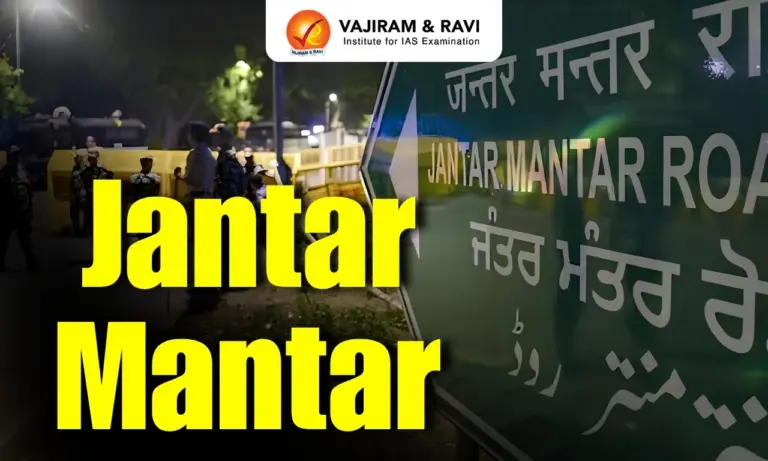
- The Delhi Police have de-notified Jantar Mantar as a designated protest site, naming Ramlila Maidan, Burari Ground (north Delhi), and CBD Ground (east Delhi) as alternatives.
- Earlier framework: Organisers needed to apply 10 days in advance to protest at Jantar Mantar (capped at 1,000 people); Ramlila Maidan could accommodate ~50,000 people.
- The move followed a recommendation by a committee constituted by the Ministry of Home Affairs (MHA), with a revised SOP for the new venues to be issued separately.
- This comes amid heavy barricading and crackdowns on protesters in central Delhi since October 10, with demonstrators gathering even near areas under prohibitory orders under Section 163 of the BNSS.
Why Delhi Is Different: Who Controls Its Police?
- Unlike other states, Delhi’s police and public order fall outside the legislative powers of the Delhi Legislative Assembly.
- Under Article 239AA(3)(a) of the Constitution, the Delhi Assembly can legislate on NCT matters except those under Entries 1, 2, and 18 of the State List — covering public order, police, and land.
- As a result, Delhi Police functions under the MHA, not the Delhi government, giving the Centre effective control over protest regulation in the capital.


The Crucial Distinction: Law and Order vs. Public Order
- Police often invoke “law and order” to regulate protests, but Article 19 permits restrictions on fundamental rights specifically on grounds of “public order” — and the Supreme Court has treated these as distinct concepts.
- Landmark precedent — Ram Manohar Lohia v. State of Bihar (1966):
- The Court described three concentric circles:
- Law and order — the largest circle.
- Public order — a narrower circle within it.
- Security of the State — the smallest, innermost circle.
- An act can affect law and order without affecting public order, just as an act can affect public order without threatening state security.
- The Court described three concentric circles:
- In Re: Ramlila Maidan Incident (2012): The Court held that restrictions for law and order should be least intruding on fundamental freedoms, while restrictions for public order may justify greater restriction, since public order is of greater social concern.
- Crucially: Public order is something distinct from order or orderliness in a local area — a disturbance must cause actual public disorder, not just a local breach of peace.
Expert Clarification
- Law and order = localised disturbances (e.g., two people fighting, a car blocking a road).
- Public order = disruptions affecting the wider community (e.g., large-scale disruption of transport or communication).
- Law and order is not a valid basis to limit the right to speech and expression.
- Police cannot invoke public order on their own — a law must first grant them that power, and police must identify the specific law under which they act.
How Are Protest Sites Legally Designated?
- Himat Lal K. Shah v. Commissioner of Police, Ahmedabad (1972)
- The Court held police can require prior permission for public meetings on streets — “nothing wrong” with that.
- However, the State cannot abridge the right of assembly by prohibiting assembly on every public street or place.
- Mazdoor Kisan Shakti Sangathan (MKSS) v. Union of India (2018)
- This case dealt with restrictions at Jantar Mantar and a proposal to shift protests to Ramlila Maidan.
- Petitioners argued Ramlila Maidan was too far from the “concentration of power” in New Delhi, undermining the very purpose of protesting against those authorities.
- The Court accepted this concern, but balanced it against residents’ rights, holding that “particular areas can be earmarked” while regulating demonstrations in public interest.
- It allowed a limited portion of Jantar Mantar Road to remain open for regulated demonstrations by smaller groups, recognising its long historical use as a protest site.
Conclusion
- The de-notification of Jantar Mantar revives a constitutional debate that courts have revisited for decades: who gets to decide where dissent is permitted, and on what legal basis?
- The Supreme Court’s concentric-circles framework makes clear that routine administrative inconvenience cannot masquerade as a threat to “public order” — a far higher threshold requiring real disruption to the wider community.
- As protest sites shift further from the “centres of power” they are meant to address, the real test will be whether India’s democratic channels remain genuinely open, or whether procedural relocation becomes a quiet tool for suppressing dissent.

 Last updated on Oct, 2026
→ UPSC 2027 Notification will be released on 13 January 2027 at upsconline.nic.in.
→ Check Nobel Prize 2026 Winners List here.
→ Download PIB PRiSM Monthly Magazine 2026 here.
→ Check UPSC Monthly Current Affairs Magazine The Recitals here.
→ Check out the latest UPSC Syllabus here.
→ Download UPSC Model Answers for Mains 2026
→ UPSC Mains Question Paper 2026 is out now for Essay & GS Paper 1, 2, 3 & 4.
→ UPSC Calendar 2027 has been released.
→ Enroll in Vajiram & Ravi’s UPSC Mains Test Series 2027 for structured answer writing practice, expert evaluation, and exam-oriented feedback.
→ Join Vajiram & Ravi’s UPSC Mentorship Program 2027 for personalized guidance, strategy planning, and one-to-one support from experienced mentors.
→ Go through the UPSC Mains Previous Year Papers to enhance your preparation.
→ UPSC has released UPSC Toppers List 2025 with the Civil Services final result on its official website.
→ Also check Best UPSC Coaching in India
Jantar Mantar FAQ
Q1. Why was Jantar Mantar de-notified as a designated protest site? +
Q2. Who controls the Delhi Police and regulates protests in Delhi? +
Q3. What is the difference between law and order and public order? +
Q4. What did the Supreme Court say about restrictions on public demonstrations? +
Q5. How do Jantar Mantar protest restrictions affect freedom of expression? +
Tags: jantar mantar mains articles upsc current affairs upsc mains current affairs