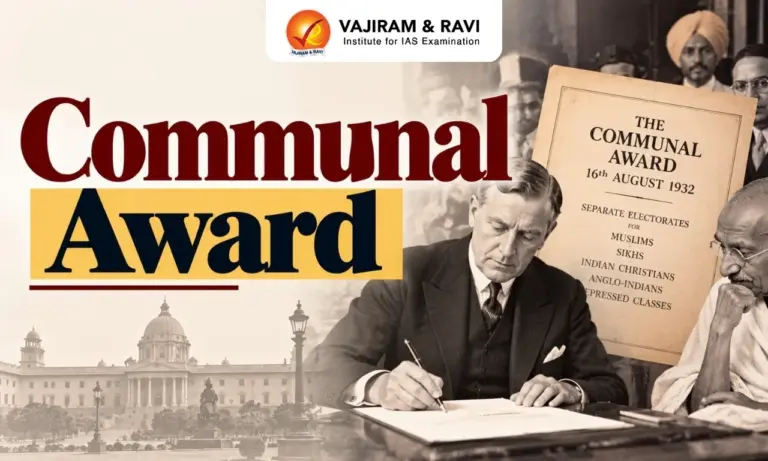
Communal Award was a British government decision that shaped the debate over political representation in colonial India. Announced by British Prime Minister Ramsay MacDonald, it extended separate electorates to the Depressed Classes, leading to a major disagreement between Mahatma Gandhi and Dr. B. R. Ambedkar and eventually to the Poona Pact.
What Was the Communal Award of 1932?
The Communal Award, also known as the MacDonald Award, was announced on 16 August 1932 to determine the representation of different communities in British India’s legislatures.
- It provided separate electorates for several religious minorities and the Depressed Classes.
- It recognised the Depressed Classes as a distinct category for electoral representation and allotted them 71 special seats in provincial legislatures.
- The Award was intended to address disagreements over minority representation that remained unresolved during the Round Table Conferences.
It became a turning point in the debate over separate electorates, caste discrimination and the political rights of the Depressed Classes.
Communal Award Background
The Communal Award emerged from constitutional negotiations over how different communities would be represented in India’s legislatures under British rule.
- Indian Councils Act, 1909: The Morley-Minto Reforms introduced separate electorates for Muslims.
- Government of India Act, 1919: The Montagu–Chelmsford Reforms extended separate representation to additional communities, including Sikhs.
- Round Table Conferences (1930-1932): The conferences discussed India’s constitutional future and the representation of minorities and the Depressed Classes.
- Second Round Table Conference (1931): Gandhi and Ambedkar disagreed over whether the Depressed Classes should have separate electorates.
- British government’s decision: With no agreement among the principal stakeholders, Ramsay MacDonald announced the Communal Award in August 1932.


Main Provisions of the Communal Award
Announced by British Prime Minister Ramsay MacDonald on 16 August 1932, the Communal Award introduced separate electorates and communal representation for various groups in British India.
- Separate electorates: Muslims, Sikhs, Indian Christians, Anglo-Indians, Europeans and the Depressed Classes were granted separate electorates. The arrangement for the Depressed Classes was to remain in force for 20 years. Women and Marathas also received specific electoral provisions.
- Communal representation: Seats in provincial legislatures were allocated on a communal basis.
- Increase in legislative seats: The number of seats in provincial legislatures was to be doubled.
- Weightage for Muslims: Muslims were granted weightage in provinces where they were in a minority.
- Reservation for women: Three per cent of seats were reserved for women in all provinces except the North-West Frontier Province.
- Status of the Depressed Classes: The Depressed Classes were recognised as a minority for electoral purposes.
- Double vote for the Depressed Classes: They could vote in elections through their separate electorate and also participate in the general electorate.
- Representation of special interests: Seats were allocated to groups such as labourers, landlords, traders and industrialists.
- Representation of Marathas: Seven seats were allocated to the Marathas in the Bombay Presidency.
Congress Stand on the Communal Award
The Indian National Congress opposed separate electorates but did not support changing the Communal Award without the consent of minorities. It therefore neither accepted nor rejected the Award.
Congress nationalists also opposed treating the Depressed Classes as a separate political entity distinct from the rest of the Hindu community.
Mahatma Gandhi’s Response to the Communal Award
Mahatma Gandhi viewed the Communal Award as a threat to Indian unity and nationalism, particularly because it granted separate electorates to the Depressed Classes.
- Opposition to separate electorates: Gandhi argued that treating the Depressed Classes as a separate political entity would weaken efforts to abolish untouchability.
- Concern about untouchability: He believed that separate electorates would perpetuate the social separation of the Depressed Classes rather than address their degraded social position.
- Demand for joint electorates: Gandhi supported electing representatives of the Depressed Classes through joint electorates, preferably with a wider electorate based on universal adult franchise. He did not oppose granting them a larger number of reserved seats.
- Fast unto death: To oppose separate electorates for the Depressed Classes, Gandhi began an indefinite fast on 20 September 1932.
B. R. Ambedkar’s Response to the Communal Award
Dr. B. R. Ambedkar supported separate electorates for the Depressed Classes, arguing that they needed independent political representation to protect their interests and challenge caste-based discrimination.
- Political representation: Ambedkar believed that separate electorates would enable the Depressed Classes to elect their own representatives without depending on the support of the caste Hindu majority.
- Independent leadership: He argued that political safeguards were necessary for the Depressed Classes to develop independent leadership and effectively raise their concerns.
Gandhi-Ambedkar Debate on Separate Electorates
While Gandhi opposed separate electorates for the Depressed Classes on grounds of Hindu and national unity, Ambedkar prioritised their political autonomy and protection against caste-based domination.
|
Mahatma Gandhi |
Dr. B. R. Ambedkar |
|
Opposed separate electorates for the Depressed Classes. |
Supported separate electorates to ensure independent political representation. |
|
Believed separate electorates would divide Hindu society. |
Believed joint electorates could leave representatives dependent on dominant-caste voters. |
|
Emphasised social unity and the eradication of untouchability. |
Emphasised political safeguards and the independent voice of the Depressed Classes. |
|
Favoured representation within a common electorate. |
Initially demanded a separate electorate for the Depressed Classes. |
The debate culminated in the Poona Pact of September 1932, which replaced separate electorates with joint electorates and reserved seats.
What Was the Poona Pact of 1932?
The Poona Pact was signed on 24 September 1932 by Dr. B. R. Ambedkar on behalf of the Depressed Classes. It abandoned separate electorates for the Depressed Classes but increased their representation through reserved seats in legislatures.
- Provincial legislatures: The number of reserved seats for the Depressed Classes increased from 71 under the Communal Award to 147 under the Poona Pact.
- Central Legislature: The Pact provided for 18% of the seats allotted to the general electorate in British India to be reserved for the Depressed Classes.
- Acceptance by the British government: The government accepted the Poona Pact as an amendment to the Communal Award.
Impact of the Poona Pact on Dalits
Although the Poona Pact granted certain political rights to the Depressed Classes, critics argued that it failed to achieve their emancipation and allowed the existing Hindu social order to continue.
- Political dependence: The Pact made the Depressed Classes vulnerable to political influence from majoritarian caste Hindu organisations.
- Weakening of independent leadership: Critics argued that genuine representatives of the Depressed Classes could lose elections to candidates supported by caste Hindu organisations.
- Continuation of the status quo: The system hindered the development of independent leadership capable of challenging the Brahminical social order in political, ideological and cultural spheres.
- Loss of a distinct political identity: Critics argued that the Pact incorporated the Depressed Classes into the existing Hindu social order without recognising their separate political identity.
- Challenges to social justice: Critics maintained that the Pact obstructed the development of a society based on equality, liberty, fraternity and justice. They also argued that denying Dalits a distinct place in national life weakened the protection of their rights and safeguards in independent India.
Joint Electorates and Their Impact on the Depressed Classes
The Working Committee of the All India Scheduled Caste Federation criticised the joint-electorate system following elections held under the Government of India Act, 1935.
- Ineffective representation: The Federation argued that joint electorates prevented Scheduled Castes from electing representatives who could effectively voice their interests.
- Influence of the Hindu majority: It contended that the system allowed the Hindu majority to influence the election of Scheduled Caste representatives who were dependent on its support.
- Demand for separate electorates: The Federation called for the restoration of separate electorates and the abolition of the joint-electorate system with reserved seats.
- Ambedkar’s continued criticism: Dr. B. R. Ambedkar continued to criticise the Poona Pact until 1947.
Difference Between the Communal Award and the Poona Pact
The principal difference was that the Communal Award provided separate electorates for the Depressed Classes, whereas the Poona Pact introduced joint electorates with reserved seats.
|
Basis |
Communal Award, 1932 |
Poona Pact, 1932 |
|
Electoral system |
Separate electorates for the Depressed Classes |
Joint electorates with reserved seats |
|
Provincial seats |
71 |
148 |
|
Candidate selection |
Separate electorate for the Depressed Classes |
Primary election to select a panel of candidates, followed by a joint electorate |
|
Central representation |
Separate-electorate arrangements |
18% of seats allotted to the general electorate for British India reserved for the Depressed Classes |
|
Outcome |
Recognised the Depressed Classes as a separate electoral category |
Increased reserved seats while retaining a common electorate |
Significance of the Communal Award in Indian History
The Communal Award was an important development in the Indian national movement because it brought political representation, caste inequality and minority rights to the centre of constitutional negotiations.
- Political representation: It highlighted the demand for independent representation by communities that feared domination by numerical majorities.
- Gandhi-Ambedkar relationship: It exposed fundamental differences between Gandhi and Ambedkar over the political safeguards required by the Depressed Classes.
- Poona Pact: The resulting agreement increased reserved legislative seats while replacing separate electorates with joint electorates.
- Constitutional legacy: The debate provides historical context for understanding reserved seats for Scheduled Castes in independent India.
- Social justice: The episode highlights the relationship between political representation, caste discrimination and the protection of disadvantaged communities.
Reservation for Scheduled Castes in Independent India
The Poona Pact forms an important part of the historical background to the system of reserved legislative seats for Scheduled Castes in India.
- The Constitution provides for the reservation of seats for Scheduled Castes and Scheduled Tribes in the Lok Sabha and State Legislative Assemblies.
- Article 330 provides for the reservation of seats for Scheduled Castes and Scheduled Tribes in the Lok Sabha.
- Article 332 provides for reservation of seats for Scheduled Castes and Scheduled Tribes in State Legislative Assemblies.
Unlike the separate-electorate system proposed under the Communal Award, reserved seats in independent India operate through joint electorates.

 Last updated on Oct, 2026
→ UPSC 2027 Notification will be released on 13 January 2027 at upsconline.nic.in.
→ Check Nobel Prize 2026 Winners List here.
→ Download PIB PRiSM Monthly Magazine 2026 here.
→ Check UPSC Monthly Current Affairs Magazine The Recitals here.
→ Check out the latest UPSC Syllabus here.
→ Download UPSC Model Answers for Mains 2026
→ UPSC Mains Question Paper 2026 is out now for Essay & GS Paper 1, 2, 3 & 4.
→ UPSC Calendar 2027 has been released.
→ Enroll in Vajiram & Ravi’s UPSC Mains Test Series 2027 for structured answer writing practice, expert evaluation, and exam-oriented feedback.
→ Join Vajiram & Ravi’s UPSC Mentorship Program 2027 for personalized guidance, strategy planning, and one-to-one support from experienced mentors.
→ Go through the UPSC Mains Previous Year Papers to enhance your preparation.
→ UPSC has released UPSC Toppers List 2025 with the Civil Services final result on its official website.
→ Also check Best UPSC Coaching in India
Communal Award FAQs
Q1. What was the Communal Award?+
Q2. Why did Gandhi oppose the Communal Award?+
Q3. Why did Dr. B. R. Ambedkar support separate electorates?+
Q4. What was the Poona Pact of 1932?+
Q5. What was the difference between the Communal Award and the Poona Pact?+
Tags: Ambedkar communal award indian national congress mahatma gandhi modern indian history poona pact round table conference separate electorate