Crowd Disasters in India Latest News
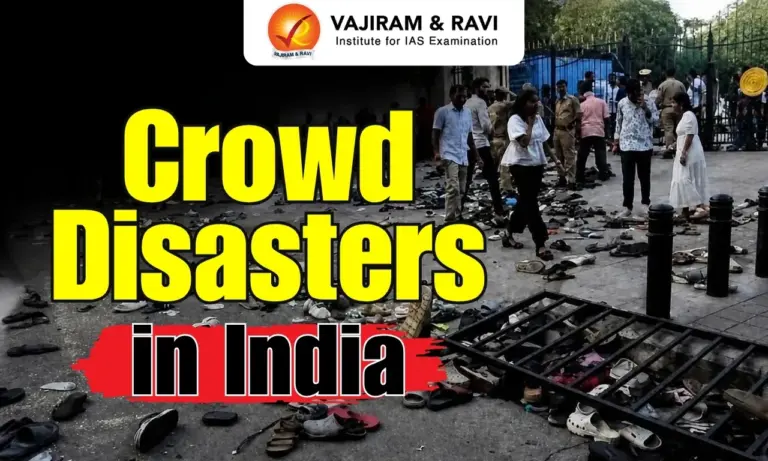
- A crowd surge at the Chorbagan Sarbojanin Durga Puja pandal in north Kolkata, killed 19 people and injured around 25, once again spotlighting the risks of large unregulated gatherings in India.
- Heavy rain, a crowd of pandal-hoppers, and a possible public-address announcement appear to have triggered the deadly crush.
- A 2014 National Disaster Management Authority (NDMA) report notes that a majority of crowd disasters in India occur at religious places — making this a recurring governance challenge.
Understanding Stampede: It’s Really a Crowd Crush
- What is loosely called a “stampede” is more accurately a crowd crush — a situation where crowd density becomes so high that individuals lose control over their own movement.
- Structural Causes: Weak temporary structures, inadequate barricades, poorly lit stairways, narrow entry/exit points.
- Trigger Events: Fires, electrical failures, security scares, or failures of crowd management.
- Critical NDMA Insight: Deaths usually result not from literal “trampling” but from compressive asphyxia — when people packed tightly together cannot expand their chest to breathe.


What Went Wrong at Chorbagan?
- Preliminary accounts suggest multiple risk factors converged:
- Heavy pandal-hopper crowds when rain began suddenly.
- People moving forward as some fell, with the crowd behind continuing to press ahead.
- A Public Address (PA) system announcement that may have intensified the rush.
- Puja committee members and private security personnel have been detained; a SIT (Special Investigation Team) has been formed.
- Following the tragedy, authorities asked other high-footfall pandals to temporarily halt admissions — reinforcing that crowd management is about density per space, not just total attendance.
How Crowd Behaviour Amplifies Risk
- As per NDMA, individual behaviour is influenced by others — a few people jumping a barricade can trigger mass imitation.
- This is not irrational behaviour; it reflects people responding to limited information and to what others around them appear to be doing.
- Announcements Can Backfire: A message meant to warn or disperse people may instead cause simultaneous mass movement, unless carefully worded with managed exit routes.
- Poor Coordination Risk: If police push one crowd in a direction that collides with an incoming stream, the opposing flows can create a dangerous crush.
- Modern crowd science therefore favours communication and community-based management over force-based control.
Lessons From Past Disasters
- Nashik Kumbh (August 2003): 29 killed — caused by barricade pressure, reverse crowd movement, and processions/vehicles sharing pilgrim routes.
- Kalubai Yatra, Mandhardevi, Maharashtra (January 2005): 293 killed — India’s deadliest such tragedy. A Justice Rajan Kochar inquiry found:
- Wrong crowd estimates
- Narrow, steep, slippery approach route
- Illegal vendors (some with gas cylinders) blocking the path
- No watchtowers, PA systems, or adequate firefighting arrangements
- Poor inter-agency coordination
- Common Thread: Crowd disasters rarely have one cause — they result from multiple weaknesses (density, constricted movement, poor information, an unexpected trigger, weak coordination) converging simultaneously.
The NDMA Framework for Crowd Control
- The guiding principle is managing demand and capacity:
- Estimate Demand — based on past attendance, arrival patterns, religious significance, visitor profile.
- Calculate Capacity — not just of the overall ground, but of critical bottlenecks (narrow lanes, bridges, staircases, entrances).
- Apply Input Control — restrict or stagger entry when demand exceeds capacity (used at Vaishno Devi and Sabarimala via pilgrim registration).
- For Unregulated Urban Events (like Durga Puja) — create holding areas, one-way routes, separate entry/exit points, real-time density monitoring, and temporary closures before congestion turns dangerous.
- Make Waiting Safe Where Capacity Cannot be Increased — through adequate space, lighting, barricading, drinking water, medical facilities, trained volunteers, and clear, panic-free signage.
- As experts put it: “The purpose of crowd management is to ensure that it never reaches the density and disorder at which a small trigger can become a catastrophe.”
Conclusion
- The Kolkata tragedy is a grim reminder that crowd disasters are preventable, not inevitable — they occur when administrative foresight fails to match the scale of human congregation.
- India’s recurring pattern, from Mandhardevi to Chorbagan, shows that density management, clear communication, and inter-agency coordination matter far more than sheer attendance numbers.
- As urbanisation and mass religious tourism continue to grow, embedding NDMA’s demand-capacity framework into routine event planning — rather than treating it as a post-disaster lesson — remains the only sustainable path to safer public gatherings.

 Last updated on Oct, 2026
→ UPSC 2027 Notification will be released on 13 January 2027 at upsconline.nic.in.
→ Check Nobel Prize 2026 Winners List here.
→ Download PIB PRiSM Monthly Magazine 2026 here.
→ Check UPSC Monthly Current Affairs Magazine The Recitals here.
→ Check out the latest UPSC Syllabus here.
→ Download UPSC Model Answers for Mains 2026
→ UPSC Mains Question Paper 2026 is out now for Essay & GS Paper 1, 2, 3 & 4.
→ UPSC Calendar 2027 has been released.
→ Enroll in Vajiram & Ravi’s UPSC Mains Test Series 2027 for structured answer writing practice, expert evaluation, and exam-oriented feedback.
→ Join Vajiram & Ravi’s UPSC Mentorship Program 2027 for personalized guidance, strategy planning, and one-to-one support from experienced mentors.
→ Go through the UPSC Mains Previous Year Papers to enhance your preparation.
→ UPSC has released UPSC Toppers List 2025 with the Civil Services final result on its official website.
→ Also check Best UPSC Coaching in India
Crowd Disasters in India FAQs
Q1. What are crowd disasters in India? +
Q2. What are the major causes of crowd disasters in India? +
Q3. What is the difference between a stampede and a crowd crush? +
Q4. Which major crowd disasters have occurred in India? +
Q5. How can crowd disasters in India be prevented? +
Tags: Crowd Disasters in India mains articles upsc current affairs upsc mains current affairs