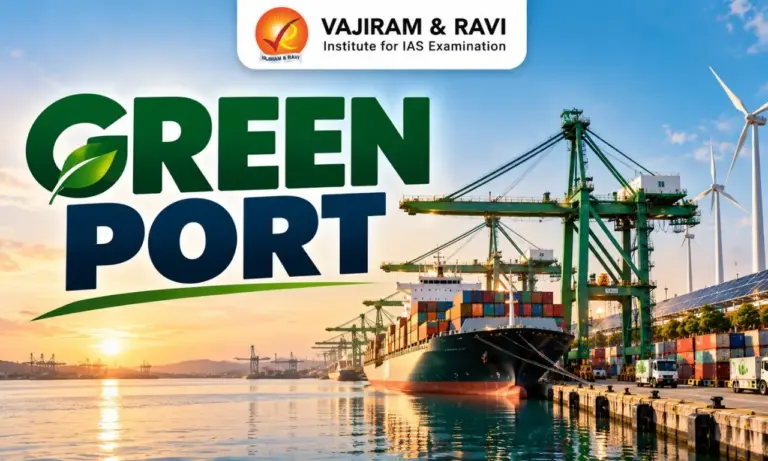
Green ports are an important part of sustainable maritime development in India. They aim to reduce emissions, promote renewable energy, conserve coastal ecosystems and improve the environmental performance of port operations. Initiatives such as the Harit Sagar Green Port Guidelines, 2023, and the Green Tug Transition Programme support India’s efforts to develop cleaner, energy-efficient and climate-resilient ports.
What is a Green Port?
A green port is a port that adopts environmentally sustainable practices in its infrastructure, operations and management to reduce pollution, greenhouse gas emissions and damage to coastal and marine ecosystems.
Green ports promote renewable energy, energy-efficient cargo handling, cleaner fuels, waste reduction, water conservation and biodiversity protection while supporting efficient maritime trade.
Key Features of Green Ports
Green ports adopt environmentally sustainable technologies and practices to reduce pollution, conserve natural resources and minimise the environmental impact of port operations. Their key features include:
- Renewable energy: Using solar and wind energy to meet port electricity requirements and reduce dependence on fossil fuels.
- Electrification of equipment: Replacing diesel-powered cranes, cargo-handling machinery, trucks and port vehicles with electric alternatives.
- Shore-to-ship power: Supplying electricity to vessels from the shore so that ships can switch off their auxiliary engines while berthed, reducing local air pollution.
- Cleaner marine fuels: Developing facilities for green hydrogen, green ammonia, green methanol and other lower-emission fuels.
- Sustainable waste management: Following the principles of reduce, reuse, repurpose and recycle to minimise waste generation and disposal.
- Water conservation: Treating and reusing wastewater, reducing freshwater consumption and improving oil-spill prevention and response.
- Coastal ecosystem protection: Protecting mangroves, wetlands and marine biodiversity during port development and expansion.
- Digital environmental monitoring: Tracking emissions, energy consumption, water use and waste generation through environmental performance indicators.


Examples of Green Port Initiatives in India
Several Indian ports are adopting renewable energy, cleaner fuels, electrification and sustainable waste management to reduce their environmental impact.
- Deendayal Port Authority, Gujarat: Commissioned a 1 MW green hydrogen plant, deployed electric wheel loaders and allocated land for green hydrogen and green ammonia projects.
- Paradip Port Authority, Odisha: Uses renewable energy, shore-to-ship power facilities, energy-efficient lighting and dust-suppression systems. A green hydrogen and green ammonia handling jetty has also been approved.
- V.O. Chidambaranar Port Authority, Tamil Nadu: Commissioned a pilot green hydrogen plant in April 2025 and is developing a green methanol bunkering facility.
- New Mangalore Port, Karnataka: Achieved 100% solar power integration, demonstrating the potential of renewable energy in port operations.
- Jawaharlal Nehru Port Authority, Maharashtra: Has adopted renewable energy and is among the major ports implementing the Green Tug Transition Programme to shift towards electric harbour tugs.
Harit Sagar Green Port Guidelines, 2023
The Harit Sagar Green Port Guidelines were launched by the Ministry of Ports, Shipping and Waterways on 10 May 2023. They provide a framework for major ports to reduce their environmental impact and adopt sustainable practices in port development, operation and maintenance.
The guidelines follow the concept of “Working with Nature”, which emphasises minimising the environmental impact of port activities and protecting surrounding ecosystems.
Key targets for 2030
Under the government’s maritime sustainability framework, the major targets include:
- Carbon emissions: Reduce carbon dioxide emissions per tonne of cargo handled by 30% compared with the FY 2022–23 baseline.
- Renewable energy: Increase the share of renewable energy consumption at ports to more than 60%.
- Electrification: Electrify 50% of port equipment.
- Green cover: Increase the area under green cover to 20%.
- Water conservation: Reduce freshwater consumption per tonne of cargo handled by 20%.
These targets are intended to improve energy efficiency, reduce emissions and promote environmentally responsible port operations.
Government Initiatives for Green Ports in India
Government initiatives aim to reduce emissions, promote clean energy and integrate environmental sustainability into India’s maritime infrastructure.
- Maritime India Vision 2030: Promotes renewable energy adoption, port electrification, efficient resource use and reduced emissions from port operations.
- Maritime Amrit Kaal Vision 2047: Provides a long-term roadmap for developing modern, efficient and environmentally sustainable maritime infrastructure.
- Green Tug Transition Programme (GTTP): Promotes the replacement of diesel-powered harbour tugs with electric and other green-propulsion alternatives to reduce emissions in port waters.
- National Green Hydrogen Mission: Supports green hydrogen production and infrastructure development. Deendayal, Paradip and V.O. Chidambaranar port authorities have been recognised as Green Hydrogen Hubs.
- Sagarmala Programme: Promotes port-led development, improved connectivity and efficient maritime logistics, helping integrate sustainability into port infrastructure.
- National Centre of Excellence in Green Ports and Shipping: Supports research, capacity building and the adoption of cleaner technologies in ports and shipping.
- Harit Sagar Green Port Guidelines, 2023: Provide a framework for major ports to reduce emissions, increase renewable energy use, improve waste management, conserve water and protect coastal ecosystems.
Significance of Green Ports
Green ports offer environmental, economic and strategic benefits by reducing maritime emissions, improving resource efficiency and supporting sustainable trade. Their significance extends beyond pollution control to energy security, public health and India’s transition towards low-carbon maritime infrastructure.
1. Environmental Benefits
- Reduce greenhouse gas emissions and local air pollution.
- Protect coastal ecosystems, marine biodiversity and water quality.
- Improve waste management and conserve natural resources.
- Support climate change mitigation and sustainable development.
2. Economic Benefits
- Reduce energy consumption and operating costs over time.
- Improve port efficiency and international competitiveness.
- Attract investment in renewable energy, clean fuels and green infrastructure.
- Create employment opportunities in clean energy and sustainable maritime technologies.
3. Energy Security
Using renewable electricity and alternative fuels can reduce dependence on conventional fossil fuels. Ports can also become important hubs for the production, storage and export of green hydrogen and its derivatives.
4. Public Health Benefits
Reducing emissions from port machinery, trucks and berthed vessels can improve air quality for port workers and nearby communities.
5. Strategic Significance
Green ports can strengthen India’s position in sustainable maritime trade, support its climate commitments and prepare its port infrastructure for the global transition towards low-emission shipping.
Challenges in Developing Green Ports
Despite their environmental and economic benefits, developing green ports in India faces several financial, technological and infrastructural challenges. Addressing these barriers is essential to ensure the effective adoption of cleaner technologies while maintaining efficient port operations and protecting coastal ecosystems.
- High initial investment: Electrification, renewable energy installations, shore-power systems and alternative-fuel infrastructure require substantial capital.
- Technology constraints: Green hydrogen and other alternative fuels need specialised storage, handling, safety systems and reliable supply chains.
- Power infrastructure limitations: Some ports may lack adequate electricity infrastructure to support large-scale electrification.
- Coastal ecosystem degradation: Port expansion, dredging and land reclamation can damage mangroves, wetlands and marine habitats.
- Coordination challenges: Implementation requires cooperation among port authorities, shipping companies, power utilities, state governments and private operators.
- Legacy infrastructure: Older ports may face difficulties in replacing conventional equipment without disrupting operations.
- Monitoring and accountability: Inconsistent environmental data and inadequate monitoring can make it difficult to assess progress towards sustainability targets.
- Alternative-fuel adoption: Limited availability of green fuels and bunkering infrastructure can slow the transition to cleaner maritime operations.
Way Forward
Developing green ports in India requires a coordinated approach that combines sustainable infrastructure, clean-energy adoption, adequate financing and strong environmental governance. The following measures can help overcome implementation challenges and accelerate the transition towards low-emission, environmentally responsible port operations.
- Port-specific transition plans: Establish measurable targets based on each port’s emissions, energy requirements, cargo profile and ecological setting.
- Green financing: Mobilise private investment, public-private partnerships and concessional finance for sustainable infrastructure.
- Accelerate electrification: Prioritise electric cargo-handling equipment, port vehicles, railway systems and shore-to-ship power.
- Develop clean-fuel infrastructure: Expand safe storage, handling and bunkering facilities for green hydrogen and other suitable low-emission fuels.
- Protect coastal ecosystems: Strengthen environmental impact assessments and safeguard mangroves, wetlands and marine habitats.
- Promote circular resource use: Improve waste segregation, recycling, wastewater reuse and environmentally safe management of dredged material.
- Strengthen monitoring: Introduce transparent environmental reporting, regular audits and comparable performance indicators.
- Encourage research and skill development: Support domestic innovation, technology transfer and training in green port operations.

 Last updated on Oct, 2026
→ UPSC 2027 Notification will be released on 13 January 2027 at upsconline.nic.in.
→ Check Nobel Prize 2026 Winners List here.
→ Download PIB PRiSM Monthly Magazine 2026 here.
→ Check UPSC Monthly Current Affairs Magazine The Recitals here.
→ Check out the latest UPSC Syllabus here.
→ Download UPSC Model Answers for Mains 2026
→ UPSC Mains Question Paper 2026 is out now for Essay & GS Paper 1, 2, 3 & 4.
→ UPSC Calendar 2027 has been released.
→ Enroll in Vajiram & Ravi’s UPSC Mains Test Series 2027 for structured answer writing practice, expert evaluation, and exam-oriented feedback.
→ Join Vajiram & Ravi’s UPSC Mentorship Program 2027 for personalized guidance, strategy planning, and one-to-one support from experienced mentors.
→ Go through the UPSC Mains Previous Year Papers to enhance your preparation.
→ UPSC has released UPSC Toppers List 2025 with the Civil Services final result on its official website.
→ Also check Best UPSC Coaching in India
Green Port FAQs
Q1. What is a green port?+
Q2. What are the key features of green ports?+
Q3. What are the Harit Sagar Green Port Guidelines, 2023?+
Q4. Which Indian ports have undertaken green port initiatives?+
Q5. What are the major challenges in developing green ports in India?+
Tags: green port green port in india