Venezuelan Oil Imports Latest News
- US Secretary of State Marco Rubio’s October 2026 visit to Reliance Industries’ Jamnagar refinery highlighted the US’ push for India to increase Venezuelan oil imports.
India’s Energy Security and Import Dependence
- India is among the world’s largest crude oil importers, making energy security a critical component of its economic and foreign policy.
- Crude oil imports support transportation, manufacturing, petrochemicals and other essential sectors, but expose the economy to global price fluctuations and geopolitical disruptions.
- India has pursued energy-source diversification by sourcing crude from more than 40 countries. However, a relatively small group of suppliers accounts for a substantial share of total imports.
- Russia emerged as India’s largest crude supplier after the Russia-Ukraine war began in February 2022. Western restrictions on Russian oil created opportunities for Indian refiners to purchase discounted crude, reshaping India’s import basket.
- The West Asia crisis has further highlighted the importance of diversifying supplies to reduce vulnerability to disruptions along critical shipping routes and in major oil-producing regions.


Venezuela’s Role in India’s Crude Oil Basket
- Venezuela possesses vast oil reserves, but its production remains limited relative to its resource base. Its flagship Merey crude is particularly heavy and contains high levels of sulphur, making it suitable mainly for refineries equipped with advanced processing capabilities.
- India resumed Venezuelan oil imports after the United States eased restrictions. Imports rose from virtually zero before the recent crisis to approximately 350,000 barrels per day (bpd) in August 2026, before declining to around 200,000 bpd in September.
- During April-August 2026, India imported Venezuelan crude worth approximately US$3.59 billion. Reliance Industries accounted for 74.3% of these imports, reflecting the importance of its Jamnagar refinery complex.
Refining Capacity and Commercial Constraints
- US efforts to increase Venezuelan oil exports to India face several technical and economic limitations.
- Refinery compatibility
- Venezuelan Merey crude is extremely heavy and highly sulphurous. Reliance’s Jamnagar complex, with combined crude-processing capacity of approximately 1.4 million bpd, is particularly well equipped to process it.
- However, only a limited number of Indian refineries can handle substantial volumes of Venezuelan crude. Refining capability therefore places a natural limit on how much India can import without changing its existing crude mix or making additional investments.
- Freight and landed cost
- Venezuelan crude may be offered at a discount of approximately US$25 per barrel to Brent, the international benchmark. However, shipping to India’s west coast can cost around US$35 per barrel.
- These transportation costs can eliminate the apparent price advantage and make Venezuelan crude more expensive on a delivered basis. The economics of transporting smaller cargoes can be particularly challenging because very large crude carriers (VLCCs) are generally more cost-efficient for long-distance shipments.
- Competition from other suppliers
- Crude supplies from West Asia are gradually returning to the market, including heavier grades from Iraq. These supplies benefit from shorter shipping distances and lower freight costs, making them potentially more competitive than Venezuelan crude.
- Consequently, Indian refiners must assess crude purchases on the basis of total delivered cost, quality, processing requirements and reliability rather than headline discounts alone.
Venezuelan Crude and Russian Oil: Different Roles
I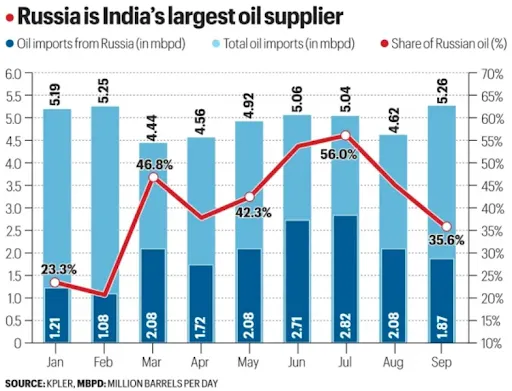
- Venezuelan oil cannot readily replace India’s large volumes of Russian crude because the two supplies differ in quality, refinery compatibility and commercial terms.
- Russia supplied approximately 1.9 million bpd of crude to India in September 2026, accounting for more than 35% of India’s total oil imports that month. Imports had reached a reported high of 2.8 million bpd in July.
- Russian Urals crude is more compatible with a broader range of Indian refining facilities than Venezuela’s particularly heavy Merey grade. Replacing Russian supplies with Venezuelan crude on a large scale would therefore require substantial adjustments to refinery operations and procurement strategies.
- The United States has encouraged India to buy more Venezuelan crude while also seeking a reduction in Russian oil purchases. However, these objectives need not be treated as inseparable. India can diversify its sources without making an automatic commitment to reduce purchases from Russia.
- For India, the central consideration is whether each transaction supports energy security and provides acceptable commercial returns.
Geopolitical Dimensions of the US Push
- The US’ interest in Venezuelan crude reflects both energy-market and geopolitical considerations. Increasing exports to buyers such as India could help establish a larger market for Venezuelan oil under US oversight.
- India’s large refining sector makes it an attractive destination, particularly because relatively few countries can process heavy Venezuelan crude at scale.
- At the same time, energy trade has become closely linked to broader US-India economic relations, including negotiations over a bilateral trade agreement and discussions about sanctions on Russian energy.
- This creates a policy challenge for India: it must preserve constructive relations with the US while retaining flexibility in sourcing energy according to domestic economic requirements.
- Any additional commitments should be assessed against clearly defined terms covering pricing, supply reliability, investment obligations, commercial returns and the duration of demand.
Source: IE

 Last updated on Oct, 2026
→ UPSC 2027 Notification will be released on 13 January 2027 at upsconline.nic.in.
→ Check Nobel Prize 2026 Winners List here.
→ Download PIB PRiSM Monthly Magazine 2026 here.
→ Check UPSC Monthly Current Affairs Magazine The Recitals here.
→ Check out the latest UPSC Syllabus here.
→ Download UPSC Model Answers for Mains 2026
→ UPSC Mains Question Paper 2026 is out now for Essay & GS Paper 1, 2, 3 & 4.
→ UPSC Calendar 2027 has been released.
→ Enroll in Vajiram & Ravi’s UPSC Mains Test Series 2027 for structured answer writing practice, expert evaluation, and exam-oriented feedback.
→ Join Vajiram & Ravi’s UPSC Mentorship Program 2027 for personalized guidance, strategy planning, and one-to-one support from experienced mentors.
→ Go through the UPSC Mains Previous Year Papers to enhance your preparation.
→ UPSC has released UPSC Toppers List 2025 with the Civil Services final result on its official website.
→ Also check Best UPSC Coaching in India
Venezuelan Oil Imports FAQs
Q1. Why does the United States want India to import more Venezuelan oil?+
Q2. Why is Venezuelan crude difficult for many Indian refineries to process?+
Q3. Why may discounted Venezuelan oil still be expensive for India?+
Q4. Can Venezuelan oil replace Russian crude in India's import basket?+
Q5. What should guide India's crude oil procurement decisions?+
Tags: mains articles upsc current affairs upsc mains current affairs venezuelan oil imports