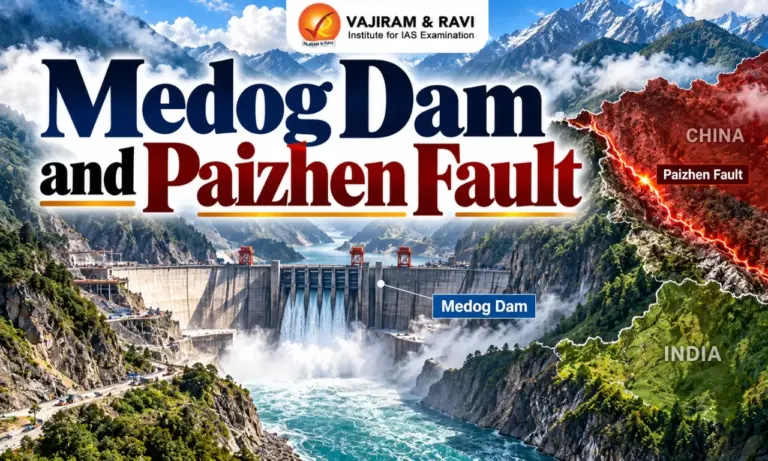
The Medog Hydropower Project is a mega hydropower project under construction on the Yarlung Tsangpo River in Tibet, China. With a planned capacity of approximately 60,000 megawatts (MW), it is expected to become the world’s largest hydropower project by installed capacity.
The project has attracted attention following geological research highlighting risks associated with the Paizhen Fault, an active fault in the project area. Its location upstream of India also raises concerns about dam safety, downstream water security and India–China relations.
Medog Hydropower Project Location and Key Features
The project aims to harness the steep descent of the Yarlung Tsangpo River near its Great Bend in the eastern Himalayas.
- Location: Medog County, Tibet Autonomous Region, China, near the Great Bend of the Yarlung Tsangpo River.
- Proximity to India: The project area is reported to be approximately 50 km from the Indian border.
- Planned capacity: Approximately 60,000 MW (60 GW).
- Projected annual electricity generation: Around 300 billion kilowatt-hours (kWh).
- Approval: December 2024.
- Construction commencement: July 2025.
- Expected completion: The project is reported to have a target timeline extending into the 2030s, with 2033 cited in reports.
The river’s steep gradient offers enormous hydropower potential, but the mountainous terrain also creates substantial engineering challenges.
What is the Paizhen Fault?
The Paizhen Fault is an active geological fault identified in the area of the Medog hydropower project. A 2026 study by Chinese researchers raised concerns about its implications for nearby infrastructure and the stability of slopes around the proposed reservoir.
A geological fault is a fracture in the Earth’s crust along which rocks have moved relative to one another.
Geological Features of the Paizhen Fault
The Paizhen Fault lies in the tectonically active eastern Himalayan region, where the Indian Plate continues to converge with the Eurasian Plate. Geological studies indicate that the fault has a long history of activity.
- The fault has reportedly been active since the Pleistocene Epoch, with geological evidence indicating continued activity during the Holocene Epoch.
- Geological dating suggests that movement occurred approximately 9,500 years ago, indicating relatively recent activity in geological terms.
- A magnitude 6.9 earthquake struck the Milin area of Tibet in 2017, highlighting the region’s seismic hazard. However, this earthquake should not be directly attributed to the Paizhen Fault without conclusive evidence.


Why does the Paizhen fault raise concerns?
The fault may increase geological risks to the project, particularly where fractured rocks, steep slopes and prolonged water exposure interact. However, the presence of an active fault does not by itself establish that a dam will fail.
- Foundation stability: Fractured rocks may have lower strength and reduced capacity to support structures.
- Earthquake hazard: Strong ground shaking could damage dams, tunnels, roads and power-generation infrastructure.
- Landslides and slope collapse: Earthquakes, weakened rocks and water saturation may destabilise steep slopes.
- River blockage: A major landslide could obstruct the river; the subsequent failure of a natural blockage could cause sudden downstream flooding.
- Reservoir-related hazards: Changes in water levels may affect slope stability, while reservoir-induced seismicity is a possible site-dependent concern.
The 2026 geological study recommended measures such as slope reinforcement and retaining structures to reduce the risks of landslides and collapses.
Significance of the Medog Dam for India
The project is strategically important because the Yarlung Tsangpo flows from Tibet into Arunachal Pradesh as the Siang River and subsequently forms part of the Brahmaputra river system in Assam.
- Water security: Changes in the timing or volume of upstream water releases could affect downstream flows, depending on the project’s design and operation.
- Flood management: Timely information about upstream river conditions is important for flood forecasting in Arunachal Pradesh and Assam.
- Ecological impacts: Changes in river flows and sediment transport could affect aquatic ecosystems, river channels and downstream livelihoods.
- Strategic concerns: The project raises questions about transparency, hydrological data sharing and the management of a transboundary river.
- Bilateral relations: India and China need reliable communication to address concerns about downstream impacts and disaster preparedness.
These are potential risks rather than established outcomes. The actual downstream effects will depend on the project’s design, operating arrangements and the river basin’s hydrological conditions.
Challenges Associated with the Medog Dam
The project presents geological, environmental and transboundary challenges, particularly for downstream India.
- Seismic risk: The Paizhen Fault raises concerns about earthquake hazards and the stability of dam infrastructure.
- Downstream water security: Uncertainty over upstream dam operations could complicate India’s assessment of potential changes in Brahmaputra flows.
- Ecological impacts: Changes in river flow and sediment transport could affect downstream ecosystems and livelihoods.
- Limited data sharing: Inadequate access to timely hydrological information could complicate flood forecasting and disaster preparedness in Arunachal Pradesh and Assam.
Way Forward
For India, the Medog project highlights the need to safeguard downstream water security while strengthening disaster preparedness and regional cooperation.
- Transboundary cooperation: Strengthen India-China dialogue on Brahmaputra water-data sharing, upstream dam operations and timely flood warnings.
- Disaster preparedness: Improve flood forecasting and early-warning systems in Arunachal Pradesh and Assam to mitigate potential downstream risks.
- Geological risk monitoring: Track seismic activity and landslide hazards in the eastern Himalayas to assess potential threats to river infrastructure and downstream communities.
- Environmental security: Assess potential changes in river flows and sediment transport to protect the Brahmaputra basin’s ecosystems and livelihoods.

 Last updated on Oct, 2026
→ UPSC 2027 Notification will be released on 13 January 2027 at upsconline.nic.in.
→ Check Nobel Prize 2026 Winners List here.
→ Download PIB PRiSM Monthly Magazine 2026 here.
→ Check UPSC Monthly Current Affairs Magazine The Recitals here.
→ Check out the latest UPSC Syllabus here.
→ Download UPSC Model Answers for Mains 2026
→ UPSC Mains Question Paper 2026 is out now for Essay & GS Paper 1, 2, 3 & 4.
→ UPSC Calendar 2027 has been released.
→ Enroll in Vajiram & Ravi’s UPSC Mains Test Series 2027 for structured answer writing practice, expert evaluation, and exam-oriented feedback.
→ Join Vajiram & Ravi’s UPSC Mentorship Program 2027 for personalized guidance, strategy planning, and one-to-one support from experienced mentors.
→ Go through the UPSC Mains Previous Year Papers to enhance your preparation.
→ UPSC has released UPSC Toppers List 2025 with the Civil Services final result on its official website.
→ Also check Best UPSC Coaching in India
Medog Dam and Paizhen Fault FAQs
Q1. Where is the Medog Hydropower Project located?+
Q2. What is the planned capacity of the Medog Dam?+
Q3. What is the Paizhen Fault?+
Q4. Why is the Paizhen Fault geologically significant?+
Q5. Why is the Medog Dam important for India?+
Tags: medog dam medog dam and paizhen fault paizhen fault