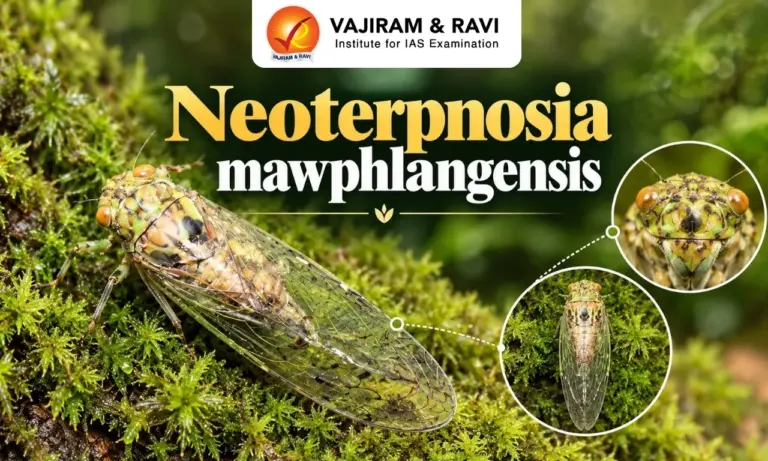
Neoterpnosia mawphlangensis Latest News
A new species of the genus Neoterpnosia (Neoterpnosia mawphlangensis sp. nov.) was recently described from the semi-evergreen forests of Mawphlang Hills, Meghalaya, northeastern India.
About Neoterpnosia mawphlangensis
- It is a new species of cicada.
- It was discovered in forests of Mawphlang in Meghalaya’s East Khasi Hills at elevations of 1,378 to 1,605 metres.
- It is distinguished by characteristic structures in the male reproductive organs, along with distinctive markings on its transparent wings.
- It is active mainly around dawn and calls from the upper branches and foliage of subtropical pine forests.
- Males typically begin singing at around 6 pm, often forming a chorus that can continue for about 30 minutes under suitable weather conditions.
- The insects were observed calling during misty and rainy weather but stopped during heavy rain.
- Researchers also noted that they are well camouflaged among moss and are not attracted to light.


What are Cicadas?
- They are a family of more than 3,000 species of sound-producing insects.
- They are known for their loud, complex and species-specific acoustic signals or songs.
- They are found worldwide, with the highest diversity occurring in tropical regions.
- Lifecycle:
- The cicada lifecycle begins with an adult female laying eggs in slits she created in tree branches or stems.
- Once the eggs hatch, the nymphs fall to the ground and burrow into the soil, feeding on plant sap for several years.
- Once the mature nymphs have emerged from the ground, they’ll firmly attach themselves to a tree branch or other natural element to molt and transform into an adult.
- From here, they’ll live for approximately four to six weeks.
- The lifespan of cicadas varies depending on the species and whether they are annual or periodical cicadas.
- Annual cicadas typically live for four to six weeks as adults.
- Periodical cicadas have much longer lifespans due to their extended nymphal periods, which can last either 13 or 17 years, depending on the species. Once they emerge, they also live for a few weeks.
- Male cicadas produce loud calls using specialised organs called tymbals, located on their abdomen, to attract females.
News: TAXA

 Last updated on Oct, 2026
→ UPSC 2027 Notification will be released on 13 January 2027 at upsconline.nic.in.
→ Check Nobel Prize 2026 Winners List here.
→ Download PIB PRiSM Monthly Magazine 2026 here.
→ Check UPSC Monthly Current Affairs Magazine The Recitals here.
→ Check out the latest UPSC Syllabus here.
→ Download UPSC Model Answers for Mains 2026
→ UPSC Mains Question Paper 2026 is out now for Essay & GS Paper 1, 2, 3 & 4.
→ UPSC Calendar 2027 has been released.
→ Enroll in Vajiram & Ravi’s UPSC Mains Test Series 2027 for structured answer writing practice, expert evaluation, and exam-oriented feedback.
→ Join Vajiram & Ravi’s UPSC Mentorship Program 2027 for personalized guidance, strategy planning, and one-to-one support from experienced mentors.
→ Go through the UPSC Mains Previous Year Papers to enhance your preparation.
→ UPSC has released UPSC Toppers List 2025 with the Civil Services final result on its official website.
→ Also check Best UPSC Coaching in India
Neoterpnosia mawphlangensis FAQs
Q1. What is Neoterpnosia mawphlangensis?+
Q2. Where was Neoterpnosia mawphlangensis discovered?+
Q3. When is Neoterpnosia mawphlangensis mainly active?+
Q4. Which type of forest serves as the habitat of Neoterpnosia mawphlangensis?+
Tags: neoterpnosia mawphlangensis