When is Indira Gandhi’s Death Anniversary 2026?
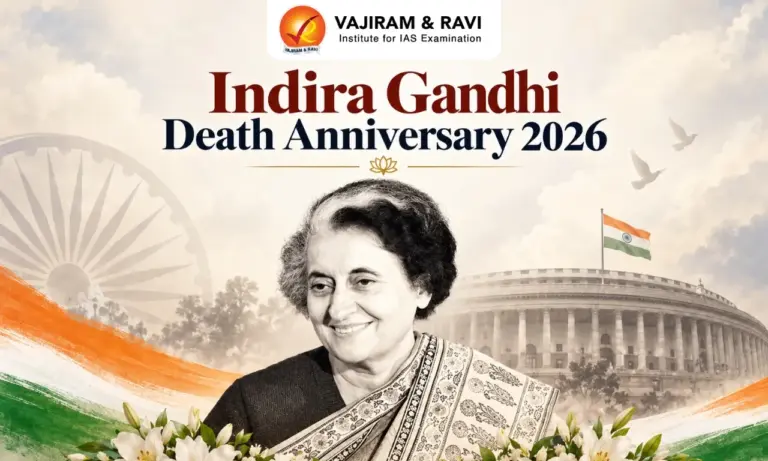
Indira Gandhi Death Anniversary 2026 will be observed on 31 October 2026, marking 42 years since her assassination.
Indira Gandhi was assassinated on 31 October 1984 at her official residence in New Delhi by two of her bodyguards, Beant Singh and Satwant Singh. The assassination was linked to the resentment following Operation Blue Star, which had been carried out at the Golden Temple in Amritsar earlier that year.
The anniversary provides an occasion to examine her political career, major policy decisions and the events that shaped her legacy.
Who was Indira Gandhi?
Indira Gandhi was the third Prime Minister of India and the country’s first woman Prime Minister. She served from 1966 to 1977 and again from 1980 until her assassination in 1984.
Born on 19 November 1917 in Allahabad (now Prayagraj), Uttar Pradesh, she was the daughter of India’s first Prime Minister, Jawaharlal Nehru, and Kamala Nehru.
Her leadership was marked by strong central authority, major economic interventions and an assertive foreign policy. While she is remembered for significant achievements such as the creation of Bangladesh and the expansion of India’s agricultural and scientific capabilities, her tenure also faced criticism for the imposition of the Emergency and the concentration of political power.


Indira Gandhi Early Life and Political Career
Indira Gandhi’s political journey was shaped by her upbringing in a politically active family and her early involvement in India’s freedom movement.
- Early involvement: During her childhood, she formed the Vanar Sena, a group of children who supported the freedom movement by carrying messages and assisting Congress workers.
- Education: She studied at institutions in India and abroad, including Visva-Bharati University and the University of Oxford.
- Entry into politics: She formally joined the Indian National Congress in 1938 and became increasingly involved in party activities.
- Congress President (1959): She was elected President of the Indian National Congress.
- Minister of Information and Broadcasting (1964): After Jawaharlal Nehru’s death, she joined the Union Cabinet under Prime Minister Lal Bahadur Shastri.
- Becoming Prime Minister (1966): Following Shastri’s sudden death in January 1966, she became India’s Prime Minister on 24 January 1966.
Her initial years as Prime Minister were challenging, marked by food shortages, economic difficulties, political instability and growing differences within the Congress party.
Major Achievements and Contributions of Indira Gandhi
Indira Gandhi’s governments introduced several important policies and initiatives that influenced India’s economy, agriculture, foreign relations, science and environment.
1. Nationalisation of Banks (1969)
Nationalisation of Banks was one of the most significant economic decisions taken during Indira Gandhi’s first term as Prime Minister.
On 19 July 1969, the government nationalised 14 major commercial banks. The decision aimed to bring the banking sector under greater public control and direct financial resources towards national development.
The major objectives of Nationalisation of Banks:
- Expanding banking services in rural and underserved areas.
- Increasing access to institutional credit for farmers, small industries and weaker sections.
- Reducing the concentration of economic power in a few private business groups.
- Aligning banking activities with national development priorities.
In 1980, six more commercial banks were nationalised.
The policy expanded the reach of formal banking in India, although it also raised concerns about political interference and the efficiency of public sector banks.
2. Green Revolution and Agricultural Development
The Green Revolution transformed India’s agricultural production and helped the country reduce its dependence on food imports.
The government supported the expansion of the High-Yielding Varieties (HYV) Programme, introduced in 1966, through the use of improved seeds, chemical fertilisers, pesticides, irrigation and modern farming techniques.
Its major developments included:
- Increased production of wheat and rice, particularly in Punjab, Haryana and western Uttar Pradesh.
- Expansion of irrigation facilities and agricultural research.
- Greater use of fertilisers, tractors and other agricultural inputs.
- Improved foodgrain availability and progress towards food self-sufficiency.
Agricultural scientist M. S. Swaminathan played a major role in developing and promoting the Green Revolution in India.
However, its benefits were unevenly distributed. It also contributed to regional inequalities, groundwater depletion, soil degradation and excessive dependence on a few crops in certain areas.
3. Indo-Pakistan War of 1971 and Creation of Bangladesh
The Indo-Pakistan War of 1971 was a defining event in Indira Gandhi’s foreign policy and established India’s strategic influence in South Asia.
The conflict originated in political and military tensions within Pakistan, which then consisted of two geographically separated regions: East Pakistan and West Pakistan.
In the 1970 general elections in Pakistan, the Awami League, led by Sheikh Mujibur Rahman, won a majority. However, the transfer of power was denied. In March 1971, the Pakistani military launched Operation Searchlight, a violent crackdown in East Pakistan.
The resulting violence triggered a large refugee crisis, with nearly 10 million refugees entering India.
India supported the Bangladesh liberation movement and took several diplomatic and military steps:
- Indo-Soviet Treaty (1971): India signed the Treaty of Peace, Friendship and Cooperation with the Soviet Union on 9 August 1971, strengthening its diplomatic position.
- Military intervention: After Pakistan launched air strikes on Indian airfields on 3 December 1971, India formally entered the war.
- Role of Mukti Bahini: Indian forces fought alongside the Mukti Bahini, the Bengali liberation forces.
- Creation of Bangladesh: Pakistani forces surrendered in Dhaka on 16 December 1971, leading to the creation of Bangladesh.
The war strengthened India’s position in South Asia. The subsequent Shimla Agreement, signed between India and Pakistan on 2 July 1972, sought to establish a framework for resolving bilateral issues peacefully.
4. Pokhran-I Nuclear Test (1974)
India conducted its first nuclear test on 18 May 1974 at Pokhran in Rajasthan under Indira Gandhi’s leadership.
The test was code-named Smiling Buddha and was officially described by India as a peaceful nuclear explosion.
It demonstrated India’s growing scientific and technological capabilities and marked an important stage in the development of its nuclear programme.
The test also raised international concerns about nuclear proliferation and contributed to the formation of the Nuclear Suppliers Group (NSG) in 1974.
5. Abolition of Privy Purses (1971)
After Independence, the princely states joined the Indian Union through agreements of accession and integration. In return, their former rulers were assured certain privileges, including annual payments known as privy purses.
Indira Gandhi’s government sought to abolish these payments as part of its efforts to reduce inherited privileges and promote equality.
The 26th Constitutional Amendment Act, 1971 abolished privy purses and ended the official recognition of former rulers of princely states.
The amendment removed Articles 291 and 362 and inserted Article 363A into the Constitution.
6. Launch of Project Tiger (1973)
Project Tiger was launched on 1 April 1973 to protect India’s declining tiger population and conserve its natural habitats.
The initiative focused on:
- Establishing protected tiger reserves.
- Preventing poaching and illegal wildlife trade.
- Conserving forests and natural habitats.
- Improving monitoring and management of tiger populations.
Project Tiger became an important milestone in India’s wildlife conservation efforts and laid the foundation for a more organised approach to tiger protection.
7. Integration of Sikkim into India (1975)
Sikkim was initially a kingdom ruled by the Chogyal. Under the 1950 Indo-Sikkim Treaty, India was responsible for its defence, external affairs and communications.
In 1975, political developments within Sikkim led to a referendum in which voters supported the abolition of the monarchy and integration with India.
Through the 36th Constitutional Amendment Act, 1975, Sikkim became the 22nd state of the Indian Union. The amendment also inserted Article 371F, providing special constitutional provisions for Sikkim.
8. Development of India’s Space Programme
Indira Gandhi’s tenure witnessed important institutional and technological developments in India’s space programme.
- Department of Space: Established in 1972 to coordinate and promote India’s space activities.
- Space Commission: Also established in 1972 to formulate policies and oversee the development of the space programme.
- Aryabhata Satellite: India’s first satellite, Aryabhata, was launched on 19 April 1975 with Soviet assistance. It was designed and manufactured in India.
- Satellite Instructional Television Experiment (SITE): Conducted during 1975-76, it used satellite communication to deliver educational programmes to rural communities.
These developments helped establish the institutional foundation for India’s future achievements in space technology.
National Emergency (1975-1977)
The National Emergency was one of the most controversial periods of Indira Gandhi’s tenure, marked by restrictions on civil liberties and the weakening of democratic institutions.
- Political tensions had been rising due to inflation, unemployment and protests against the government. The crisis deepened on 12 June 1975, when the Allahabad High Court declared Indira Gandhi’s election from Rae Bareli void on grounds of electoral malpractice.
- Amid growing demands for her resignation, a National Emergency was proclaimed on 25 June 1975 under Article 352 of the Constitution on the grounds of internal disturbance. It continued until 21 March 1977.
- During this period, opposition leaders were arrested, press censorship was imposed and civil liberties were restricted. The government also enacted the 42nd Constitutional Amendment Act, 1976, popularly known as the ‘Mini Constitution’ because of its wide-ranging changes to the Constitution. It added Socialist, Secular and Integrity to the Preamble, introduced Fundamental Duties and sought to limit judicial review.
- The Emergency ended in 1977 after the Congress lost the general election and the Janata Party came to power.
- Subsequently, the 44th Constitutional Amendment Act, 1978 introduced safeguards against the misuse of Emergency provisions, including replacing internal disturbance with armed rebellion as a ground for proclaiming an Emergency.
The Emergency remains a defining episode in India’s constitutional history, highlighting the importance of civil liberties, democratic institutions and checks on executive power.
Operation Blue Star and Assassination of Indira Gandhi
Operation Blue Star was a major military operation undertaken by the Indian Army in June 1984. Its consequences had a lasting impact on India’s internal security and political stability.
Background of Operation Blue Star
During the early 1980s, Punjab experienced growing political and religious tensions, with demands for greater autonomy and increasing militancy.
Jarnail Singh Bhindranwale, a Sikh religious preacher and head of the Damdami Taksal, emerged as an influential figure during this period. He and his armed supporters took shelter inside the Golden Temple complex in Amritsar. The government’s decision to remove the armed militants from the complex eventually led to the launch of Operation Blue Star.
What was Operation Blue Star?
Operation Blue Star was launched by the Indian Army between 1 and 8 June 1984 to remove armed militants from the Golden Temple complex.
The operation resulted in significant casualties and extensive damage to the Akal Takht, one of the most important religious buildings in Sikhism.
Although the government stated that the operation was necessary to restore law and order, it generated deep resentment among sections of the Sikh community because of the military action at a sacred religious site.
Assassination of Indira Gandhi
On 31 October 1984, Indira Gandhi was assassinated by two of her Sikh bodyguards, Beant Singh and Satwant Singh, at her official residence in New Delhi.
The assassination was widely linked to the anger following Operation Blue Star.
Her death was followed by widespread anti-Sikh violence, particularly in Delhi. Thousands of Sikhs were killed, and many families lost their homes and livelihoods.
The violence exposed serious failures in the protection of citizens and raised questions about the role of state institutions in preventing and responding to communal violence.
Legacy of Indira Gandhi
Indira Gandhi’s legacy remains complex because her tenure combined major national achievements with serious controversies.
Her contributions to India included:
- Strengthening India’s position in South Asia through the 1971 war and the creation of Bangladesh.
- Expanding public control over the banking sector through nationalisation.
- Supporting agricultural transformation through the Green Revolution.
- Advancing India’s nuclear and space capabilities.
- Promoting wildlife conservation through Project Tiger.
- Playing an important role in the integration of Sikkim into India.
Her tenure also faced significant criticism:
- The imposition of the Emergency (1975-1977) weakened democratic institutions and restricted civil liberties.
- Concentration of political power raised concerns about institutional independence and accountability.
- Operation Blue Star caused deep religious and political resentment.
- The anti-Sikh violence following her assassination exposed grave failures in protecting minority communities.
Her political career demonstrates how strong leadership can influence national development while also raising questions about constitutional limits, democratic accountability and the responsible exercise of power.

 Last updated on Oct, 2026
→ UPSC 2027 Notification will be released on 13 January 2027 at upsconline.nic.in.
→ Check Nobel Prize 2026 Winners List here.
→ Download PIB PRiSM Monthly Magazine 2026 here.
→ Check UPSC Monthly Current Affairs Magazine The Recitals here.
→ Check out the latest UPSC Syllabus here.
→ Download UPSC Model Answers for Mains 2026
→ UPSC Mains Question Paper 2026 is out now for Essay & GS Paper 1, 2, 3 & 4.
→ UPSC Calendar 2027 has been released.
→ Enroll in Vajiram & Ravi’s UPSC Mains Test Series 2027 for structured answer writing practice, expert evaluation, and exam-oriented feedback.
→ Join Vajiram & Ravi’s UPSC Mentorship Program 2027 for personalized guidance, strategy planning, and one-to-one support from experienced mentors.
→ Go through the UPSC Mains Previous Year Papers to enhance your preparation.
→ UPSC has released UPSC Toppers List 2025 with the Civil Services final result on its official website.
→ Also check Best UPSC Coaching in India
Indira Gandhi Death Anniversary 2026 FAQs
Q1. Who was Indira Gandhi?+
Q2. When is Indira Gandhi Death Anniversary 2026 observed?+
Q3. How did Indira Gandhi die?+
Q4. What were the major achievements of Indira Gandhi?+
Q5. Why was the National Emergency declared in 1975?+
Q6. What was Operation Blue Star?+
Tags: indira gandhi death indira gandhi death anniversary indira gandhi death anniversary 2026