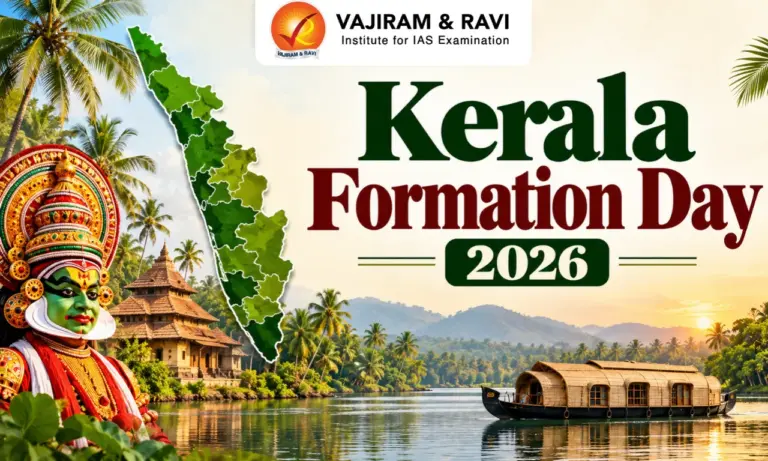
When is Kerala Formation Day Celebrated?
Kerala Formation Day is celebrated every year on 1 November as Kerala Piravi, which means the birth of Kerala.
- Kerala was formed on 1 November 1956.
- In 2026, the state marks the 70th anniversary of its formation.
- Kerala Piravi is the popular name for the occasion.
- The state’s current official name is Keralam, following the name change that came into force on 25 August 2026.
Why is Kerala Formation Day Celebrated on 1 November?
Kerala Formation Day is celebrated on 1 November because the States Reorganisation Act, 1956 provided for the formation of Kerala on this date, bringing together Malayalam-speaking regions of the erstwhile Travancore-Cochin State and Madras State.
Before 1956, the regions that now form Kerala were administered mainly through three political and administrative units:
- Travancore was a princely state covering much of present-day southern Kerala.
- Cochin was a princely state covering parts of central Kerala.
- Malabar was a district of the erstwhile Madras State, covering much of northern Kerala.
The integration of these regions created a unified state for Malayalam-speaking people.


Historical Background: Aikya Kerala Movement
The demand for a unified Malayalam-speaking state emerged from the desire to bring Malayalam-speaking regions under a common administrative unit.
Before Independence, Travancore and Cochin were princely states, while Malabar was part of the Madras Presidency. Their separate administration encouraged the demand for a common linguistic and cultural identity.
The Aikya Kerala Movement (United Kerala Movement) gradually gained momentum to unite these regions.
- The idea of a united Kerala began taking shape during the 1920s, with discussions on bringing Malayalam-speaking regions under a common administration.
- The demand received wider support during the freedom movement, as political organisations advocated the unification of Malayalam-speaking people.
- An Aikya Kerala Conference was held at Thrissur in April 1947, supporting the formation of a united state comprising Malabar, Cochin and Travancore.
- Travancore and Cochin merged on 1 July 1949 to form Travancore-Cochin State.
- The demand for including Malabar and other Malayalam-speaking areas in the unified state continued after Independence and was eventually realised in 1956.
States Reorganisation Act, 1956: Formation of Kerala State
The demand for linguistic reorganisation of states gained momentum after the formation of Andhra State in 1953. The Union Government subsequently established the States Reorganisation Commission (SRC) to examine the reorganisation of Indian states.
States Reorganisation Commission (1953-1955)
The Commission was constituted on 29 December 1953 under the chairmanship of Justice Fazl Ali. Its other members were:
- H.N. Kunzru
- K.M. Panikkar
The Commission submitted its report in 1955. It examined linguistic, administrative, economic and national considerations while recommending the reorganisation of states.
States Reorganisation Act, 1956
Parliament enacted the States Reorganisation Act, 1956 on 31 August 1956. The Act defined 1 November 1956 as the appointed day for the reorganisation of states and provided for the formation of Kerala on that date.
Under Section 5, the new State of Kerala comprised:
- The existing Travancore-Cochin State, excluding the territories transferred to Madras State under Section 4.
- Malabar district of the erstwhile Madras State, excluding the Laccadive and Minicoy Islands.
- Kasaragod taluk of the erstwhile South Kanara district.
The southern territories of Travancore-Cochin, including the areas that now form Kanyakumari district and Shencottah taluk, were transferred to Madras State.
Under Section 6, the Laccadive, Minicoy and Amindivi Islands were constituted as a separate Union Territory.
Renaming of Kerala to Keralam in 2026
In 2026, the official name of Kerala was changed to Keralam through the Kerala (Alteration of Name) Act, 2026.
The change followed a resolution passed by the Kerala Legislative Assembly, seeking to adopt the state’s name in Malayalam. The objective was to reflect its linguistic and cultural identity in its official name.
The change was made under Article 3 of the Constitution, which empowers Parliament to alter the name of a state. Accordingly, Kerala was replaced with Keralam in the relevant constitutional provisions, including the First and Fourth Schedules.
Constitutional provisions related to the formation of states in India
The formation of Kerala in 1956 and its renaming in 2026 illustrate Parliament’s constitutional power to reorganise states and alter their names.
Article 3 – Formation of New States and Alteration of Boundaries
Article 3 empowers Parliament to:
- Form a new state by separating territory from an existing state or by merging territories.
- Increase or reduce the area of a state.
- Alter the boundaries of a state.
- Change the name of a state.
A Bill under Article 3 can be introduced in Parliament only on the recommendation of the President. If the proposal affects the area, boundaries or name of a state, the President refers it to the concerned State Legislature for its views. However, Parliament is not bound by those views.
Article 4 – Supplemental Provisions
A law passed under Articles 2 and 3 may:
- Amend the First Schedule and Fourth Schedule of the Constitution.
- Include supplemental, incidental and consequential provisions necessary to implement the reorganisation.
Such a law is not treated as a constitutional amendment under Article 368.
How is Kerala Formation Day celebrated?
Kerala Formation Day, popularly known as Kerala Piravi, is observed through official ceremonies and cultural programmes across the state.
Major celebrations include:
- Cultural programmes showcasing Malayalam literature, music, dance, folk traditions and the state’s heritage.
- Schools and colleges organising competitions and programmes highlighting Kerala’s history, language and culture.
- Government institutions and departments conducting events to mark the formation of the state.
- Programmes promoting the preservation and development of Malayalam language and literature.

 Last updated on Oct, 2026
→ UPSC 2027 Notification will be released on 13 January 2027 at upsconline.nic.in.
→ Check Nobel Prize 2026 Winners List here.
→ Download PIB PRiSM Monthly Magazine 2026 here.
→ Check UPSC Monthly Current Affairs Magazine The Recitals here.
→ Check out the latest UPSC Syllabus here.
→ Download UPSC Model Answers for Mains 2026
→ UPSC Mains Question Paper 2026 is out now for Essay & GS Paper 1, 2, 3 & 4.
→ UPSC Calendar 2027 has been released.
→ Enroll in Vajiram & Ravi’s UPSC Mains Test Series 2027 for structured answer writing practice, expert evaluation, and exam-oriented feedback.
→ Join Vajiram & Ravi’s UPSC Mentorship Program 2027 for personalized guidance, strategy planning, and one-to-one support from experienced mentors.
→ Go through the UPSC Mains Previous Year Papers to enhance your preparation.
→ UPSC has released UPSC Toppers List 2025 with the Civil Services final result on its official website.
→ Also check Best UPSC Coaching in India
Kerala Formation Day 2026 FAQs
Q1. When is Kerala Formation Day celebrated?+
Q2. When was Kerala formed as a state?+
Q3. Which regions were integrated to form Kerala?+
Q4. What was the Aikya Kerala Movement?+
Q5. What is the current official name of Kerala?+
Tags: kerala day kerala formation day kerala formation day 2026