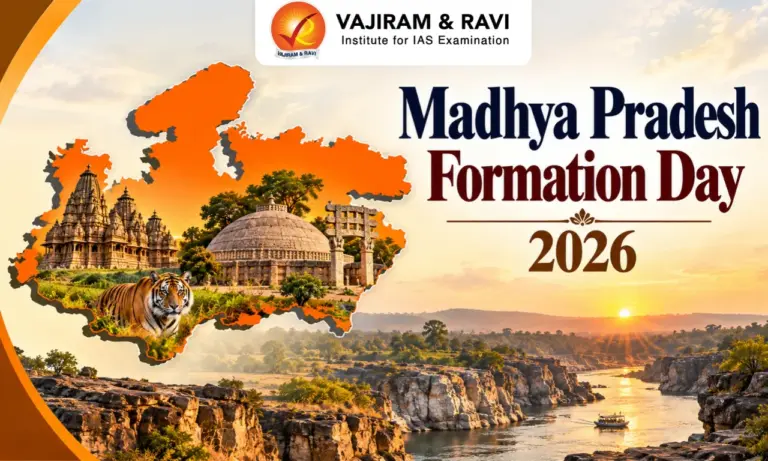
Madhya Pradesh Formation Day marks an important milestone in India’s post-Independence history, particularly the integration of princely states and the reorganisation of administrative boundaries. The formation of the state in 1956 brought several regions of central India under a common administration. Its territorial boundaries were subsequently changed with the creation of Chhattisgarh in 2000.
When is Madhya Pradesh Formation Day celebrated?
Madhya Pradesh Formation Day, also known as Madhya Pradesh Sthapana Diwas, is celebrated every year on 1 November.
- Madhya Pradesh was formed on 1 November 1956.
- In 2026, the state completes 70 years since its formation and observes its 71st Foundation Day.
- Bhopal is the capital of Madhya Pradesh.
- The occasion is marked by cultural programmes, public celebrations and events highlighting the state’s development.
Historical Background: Madhya Pradesh Before 1956
Before the reorganisation of states in 1956, the territories that constitute present-day Madhya Pradesh were divided among several administrative and political units.
After Independence, the integration of princely states led to the formation of different administrative units in central India. The major units included:
- Central Provinces and Berar: This region included Mahakoshal and the Chhattisgarh area. It was part of the erstwhile Madhya Pradesh.
- Madhya Bharat: Formed in 1948 through the integration of several princely states, including Gwalior and Indore.
- Vindhya Pradesh: Formed in 1950 by integrating princely states of the Bundelkhand and Baghelkhand regions.
- Bhopal State: Became a Part C State of the Indian Union after its merger with India in 1949.
These separate administrative units were subsequently reorganised to create a larger state of Madhya Pradesh in 1956.


States Reorganisation Commission (1953-1955)
The demand for reorganising Indian states on linguistic lines gained momentum following the formation of Andhra State in 1953. The Union Government appointed the States Reorganisation Commission (SRC) on 29 December 1953 to examine the reorganisation of states.
The Commission was chaired by Justice Fazl Ali and included two other members:
- H.N. Kunzru
- K.M. Panikkar
The Commission submitted its report in 1955. It considered linguistic, administrative, economic and national factors while recommending changes to India’s state boundaries.
Formation of Madhya Pradesh under the States Reorganisation Act, 1956
The States Reorganisation Act, 1956 provided the legal basis for the formation of the new State of Madhya Pradesh on 1 November 1956.
Under Section 9 of the Act, the new state was formed by bringing together the following territories:
- The existing State of Madhya Pradesh, excluding the districts transferred to the new Bombay State.
- The territories of the erstwhile Madhya Bharat, excluding Sunel Tappa of Mandsaur district.
- The territories of the erstwhile Bhopal State.
- The territories of the erstwhile Vindhya Pradesh.
- Sironj subdivision of Kota district in Rajasthan.
These territories were combined to constitute the new State of Madhya Pradesh.
Bhopal was made the capital of the reorganised state. Nagpur, which had been the capital of the erstwhile Madhya Pradesh, became part of Bombay State following the reorganisation.
How did Madhya Pradesh’s boundaries change in 2000?
Madhya Pradesh underwent another major territorial reorganisation in 2000 when its southeastern districts were separated to form the new state of Chhattisgarh.
The Madhya Pradesh Reorganisation Act, 2000 provided the legal framework for this change.
- Section 3 provided for the formation of Chhattisgarh from 16 districts of the existing Madhya Pradesh.
- Section 4 defined the territories that would remain part of Madhya Pradesh after the separation.
- Chhattisgarh came into existence as a separate state on 1 November 2000.
- Madhya Pradesh retained Bhopal as its capital.
Following this reorganisation, Madhya Pradesh acquired its present territorial boundaries.
Constitutional Provisions related to the formation and reorganisation of states
The formation of Madhya Pradesh in 1956 and the creation of Chhattisgarh in 2000 illustrate Parliament’s constitutional power to reorganise states.
Article 3 – Formation of New States and Alteration of Boundaries
Article 3 empowers Parliament to:
- Form a new state by separating territory from an existing state or by merging two or more states or parts of states.
- Increase or reduce the area of any state.
- Alter the boundaries of any state.
- Change the name of any state.
A Bill under Article 3 can be introduced in Parliament only on the recommendation of the President. If a proposal affects the area, boundaries or name of a state, the President refers it to the concerned State Legislature for its views.
However, Parliament is not bound by the views of the State Legislature.
Article 4 – Supplemental and Consequential Provisions
Article 4 provides that laws made under Articles 2 and 3 may:
- Amend the First Schedule and Fourth Schedule of the Constitution.
- Include supplemental, incidental and consequential provisions necessary to implement the formation or reorganisation of states.
Such laws are not considered constitutional amendments under Article 368.
Madhya Pradesh Formation Day 2026: Rajyotsav Celebrations
Madhya Pradesh will celebrate its 71st Foundation Day through a three-day state-level festival, Rajyotsav, from 1 to 3 November 2026 at Lal Parade Ground in Bhopal.
The celebrations will showcase the state’s cultural heritage, development journey and achievements in different sectors.
Major features of Rajyotsav 2026 include:
- Cultural programmes: Folk and tribal performances, instrumental music, light music and traditional art forms.
- Development exhibitions: Displays focusing on agriculture, infrastructure, industrial development and government initiatives.
- Women’s entrepreneurship pavilion: A platform showcasing women’s enterprises and economic participation.
- Traditional food and handicrafts: Exhibitions highlighting indigenous cuisine and local handicraft traditions.
- Student recognition: 102 meritorious students will receive ₹1 lakh each under the Bhagwan Shri Krishna Meritorious Student Scholarship.
- Farmers’ felicitation: 165 winners of the Kisan Kalyan Swabhiman Parv Quiz will be recognised. Prizes include tractors, motorcycles and electric scooters.
The announced theme for the 2026 celebrations is ‘State Moving Forward on the Path from Heritage to Development’. It highlights the state’s focus on preserving its historical, spiritual and tribal heritage while pursuing development in agriculture, infrastructure, industry, tourism and employment generation.
Significance of Madhya Pradesh Formation Day
Madhya Pradesh Formation Day is significant for understanding India’s post-Independence political and administrative consolidation.
- Integration of regions: The formation brought several erstwhile administrative units under a common state administration.
- National integration: The integration of different regions reflected the consolidation of the Indian Union after Independence.
- Federal structure: The reorganisation demonstrates Parliament’s constitutional power to alter state boundaries and create new states.
- Administrative development: The formation provided a common administrative framework for the different regions of central India.
- Cultural heritage: The occasion recognises the diverse historical and cultural traditions of the state.

 Last updated on Oct, 2026
→ UPSC 2027 Notification will be released on 13 January 2027 at upsconline.nic.in.
→ Check Nobel Prize 2026 Winners List here.
→ Download PIB PRiSM Monthly Magazine 2026 here.
→ Check UPSC Monthly Current Affairs Magazine The Recitals here.
→ Check out the latest UPSC Syllabus here.
→ Download UPSC Model Answers for Mains 2026
→ UPSC Mains Question Paper 2026 is out now for Essay & GS Paper 1, 2, 3 & 4.
→ UPSC Calendar 2027 has been released.
→ Enroll in Vajiram & Ravi’s UPSC Mains Test Series 2027 for structured answer writing practice, expert evaluation, and exam-oriented feedback.
→ Join Vajiram & Ravi’s UPSC Mentorship Program 2027 for personalized guidance, strategy planning, and one-to-one support from experienced mentors.
→ Go through the UPSC Mains Previous Year Papers to enhance your preparation.
→ UPSC has released UPSC Toppers List 2025 with the Civil Services final result on its official website.
→ Also check Best UPSC Coaching in India
Madhya Pradesh Formation Day 2026 FAQs
Q1. When is Madhya Pradesh Formation Day celebrated?+
Q2. When was Madhya Pradesh formed?+
Q3. Which regions were merged to form Madhya Pradesh in 1956?+
Q4. Which section of the States Reorganisation Act, 1956 deals with the formation of Madhya Pradesh?+
Q5. Which constitutional articles deal with the formation and reorganisation of states?+
Tags: important days important days in 2026 madhya pradesh formation day madhya pradesh formation day 2026