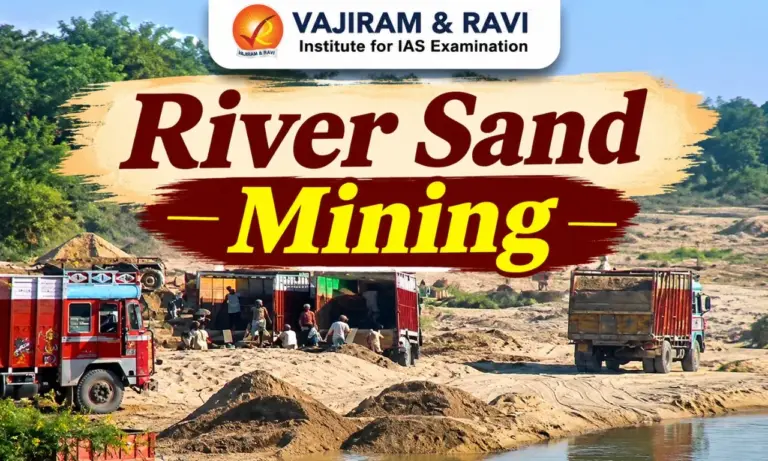
River Sand Mining Latest News
- The Supreme Court-appointed Central Empowered Committee (CEC) has recommended phasing out unsustainable sand extraction from active river channels within three years and developing alternative sources to meet construction demand.
Background and CEC Recommendations
- The recommendations form part of CEC Report No. 36 of 2026, submitted to the Supreme Court on November 2, in the suo motu proceedings concerning illegal sand mining in the National Chambal Sanctuary.
- The Supreme Court had expanded the proceedings to cover river sand mining across India, after expressing concern over its damaging impact on river ecosystems.
- The CEC has proposed a time-bound roadmap to progressively phase out unsustainable extraction from active river channels over three years.
- The transition would be supported by alternative sources, including:
- Reservoir sediment: Sand recovered through planned desilting of dams.
- Manufactured Sand (M-sand): Produced by crushing and processing suitable rock. It can substitute natural river sand in construction when it meets Bureau of Indian Standards (BIS) specifications.
- Recycled Construction and Demolition (C&D) Waste: Recovered material that can help meet construction requirements.


Reservoir Desilting as an Alternative
- The CEC has recommended a time-bound desilting programme, with contracts for eligible works awarded within three years, followed by a structured 10-year cycle for reservoirs identified as suitable.
- The proposed framework includes:
- Assessing all storage dams older than 15 years that have not undergone systematic desilting.
- Desilting approximately one-tenth of suitable reservoirs annually.
- Selling recovered sand through transparent mechanisms.
- Ensuring that desilting is based on technical and environmental suitability rather than treating it as mandatory for every dam.
- The Ministry of Jal Shakti has been recommended as the lead agency for developing a national framework in consultation with relevant institutions, including the Central Water Commission, National Dam Safety Authority, Ministry of Environment, Forest and Climate Change, and State Governments.
Reservoir Sedimentation and Storage Loss
- The CEC cited Ministry of Jal Shakti data presented to Parliament in December 2025:
- Of the 439 assessed reservoirs, average gross storage loss due to sedimentation was 19.24%.
- Twenty-three reservoirs had lost more than half of their storage capacity.
- Gobind Sagar reservoir, behind the Bhakra Dam, had declined from 9,868 million cubic metres (MCM) to approximately 7,300 MCM, representing a reduction of about 26%.
- Desilting could therefore serve a dual purpose: restoring reservoir storage capacity and supplying part of the construction sector’s demand for sand.
- However, the CEC cautioned that total accumulated sediment cannot be treated as entirely recoverable or commercially usable sand. Its technical recoverability and environmental acceptability require assessment.
Digital Monitoring and Traceability
- To improve regulation and curb illegal extraction, the CEC recommended a digital monitoring system covering:
- Mining permissions and permitted quantities
- Actual mineral extraction
- Electronic transit permits
- End-use of extracted material
- Secure electronic transit permits should incorporate unique QR codes, barcodes or RFID-based identification to improve traceability of mineral movement.
Challenges in Implementing the Recommendations
- Limited national data: There is no consolidated and reliable national database quantifying the volume or value of illegally extracted river sand.
- Uncertain reservoir potential: The usable quantity of construction-grade sand available in reservoirs has not been adequately assessed at the national level.
- Centre-State coordination: Sand, classified as a minor mineral, and water are State subjects. Implementation will require coordination between the Union Government and State Governments.
- Construction demand: Alternative sources must be developed without disrupting legitimate construction requirements.
- The CEC also highlighted an earlier 2020 report on Rajasthan, which found that legal sand collection declined from approximately 57 million tonnes annually to 5 million tonnes after mining restrictions imposed by the Supreme Court. The report identified the resulting supply gap as a major driver of illegal mining.
Conclusion
- The CEC’s recommendations seek to shift India’s approach from restricting illegal river sand mining towards developing sustainable alternatives and improving mineral traceability.
- Reservoir desilting, M-sand and recycled construction waste could reduce pressure on river ecosystems while supporting construction demand.
- Their implementation will depend on scientific assessments, environmental safeguards and effective Centre-State coordination.
Source: IE

 Last updated on Nov, 2026
→ UPSC 2027 Notification will be released on 13 January 2027 at upsconline.nic.in.
→ Check Nobel Prize 2026 Winners List here.
→ Download PIB PRiSM Monthly Magazine 2026 here.
→ Check UPSC Monthly Current Affairs Magazine The Recitals here.
→ Check out the latest UPSC Syllabus here.
→ Download UPSC Model Answers for Mains 2026
→ UPSC Mains Question Paper 2026 is out now for Essay & GS Paper 1, 2, 3 & 4.
→ UPSC Calendar 2027 has been released.
→ Enroll in Vajiram & Ravi’s UPSC Mains Test Series 2027 for structured answer writing practice, expert evaluation, and exam-oriented feedback.
→ Join Vajiram & Ravi’s UPSC Mentorship Program 2027 for personalized guidance, strategy planning, and one-to-one support from experienced mentors.
→ Go through the UPSC Mains Previous Year Papers to enhance your preparation.
→ UPSC has released UPSC Toppers List 2025 with the Civil Services final result on its official website.
→ Also check Best UPSC Coaching in India
River Sand Mining FAQs
Q1. What is the Central Empowered Committee (CEC)?+
Q2. What has the CEC recommended regarding river sand mining?+
Q3. What is Manufactured Sand (M-sand)?+
Q4. Why is reservoir desilting being proposed?+
Q5. What is the proposed desilting cycle?+
Tags: mains articles river sand mining upsc current affairs upsc mains current affairs